Showing posts with label Mountjoy Brewery. Show all posts

Monday, 3 November 2025

A Shot of Beer History #10: Some Late 19th Century Dublin & Cork Stout Labels

In March of 1896 the following commentary appeared in the wonderfully titled Dublin newspaper The Illustrograph:

THE STOUT LABEL QUESTION

   DURING the past few months the magnificent Dublin firm of stout brewers are considered to have tarnished their reputation in Ireland by enacting a business rule to the effect that any licensed liquor trader may use the official Guinness's Extra Stout label supplied by the Company conditionally that such trader will enter into agreement with the Company not to sell the bottling stout of any Dublin or other brewer. This is the sum total of the agreement. The trader may sell porter of any other brewer as drawn from the cask and supplied by the glass or the tankard, but no bottled stout, except that bearing the label of Messrs, Guinness will be allowed to be vended under this arbitrary agreement.
   Now there exists in Dublin, as is the case in Burton-on-Trent, though not to the same extent, several other large brewers besides the largest and most popular one, but the great English brewery town of Burton, which is as equally noted for its Ales as Dublin is for its Stout, enjoys the distinction over Dublin of having the ale brews of its hundred and one other breweries (other than the great leviathan) extensively and fairly patronised by the English people, more so than the other Dublin brewers are patronised by the Irish people.
   This was not always so, for rather more than a quarter of a century ago honours, so to speak, were more evenly divided, nor were Messrs. Guinness the chief or largest stout brewers.
   Neither is the reason for the present unique (not to say monopolising) position of the great James's Gate Brewery due to superior quality of its manufacture, because the brews of several rival breweries in the Irish capital are considered by experts to be equally as good. On another page of this issue of the ILLUSTROGRAPH will be found the extra or double stout labels as issued by the five other Dublin brewers (Jameson, Pim and Co., Watkins and Co., Mountjoy Brewery Co., Ltd., Phoenix Brewery Co., and D’Arcy and Son) and one Cork brewer (Messrs. Jas. J. Murphy and Co., Limited) outside the Guinness pale, and also an edict issued to the public at large bearing on the monopoly and injustice likely to accrue if it should happen that Messrs. Guinness and Co.'s new Irish plan of campaign be universally adopted.
   To this manifesto and the facsimile of labels (except in colour), we direct the attention of our readers, whom we would advise, without any animus against but with a keen appreciation of the great House of Guinness, to try the extra stout bottlings of these six other brewers. This may be easily effected by those in authority over households ordering direct of the respective breweries or their agents, whose names will be supplied on application to the brewers mentioned. A comparison can then be made, and the writer for one has no fear of the result.
   "Live and let live" and "Free Trade" are prevailing mottos at this the latter portion of the nineteenth century, and most certainly an exclusive policy like that of Messrs. Guinness and Co. would have been more befittingly bestowed, according to history and tradition, at the commencement rather than the close of enlightened nineteenth century.

This appears to be a damning (if clunkily written*) indictment of a new policy by the Guinness brewery to force those who choose to use the Guinness label to only bottle their stout porter and no other. These days this might be dismissed by many with a shrug and a comment about Guinness just being Guinness but it appears that at the time the other breweries in the city were rather incensed by this behaviour to the point where they issued what could be seen as a full page proclamation under the title 'Protest of the Dublin brewing Trade Against the New Guinness Label' where they called out Guinness on what the claimed to be its attempt to establish a monopoly under the guise of wishing to stop adulteration, plus the mislabelling of others' product as their own. This was a new direction for the brewery to take in Ireland, but it had been previously done across the sea in Britain so it wasn't a new direction for Guinness to take.

The other Dublin brewers were not protesting against the use of a label by Guinness in itself, and the company had used labels prior to this period anyway, but rather the conditions mentioned above where those who were supplied with Guinness stout and labels could stock and sell no other bottled stout. The protest and commentary was carried in many newspapers and other sources at the time and it certainly sounds as if this was a turning point in the somewhat convivial if wary relations between Guinness and the other Dublin breweries - although within a little over half a century it wouldn't matter, as Guinness would be the last brewery left standing - literally.

That whole controversy is a subject for a bigger write-up but of interest to Irish brewing history are the copies of the labels used by those other breweries for their stout porter, plus the stray Cork one, which have been enhanced as much as possible and shown here. These appear to have been copies made by the newspaper of the actual labels in some cases given the quality and use of writing on a few but nevertheless some are labels which may not have seen the light of day in well over a hundred years. We have seen a couple of them on here before, notably the Watkins and D'Arcy ones, but here they all now are for posterity - or as much as that can be so in pixels and clouds.

Darcy's Dublin Extra Stout label showing their anchor trademark
-

Jameson's XXX Stout stamped with the word 'Invalid's' showing their trademark of a three-masted ship at sail and a write-up of its seemingly excellent attributes by Charles Cameron
-

Phoenix Porter Brewery Dublin Stout showing their phoenix trademark
-

Mountjoy Brewery's Dublin Stout with the words Extra Double and their three castles trademark

 -

Watkins's Extra Stout Dublin showing the shamrock trademark of the brewery
-

J.J. Murphy & Co. Cork XX Stout with their trademark of a ship at full sail between two towers
-

These beers may be long gone but at least some part of them remains, plus there are a few homebrewers who attempt to replicate them - if on modern brew systems. Below is one last image from the same source showing a bottle with the Phoenix label above but overprinted with the word 'Extra' - the bottle might be of interest to any family-brewer-based television series producers who wish to set their show in or around that era!


Liam K

*I know, I know - Pot and kettle indeed!

Please note, all written content and the research involved in publishing it here is my own unless otherwise stated and cannot be reproduced elsewhere without permission, full credit to its sources, and a link back to this post. Newspaper research was thanks to The British Newspaper Archive, who have kindly let me share the above images from The Illustrograph (Dublin) from the 1st of March 1869. DO NOT STEAL THIS CONTENT!

Wednesday, 23 August 2023

100 Years of Irish Brewing in 50 Objects: #11 – Mountjoy Brewery Cask Return Postcard (1888)

Returning to the larger yard, we crossed over to the cask-washing sheds constructed principally of iron and tiled roofs. […] Three thousand casks can be turned out of these sheds daily, and thirty men are employed at the work. Facing these sheds there is a space of ground, upwards of an acre in extent, which is covered in casks …
Alfred Barnard, The Noted Breweries of Great Britain and Ireland. Volume II - 1889.

In late January of 1888 some post from the Mountjoy Brewery in Dublin arrived on the premises of James Watford who had a wine and spirits stores at number 76 on the High Street in Bedford in England. The bespoke postcard wasn’t anything special or unusual, and was something that the Mountjoy Brewery probably posted in reasonably large quantities every month, being just another part of the accounting, notification and checks that were carried out by all breweries in this era.

The prepaid halfpenny postcard was dated and posted on the 19th of January 1888 and on the back was printed the following message:

Messrs. FINDLATER & CO., Have to this date received the undermentioned Casks, and placed the same to the credit of your account.

There follows a list of cask sizes from Hogsheads (54 Imperial gallons) down to Firkins (9 Imperial gallons) and it is beside this last size that the number 5 is written and below that a list of the reference numbers of those casks and the words ‘ad[d]ressed 23/11/87 + 28/12/87.’ Additionally there is a diagonal stamp across all of this bearing the words ‘FINDLATER’S MOUNTJOY BREWERY Co., LIMITED.’

This postcard only tells us part of a story, as it just acknowledges the return of casks to the brewery from a delivery of stout to Watford’s drink store in Bedford, which as well as being involved in spirits and wine were ale and stout bottlers at this time, but we can expand at least a little more on the tale this object can tell …

Mountjoy brewery was founded in Dublin in 1852 by a group of Irish and British businessmen and was one of the largest stout exporters in the city - and country - in the late 19th and into the early 20th century. It was a part of the large Findlater mercantile empire that was well known in the food and drink industry in general. In the late 19th century Mountjoy Brewery only brewed porters and stouts according to Barnard’s description of the brewery, and it appears from advertisements in British papers at this time that they were sending Extra XXX Stout, Extra XX Stout and X Stout in that direction and their brewings widely available in many towns. One of the most popular products was called ‘Nourishing Stout,’ which was also marketed as Crown Stout.1

We will never be sure exactly which stout - or stouts - were being sent to Watford’s but it was likely to have included that Nourishing Stout, as that was extremely popular at this time and for decades after. Indeed back in 1871 Findlater, Mackie & Co. a bottling and drink company based in England and connected to the Dublin firm were sued by Messrs. Ragget for using the term ‘Nourishing Stout’ on their beer. The case was dismissed as the word ‘nourishing’ was not seen as a trademark infringement, just a descriptor. It came out during the hearing that Ragget’s were not brewing the stout themselves, they were sourcing it from Truman’s brewery in London and bottling it under their own label, and it was reported that this was also where Findlater, Mackie & Co. were sourcing theirs!2 Why they weren’t using a Dublin brewed version of a ‘nourishing’ stout from their related brewery - if that report is correct - is a mystery, as Mountjoy were exporting to England at this time, but may have just come down to logistics and convenience, or perhaps some other internal issue. It also emerged that Raggets had already stopped a ‘Nourishing Dublin Stout’ from being sold under that description, and newspaper records show there was one being sold in 1869 with no brewery mentioned and one also being sold in 1872 brewed by Jameson, Pim & Co.3

But back to our casks and what is perhaps also of interest is that Mountjoy Brewery claimed in the 1860s to be the ‘only Dublin brewers who send out all sizes of casks in English measure.’How true this claim is might be difficult to verify but it was certainly true that many Irish breweries were using Irish cask sizes up until at least the turn of the century, and some even longer. An Irish barrel was 40 Irish gallons which was roughly the equivalent of 32 gallons whereas an Imperial ‘English’ barrel was 36 gallons.

What is clear is that there were many casks, regardless of their size, going back and forth across the Irish Sea in the latter part of the 19th century and there was a great deal of logistical work needed to document, trace and return these casks to their rightful owners. This postcard is a literal snapshot of that process and the communication that was needed for tracking individual casks, which would have been recorded on the delivery dockets and invoices sent out by the brewery at the time of dispatch.

To give an idea of the volumes involved the total exports of porter from Dublin in 1888 amounted to the equivalent of 424,205 hogsheads.5 Much of this was probably shipped in some smaller sized casks like Mountjoy’s firkins, so the total number of items shipped may have amounted to close to a million perhaps, of which not all would have returned of course. Even still, this is a huge amount of paperwork and organisation, a side of brewing that can be forgotten about compared to the actual ‘glamour’ of the brewing process itself.

Incidentally in 1888 the Mountjoy Brewery were only sending out the equivalent of 11,595 hogsheads, 6th on the list behind D’arcys, Phoenix, Jameson and Watkins, with Guinness topping the list naturally with 330,088 hogsheads by volume. Although it is worth noting that Mounjoy were in a slump in sales at this time compared to the decades before and afterward where they came second on the list at times.

And these casks would also need sniffing, sorting, cleaning, repairing, stacking and host of other jobs performed on them before they were filled and sent out, and the whole process of recording and retrieving would start yet again. A small glimpse at where some of this took place is mentioned by Alfred Barnard in the opening quotation.

Simple, fragile and ephemeral objects like this brewery postcard are important reminders of our brewing heritage, giving us a glimpse into our past, although admittedly not a very exciting one perhaps.

But because this object exists and was kept and passed on through numerous hands it became a tangible record of what a huge brewing city Dublin was in the 1880s, and that Irish brewing history exists beyond those breweries whose beers and history survived.

Liam K

1 Warrington Examiner 18th September 1875 and Leicester Daily Post 6th June 1889

2 The Law Reports : Equity Cases Including Bankruptcy Cases, Before the Master of Rolls, the Vice-chancellors, and the Chief Judge in Bankruptcy · Volume 17 1874 - Editor: George Wirgman Hemming

3 The Shrewsbury Chronicle 29th November 1872

4 The Birmingham Daily Gazette 19th May 1868

5 The Railway News, Finance and Joint-stock Companies' Journal 1889

More information on the Mountjoy brewery can be found in Findlaters: The Story of a Dublin Merchant Family by Alex Findlater

Please note, all written content and the research involved in publishing it here is my own unless otherwise stated and cannot be reproduced elsewhere without permission, full credit to its sources, and a link back to this post. The attached images are the author's own and cannot be used elsewhere without the author's permission. Newspaper research was thanks to The British Newspaper Archive and other sources are as credited.

Thursday, 16 March 2023

100 Years of Irish Brewing in 50 Objects: #5 - Mountjoy Brewery's Dublin Pale Ale Bottle Label

... after the cad came back which we fought he wars a gunner and his corkiness lay up two bottles of joy with a shandy had by Fred and a fino oloroso which he was warming to, my right, Jimmy, my old brown freer? - Whose dolour, O so mine!
Finnegans Wake - James Joyce (1939)

For readers of Irish literature there are few books as chaotically incomprehensible as Joyce’s Finnegans Wake, where even having a glossary at hand which helps give meaning to the odd words barely makes a dent in the reader’s understanding of what is actually unfolding between the pages given the unfathomable grammar and syntax. But, from the point of view of Irish brewing history, it has permanently recorded what may be a reference to a lost Dublin pale ale into a famous work of fiction, as the words ‘two bottles of joy’ are believed by some to be a reference to an ale brewed by the Mountjoy Brewery in the first half of the 20th century. This may not be the case of course, as a ‘bottle of joy’ could be taken to mean a bottle of any alcoholic drink to many people, and said brewery were more famous for their porters and stouts than their ales for the earliest parts of their history.

-o-

According to Findlaters: The Story of a Dublin Merchant Family by Alex Findlater, Mountjoy Brewery came about when six businessmen decided to establish a brewery on Russell Street on the north side of Dublin in 1852. The era they were about to enter was perhaps the heyday for the bigger Irish breweries, one reason for this was that the temperance societies were a little more subdued than they had been in previous decades, and anyhow had driven people away from strong liquor towards beers and weaker alcoholic drinks which were seen as somewhat less harmful. There was less competition from smaller local breweries too, as they went into a decline - one from which they have just recently recovered. Exports of beer from the island was also relatively high so it was certainly a good time to consider establishing a new brewery, and at this time porter and was in the ascendency so that was what the brewery initially supplied to both the local and export trade. Indeed, Alfred Barnard visited the brewery around 1888 for his books on the breweries of these islands and at that time could say with some authority that Mountjoy brewery only brewed porter and stout at this time, and a few years later in Ireland: Industrial and Agricultural published in 1902 the author also says that only porter and stout were ever brewed there up to that time.

Obviously ale – as distinct from porter - was being brewed in Ireland during this period and for many centuries before, and beers termed ‘pale ale’ had been brewed in the previous centuries. A Jonathan Herrod opened a brewery in Dublin in 1786 ‘exactly on the Burton plan’ to brew ‘Strong Pale Ale’ as reported in Saunders's News-Letter in February of that year, and the same publication notes that a C. Dubois was brewing an amber and a pale ale amongst other styles in 1805 in a brewery on Mecklenburgh Street also in Dublin. There is little doubt that beers which were pale in colour were being brewed in Ireland before these examples but seeing the words in print certainly add weight to its prevalence. (It is worth noting that there were no beers called ‘Red Ale’ at this time, that term was used in certain historical publications referring to poetry and prose from ancient history, and only came into use again in the latter part of the 20th. century, although amber ales certainly existed by name.)

The term ‘Dublin Pale Ale’ dates from at least the end of the 19th century as, Alexander, Perry & Co. of the Greenmount Brewery were brewing a beer by that name in 1870 according to advertisement in newspapers such as the Croydon Chronicle and Newry Telegraph. This could be classed as just a descriptor more so than a style or brand name as such, but it again is a nice early example of the wording in print.

It seems likely that Mountjoy Brewery first starting brewing ales around 1916 as that is when the registered the word ‘Joy’ to be used as a trademark in conjunction with their beers according to the Brewery History’s website entry for the brewery. This date is backed up by some similar but slightly earlier label designs in Niall McCormack’s book of labels - ‘Grand Stuff’ - which offers the opinion that two of the earlier labels date to the 1910s. Those labels do not have the word ‘Mount’ sitting above the word ‘Joy’, and this may be a later redesign as a way of reinforcing the name with the brand. Items like this can be quite difficult to date but the label shown above may be from the 1930s or a decade later, and the brewery were advertising their ‘Joy Ales’ in newspapers from at least 1930 so, we can be sure that they existed at this date at the very least. They were brewing more than one style of ‘Joy Ale’ too, as along with the ‘Dublin Pale Ale’ they brewed a ‘No.1 Strong’ and also a barley wine, as well as a short-lived brown ale from 1953.

Their ales – or at least some of them, were available on draught as well as bottle to the consumer, again according to newspapers of this time which evokes the wonderful idea of being able to ask for a ‘Pint of Joy’ in your local public house.

This mental image brings us on to a catchy jingle published in Brian O'Higgins’ Wolf Tone Annual in the 1930s that goes as follows:

I’ll tell you what, sir –:
There’s nothing surer,
For all man’s worries,
It’s a perfect curer.

It wipes the blues out,
At a single sitting,
And sends high dudgeon,
To the dickens flitting.

With its pleasant presence,
Sweet peace comes stealing,
It promotes good humour,
And a friendly feeling.

Joy Ale its name is,
See it brightly bubblin’
It’s the Joy of Ireland,
And it’s made in Dublin.

(It is worth noting that Dublin certainly rhymes perfectly with bubblin’ when the former is spoken in a certain Dublin accent!)

Sligo Champion - September 1933

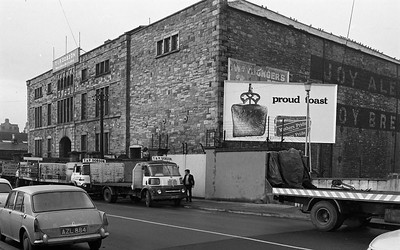
Joy Ale was quite heavily advertised in newspapers as has been mentioned but also elsewhere, as there is also a photograph of people queueing for a tram in 1948 with the words ‘Joy Ale’ written brightly across the front on the Irish Times website. The name was also written in large letters above the breweries name on the side of the brewery itself, as can be seen in this undated (c. 1970) image from Dublin City Libraries.

108_Mountjoy_Brewery

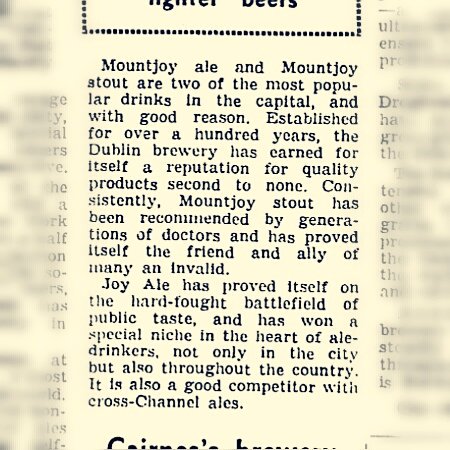
Right up as late as April of 1955 the Irish Press could carry the following piece about the beer:

Joy Ale has proved itself on the hard-fought battlefield of public taste, and has won a special niche in the heart of ale drinkers, not only in [Dublin] city but also a good competitor with cross-channel ales.

But sadly this heart-felt love was not enough to save the brewery and it closed in 1956, and so Ireland lost yet another of its former brewing giants. And one that had outlasted many of its rivals.

-o-

We might wonder what Joyce would have said about the loss of Joy Ale?

Although it probably matters little - as it is unlikely we would be able to understand him …

Liam K

(Here is the link to object #6)

Please note, all written content and the research involved in publishing it here is my own unless otherwise stated and cannot be reproduced elsewhere without permission, full credit to its sources, and a link back to this post.

Newspaper advertisement image © The British Library Board - All rights reserved. With thanks to The British Newspaper Archive (www.britishnewspaperarchive.co.uk) from whom I have received permission to display this image on this site. Label images are the authors own - as are the labels themselves. Embedded brewery image is via Dublin City Libraries Flickr page and copyrighted to them.

Wednesday, 19 September 2018

Beer History: Mountjoy Brewery, Brown Ale and Nourishing Stout

(Tweet-to-Blog-Conversion-Project)

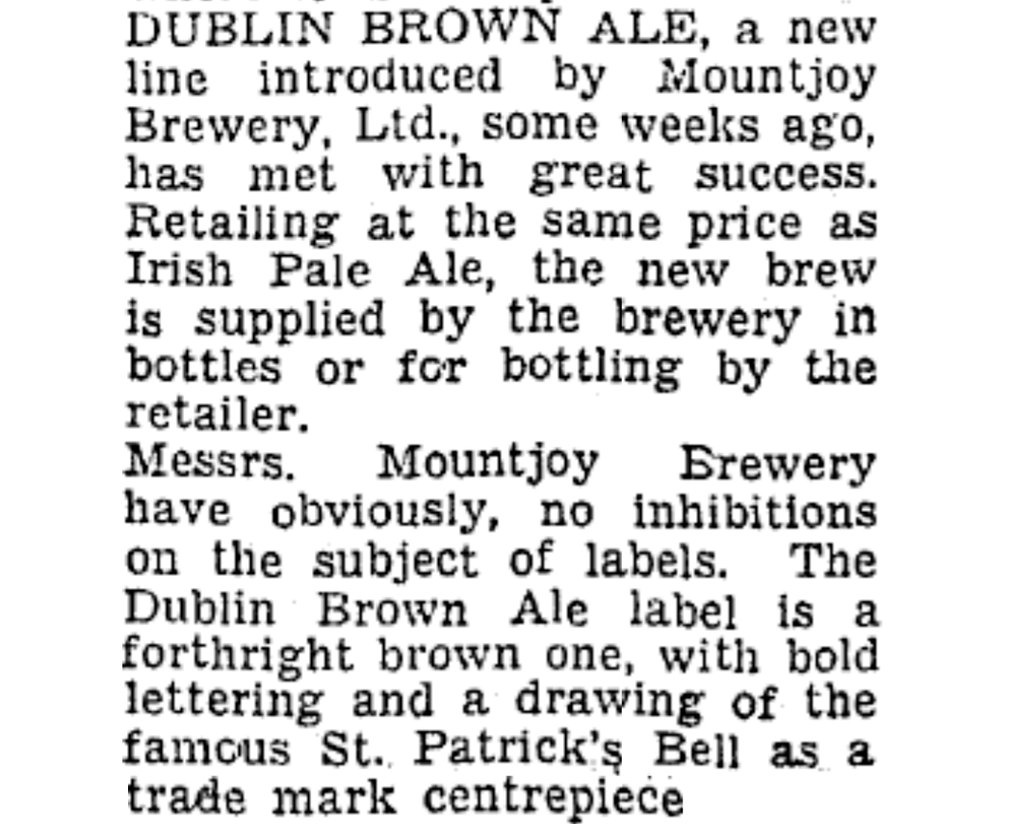
"Mountjoy Brewery brewed a 'Dublin Brown Ale' in 1953 it seems ... this is from the Irish Press of that year. I wonder if all their recipes are in someone's safe hands...?"


(This drew a question as to when they actually closed, some websites say 1949 but then I then found something online...)


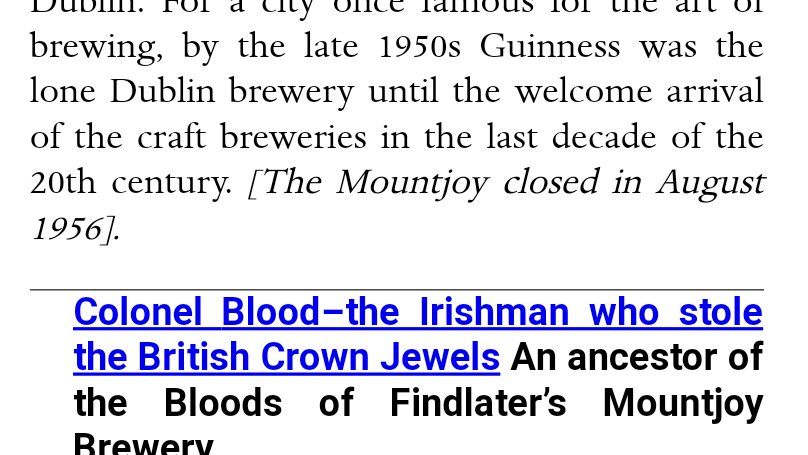
"... Interesting ... the online version of the Findlater book has an addendum that says it closed in 'August 1956'..."


(I then added this...)

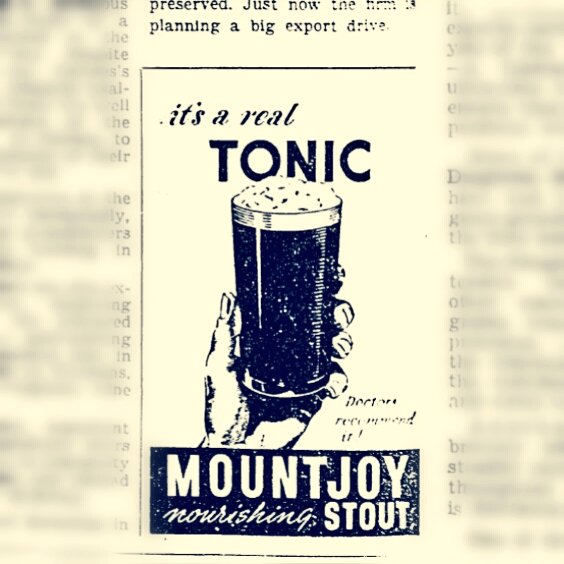
"... Further to the Mountjoy Brown Ale tweet above, here's a dubiously worded advert and a writeup from The Irish Press in 1955. It looks like that brown ale died a death - or isn't mentioned at least - and sadly the brewery was soon to head in the same direction..."


(Part of my Tweet-to-Blog-Conversion-Project - Original Tweet is here)

(With thanks to Carlow Library Local Studies room and Findlater's online book.)