Showing posts with label Dublin. Show all posts

Monday, 3 November 2025

A Shot of Beer History #10: Some Late 19th Century Dublin & Cork Stout Labels

In March of 1896 the following commentary appeared in the wonderfully titled Dublin newspaper The Illustrograph:

THE STOUT LABEL QUESTION

   DURING the past few months the magnificent Dublin firm of stout brewers are considered to have tarnished their reputation in Ireland by enacting a business rule to the effect that any licensed liquor trader may use the official Guinness's Extra Stout label supplied by the Company conditionally that such trader will enter into agreement with the Company not to sell the bottling stout of any Dublin or other brewer. This is the sum total of the agreement. The trader may sell porter of any other brewer as drawn from the cask and supplied by the glass or the tankard, but no bottled stout, except that bearing the label of Messrs, Guinness will be allowed to be vended under this arbitrary agreement.
   Now there exists in Dublin, as is the case in Burton-on-Trent, though not to the same extent, several other large brewers besides the largest and most popular one, but the great English brewery town of Burton, which is as equally noted for its Ales as Dublin is for its Stout, enjoys the distinction over Dublin of having the ale brews of its hundred and one other breweries (other than the great leviathan) extensively and fairly patronised by the English people, more so than the other Dublin brewers are patronised by the Irish people.
   This was not always so, for rather more than a quarter of a century ago honours, so to speak, were more evenly divided, nor were Messrs. Guinness the chief or largest stout brewers.
   Neither is the reason for the present unique (not to say monopolising) position of the great James's Gate Brewery due to superior quality of its manufacture, because the brews of several rival breweries in the Irish capital are considered by experts to be equally as good. On another page of this issue of the ILLUSTROGRAPH will be found the extra or double stout labels as issued by the five other Dublin brewers (Jameson, Pim and Co., Watkins and Co., Mountjoy Brewery Co., Ltd., Phoenix Brewery Co., and D’Arcy and Son) and one Cork brewer (Messrs. Jas. J. Murphy and Co., Limited) outside the Guinness pale, and also an edict issued to the public at large bearing on the monopoly and injustice likely to accrue if it should happen that Messrs. Guinness and Co.'s new Irish plan of campaign be universally adopted.
   To this manifesto and the facsimile of labels (except in colour), we direct the attention of our readers, whom we would advise, without any animus against but with a keen appreciation of the great House of Guinness, to try the extra stout bottlings of these six other brewers. This may be easily effected by those in authority over households ordering direct of the respective breweries or their agents, whose names will be supplied on application to the brewers mentioned. A comparison can then be made, and the writer for one has no fear of the result.
   "Live and let live" and "Free Trade" are prevailing mottos at this the latter portion of the nineteenth century, and most certainly an exclusive policy like that of Messrs. Guinness and Co. would have been more befittingly bestowed, according to history and tradition, at the commencement rather than the close of enlightened nineteenth century.

This appears to be a damning (if clunkily written*) indictment of a new policy by the Guinness brewery to force those who choose to use the Guinness label to only bottle their stout porter and no other. These days this might be dismissed by many with a shrug and a comment about Guinness just being Guinness but it appears that at the time the other breweries in the city were rather incensed by this behaviour to the point where they issued what could be seen as a full page proclamation under the title 'Protest of the Dublin brewing Trade Against the New Guinness Label' where they called out Guinness on what the claimed to be its attempt to establish a monopoly under the guise of wishing to stop adulteration, plus the mislabelling of others' product as their own. This was a new direction for the brewery to take in Ireland, but it had been previously done across the sea in Britain so it wasn't a new direction for Guinness to take.

The other Dublin brewers were not protesting against the use of a label by Guinness in itself, and the company had used labels prior to this period anyway, but rather the conditions mentioned above where those who were supplied with Guinness stout and labels could stock and sell no other bottled stout. The protest and commentary was carried in many newspapers and other sources at the time and it certainly sounds as if this was a turning point in the somewhat convivial if wary relations between Guinness and the other Dublin breweries - although within a little over half a century it wouldn't matter, as Guinness would be the last brewery left standing - literally.

That whole controversy is a subject for a bigger write-up but of interest to Irish brewing history are the copies of the labels used by those other breweries for their stout porter, plus the stray Cork one, which have been enhanced as much as possible and shown here. These appear to have been copies made by the newspaper of the actual labels in some cases given the quality and use of writing on a few but nevertheless some are labels which may not have seen the light of day in well over a hundred years. We have seen a couple of them on here before, notably the Watkins and D'Arcy ones, but here they all now are for posterity - or as much as that can be so in pixels and clouds.

Darcy's Dublin Extra Stout label showing their anchor trademark
-

Jameson's XXX Stout stamped with the word 'Invalid's' showing their trademark of a three-masted ship at sail and a write-up of its seemingly excellent attributes by Charles Cameron
-

Phoenix Porter Brewery Dublin Stout showing their phoenix trademark
-

Mountjoy Brewery's Dublin Stout with the words Extra Double and their three castles trademark

 -

Watkins's Extra Stout Dublin showing the shamrock trademark of the brewery
-

J.J. Murphy & Co. Cork XX Stout with their trademark of a ship at full sail between two towers
-

These beers may be long gone but at least some part of them remains, plus there are a few homebrewers who attempt to replicate them - if on modern brew systems. Below is one last image from the same source showing a bottle with the Phoenix label above but overprinted with the word 'Extra' - the bottle might be of interest to any family-brewer-based television series producers who wish to set their show in or around that era!


Liam K

*I know, I know - Pot and kettle indeed!

Please note, all written content and the research involved in publishing it here is my own unless otherwise stated and cannot be reproduced elsewhere without permission, full credit to its sources, and a link back to this post. Newspaper research was thanks to The British Newspaper Archive, who have kindly let me share the above images from The Illustrograph (Dublin) from the 1st of March 1869. DO NOT STEAL THIS CONTENT!

Tuesday, 29 October 2024

A Shot of Beer History #5 - Tankard Theft

In May 1913 the following report appeared in a Dublin newspaper as a warning to the city's publicans:

It is now some time ago since the licensed trade suffered great loss by the disappearance of pewter tankards, and now the tankard thieves have again made their appearance. They re-started on the North side of the city on Wednesday, and confined their unwelcome attentions to Upper Dorset street. The modus operandi is as follows:- Generally a man and a woman enter the "snug." the man calls for a tankard of porter, and the woman a bottle of stout. They occupy the "snug" for some time, and then leave, the woman having hid away the empty tankard, and leaving a pint tumbler in its place, the assistant in his rush forgetting, when he sees the two glasses, that he supplied a tankard.
The tankards are melted down along with the tops of soda water syphons and made into counterfeit coin, which is generally freely circulated after a tankard raid. the coins are very neatly turned out, and have a very good ring, but the bright colour will be detected if closely examined.

As alluded to in the report, this was a relatively common practice but it is interesting to see the 'modus operandi' here in print. So, it appears that the theft of drinkware from pubs isn't a new phenomena - not that we really thought it was - although the reasons for said theft appears to have changed through the years to one of collecting.  Although there is no mention of where the ladies mentioned in the report hid their soon-to-be-swapped tumblers and stolen tankards, it is possible they were tucked neatly into the folds of a dress but it is probably more likely a bag of some description was used. Anecdotally, that practice still exists, with glassware generally disappearing into a handbag these days - often at the gentleman's prompting - but without the switcheroo. (That's not to say that women don't steal glassware for their own use of course!)

It's 'nice' to see that there is equality and partnership when it comes to this exercise, although it must also be said that then - as like now - the gentleman can have plausible deniability as to the theft, as the stolen item is in the possession of the lady, and therefore perhaps the alliance is not quite what it seems ..?!

Liam K

PS. Don't steal stuff from pubs!

Please note, all written content and the research involved in publishing it here is my own unless otherwise stated and cannot be reproduced elsewhere without permission, full credit to its sources, and a link back to this post. Newspaper research was thanks to The British Newspaper Archive, who have kindly let me share the above image from The Freeman's Journal of the 16th May 1913. DO NOT STEAL THIS CONTENT!

Thursday, 7 March 2024

100 Years of Irish Brewing in 50 Objects: #18 - ‘International Bar’ Half-Pint Tankard (c. 1902)

… to run “as dim eyed animals do, towards any glittering object, were it but a scoured tankard, and mistake it for a solar luminary” …

Memoirs of the Life of Scott – London and Westminster Review 1838 – Thomas Carlyle

There is something extremely appealing about public house drinkware. Even an item that has been maimed and repurposed like this once-tankard are a comforting joy when held in hand and raised ritualistically to the drinker’s lips. This vessel is certainly enigmatic in many ways, from the material it’s made from to its exact provenance, it asks more questions than it can answer. Much like a lot of our public house and brewing history it is possible to find out some information from records and writeups but sadly, much is also down to half-educated guess work and assumption. But there are some clues to its past be found on the piece itself, which at least answer some of the more basic questions it poses ... 

-o-

This tumblerised tankard carries the word ‘1/2 Pint’ as well as the term ‘Masonoid Silver.’ It has a rubbed Edwardian stamp showing a crown flanked by a very faint later E plus an R, with the Uniform Verification Number 6 below the crown denoting it was verified in Birmingham, where it was manufactured. There is also a tiny M to the right of the verification mark whose purpose is unclear although it may reflect a date, but that Edwardian stamp puts its manufacturing firmly prior to 1910 and probably post 1902. At some point someone has removed the handle, which would have been rounded and C-shaped, and the surface is also covered in roughish scratches which means the engraved name showing the words ‘International Bar’ in, and on, a belt and buckle design is almost obliterated. Perhaps it had become damaged in use and repurposed, but as the heavier and deeper gouges are very much focussed on the engraved bar name in order to obliterate it, it would appear that the tankard may have been taken from the bar by somebody for a specific purpose, which has become lost to history.

The belt and buckle device is in fact a 'garter' and appears to have originated from the emblem of The Most Noble Order of the Garter, with the garter in question being a part of a knight's wardrobe for securing parts of the armour together or to the body. This motif turns up in many logos, decorations, and trademarks in the late 19th and early 20th century, perhaps as a way of adding an air of ostentation to a brand, company or object without it being actually connected to the order.

Masonoid Silver was a durable, bright metal alloy developed by Samuel Mason in Birmingham around or prior to 1887, when it first starts to appear under that name in publications. It was originally available in two colours, one as a replacement for silver or silver plate and another as a replacement for copper or brass. It was possibly a type of Nickel Silver, which contains mostly copper with nickel and zinc, but more was more likely similar to an early version of a more expensive alloy patented as Monel in 1906 and composed mostly of nickel with less copper than Nickel Silver and with small amounts of iron, manganese, carbon and other elements. Masonoid was used for many products, particularly those that revolve around the drinks trade such as beer engines and taps, as well as bicycle parts and other applications. The company went through a number of name changes and partnerships, such as The Masonoid Silver and Midland Rolling Mills in 1898, before disappearing from historical mentions by the end of the second decade of the twentieth century and is now only remembered in objects like this.


-o-

It is tricky to ascertain exactly which International Bar this tankard was made for as there appears to have been at least three public houses bearing that name on the island in the very early 1900s. There are newspaper mentions that reference an International Bar on Market Street in Derry, which was operating around the same time and had a reopening in 1907, which certainly ties in with the date of the tankard. There also appears to have been a pub of the same name in Newtownards and perhaps one in Belfast. It is quite possible that this object relates to any of those bars but it is equally conceivable that the tankard came from The International Bar in Dublin. (Especially given that it was discovered in a shop that specialises in house clearances from the Dublin area.) This bar still exists and appears to have been quite a salubrious spot since the very late 1890s, so it would certainly suit as an establishment that had commissioned its own personalised tankards, but sadly there is no recorded proof of this in the common sources.


The Dublin based International Bar began its beverage selling life on a slightly smaller scale than its current footprint, as it was originally focussed on the side of the building that sits on 8 St. Andrew Street, although with some frontage also on to Wicklow Street as it sat on that corner. As far back as 1827 a Mrs. B Cavenagh (also spelled Kavanagh) had a grocery, tea, wine and spirit warehouse on the site, and a possibly related James Kavanagh of the same address was declared insolvent in 1838, having let the license go into arrears the previous year and the building go into a state of disrepair, so the lease was up for sale at that point. The premises was taken over by a John Hoyne in that year and repairs were made to the building before he was granted a publican’s license, although it was opposed by some local people on the grounds that there were already 19 public houses on nearby Exchequer Street alone! A wonderfully, Joycean named person called Stephen Pidgeon applied for a license for the premises in 1839 and 1840, before it was taken on by John Dunne in 1843. Mr. Dunne appears to have ran it as a spirit grocers until his death in 1880, and by 1885 it was being operated by a John Cox. In 1887 Michael O’ Donohoe, a Cavan native, applied for a license to retail alcohol at 8 St. Andrew Street and was also leasing the 23 Wicklow Street building around the corner by 1892. (That address also appears to have been occupied by a tailor’s shop and then a jeweller and clockmaker, which overlap slightly with the O’Donohoe lease dates, but that might have been on the upper levels of the building or it may have been sublet.) In 1897 Mr. O’Donohoe applied for a new licence to sell alcohol on that attached building on Wicklow Street, it now being an extension of his original business. But big changes were afoot …

On Friday the 5th of August 1898 the International Bar, as it was then named and as it appears today, was opened as a completely new build on the two sites acquired by Mr. O’ Donohoe. A newspaper advertisement from this time reads thus:

THE INTERNATIONAL
ST. ANDREW ST. & WICKLOW ST.
___ 

M. O’DONOHOE

Begs to inform his Friends and the Public that his New Premises,

THE INTERNATIONAL BAR,
WILL BE OPENED
ON
NEXT FRIDAY, the 5th inst.

This Establishment has been fitted up throughout with the Electric Light, generated on the premises by powerful electric generator, worked gas engine of Crossley Bros, Warrington, and has already been pronounced by competent judges one of the finest of its class to be found either home or on the Continent.

In point Architectural Design and Beauty it stands second none. The art decorations and ornamentation are of the most modern and up-to-date style. The plans were designed by George O’Connor. Esq, MRIAI, and the building was carried out under his personal supervision. The Sanitary arrangements are of the most Modern Type, and ate complete In every respect.

The International has been built and fitted up regardless of expense.

It is intended it should occupy a foremost place amongst the Establishment class in this city, where Gentlemen from every part the world will find every accommodation and their requirements catered for in the best manner under the personal supervision of the Proprietor.

The Refreshments, both Home and Foreign, will all of the very best manufactured, and no inferior qualities will kept slock.
___ 
THE BRANDIES, CHAMPAGNES, WHISKIES, AND WINES,
OF ALL KINDS, TOGETHER WITH
ALES. BEERS, PORTER, STOUT, AND MINERALS, &c., &c.,
HAVE BEEN SUPPLIED BY THE LEADING MANUFACTURERS,
And will found fully Matured, and in the finest. Condition.
The CIGARS, &c., are all selected from the Best Brands.
Mr. O’D. Cordially Invites the Public to Visit his ESTABLISHMENT,
and he guarantees them every attention and courtesy.
___ 
LUNCHEONS OFF JOINTS A SPECIALITY.
___ 
NOTE ...
THE INTERNATIONAL
ST. ANDREW AND WICKLOW STREET
M. O’DONOHOE, Proprietor

Another advertisement from later in the month is of a similar vein and includes the following paragraph:

The proprietor begs to inform his numerous friends and customers and the public generally that this magnificent establishment - the finest in the city - is now in full swing and worthy the attention of connoisseurs.

THE BEST OF EVERYTHING SUPPLIED
___

J.J. & SON'S WHISKIES,
GUINNESS'S STOUT,
BASS'S ALE,
Etc, Etc, Etc

It is certainly a fine building of excellent design and sits very handsomely to this day on that site. No expense appears to have been spared with its build and fit out so it is hardly surprising that shiny new tankards may have been purchased for the premises a few years later, engraved with the bars name. 

Mr. O’Donohoe died in October 1904, and his funeral was attended by most of the other licensed traders in Dublin, a sign surely of how well he was thought of by his peers.

-o-

It could be argued that this object is more connected to beer serving and public houses than with actual Irish brewing history, but both are of course intrinsically linked so it is impossible to have a conversation about one without involving the other.

Irish pubs have always been an essential part of Irish brewery history, albeit with their former fondness for English-brewed Bass et al., and their present dalliances with foreign lager brands – although at least, as with an iteration of Bass at one time, many are brewed in Irish breweries.

The Irish brewing industry should - rightly - evolve, improve, and embrace the new, but Ireland has lost most of its breweries over the last couple of centuries. They became hollowed out brands within the portfolios of drink corporations, detached and rebooted as one-off, one-dimensional beers, with their history discarded, disfigured, and diluted. But many of the public houses that served the beer from lost breweries still exist in one form or another, and they are entangled in our brewing provenance and 'heritage,' to use an overused word. Many of the public houses of Ireland have now become the historical repositories of our relatively recent beer-laded past, as they have become aesthetics-driven exhibitions of artefacts and ephemera from that now-lost era, even though they lack perhaps the knowledge, the interest, or the want to communicate any of this history to their customers. Understandably, many focus on their own history – sometimes scribbled on the back of a beer mat over a few pints after closing time it appears – but not on the actual libations they pulled and poured over previous decades or centuries.

A cynic might say that there is little point in trying to communicate history of any type to those who don’t care, but in many cases it is how that information is communicated is the key. Irish bars are certainly good at storytelling, but for today's audience they need something more than just words, they need something tangible and ‘real,’ a touchable connection to our brewing past that will engage the customer and stimulate some conversation. It might be that framed letterhead from Mountjoy Brewery, or the beer label on the wall for D’Arcy’s Stout. It could be an old, embossed bottle from a famous Sligo brewhouse sitting on a shelf, or a price list from a Kilkenny brewery listing all of its beers.

It might even be a worn and damaged tankard that may in the past have been filled with a half pint of plain porter or a pale ale in a newly built bar in a busy city.

These stories need telling, before all of our history is completely worn away …

Liam K

Please note, all written content and the research involved in publishing it here is my own unless otherwise stated and cannot be reproduced elsewhere without permission, full credit to its sources, and a link back to this post. The photograph and tankard itself are the authors own and the image cannot be used elsewhere without the author's permission. Newspaper research was thanks to The British Newspaper Archive. DO NOT STEAL THIS CONTENT!

Wednesday, 23 August 2023

100 Years of Irish Brewing in 50 Objects: #11 – Mountjoy Brewery Cask Return Postcard (1888)

Returning to the larger yard, we crossed over to the cask-washing sheds constructed principally of iron and tiled roofs. […] Three thousand casks can be turned out of these sheds daily, and thirty men are employed at the work. Facing these sheds there is a space of ground, upwards of an acre in extent, which is covered in casks …
Alfred Barnard, The Noted Breweries of Great Britain and Ireland. Volume II - 1889.

In late January of 1888 some post from the Mountjoy Brewery in Dublin arrived on the premises of James Watford who had a wine and spirits stores at number 76 on the High Street in Bedford in England. The bespoke postcard wasn’t anything special or unusual, and was something that the Mountjoy Brewery probably posted in reasonably large quantities every month, being just another part of the accounting, notification and checks that were carried out by all breweries in this era.

The prepaid halfpenny postcard was dated and posted on the 19th of January 1888 and on the back was printed the following message:

Messrs. FINDLATER & CO., Have to this date received the undermentioned Casks, and placed the same to the credit of your account.

There follows a list of cask sizes from Hogsheads (54 Imperial gallons) down to Firkins (9 Imperial gallons) and it is beside this last size that the number 5 is written and below that a list of the reference numbers of those casks and the words ‘ad[d]ressed 23/11/87 + 28/12/87.’ Additionally there is a diagonal stamp across all of this bearing the words ‘FINDLATER’S MOUNTJOY BREWERY Co., LIMITED.’

This postcard only tells us part of a story, as it just acknowledges the return of casks to the brewery from a delivery of stout to Watford’s drink store in Bedford, which as well as being involved in spirits and wine were ale and stout bottlers at this time, but we can expand at least a little more on the tale this object can tell …

Mountjoy brewery was founded in Dublin in 1852 by a group of Irish and British businessmen and was one of the largest stout exporters in the city - and country - in the late 19th and into the early 20th century. It was a part of the large Findlater mercantile empire that was well known in the food and drink industry in general. In the late 19th century Mountjoy Brewery only brewed porters and stouts according to Barnard’s description of the brewery, and it appears from advertisements in British papers at this time that they were sending Extra XXX Stout, Extra XX Stout and X Stout in that direction and their brewings widely available in many towns. One of the most popular products was called ‘Nourishing Stout,’ which was also marketed as Crown Stout.1

We will never be sure exactly which stout - or stouts - were being sent to Watford’s but it was likely to have included that Nourishing Stout, as that was extremely popular at this time and for decades after. Indeed back in 1871 Findlater, Mackie & Co. a bottling and drink company based in England and connected to the Dublin firm were sued by Messrs. Ragget for using the term ‘Nourishing Stout’ on their beer. The case was dismissed as the word ‘nourishing’ was not seen as a trademark infringement, just a descriptor. It came out during the hearing that Ragget’s were not brewing the stout themselves, they were sourcing it from Truman’s brewery in London and bottling it under their own label, and it was reported that this was also where Findlater, Mackie & Co. were sourcing theirs!2 Why they weren’t using a Dublin brewed version of a ‘nourishing’ stout from their related brewery - if that report is correct - is a mystery, as Mountjoy were exporting to England at this time, but may have just come down to logistics and convenience, or perhaps some other internal issue. It also emerged that Raggets had already stopped a ‘Nourishing Dublin Stout’ from being sold under that description, and newspaper records show there was one being sold in 1869 with no brewery mentioned and one also being sold in 1872 brewed by Jameson, Pim & Co.3

But back to our casks and what is perhaps also of interest is that Mountjoy Brewery claimed in the 1860s to be the ‘only Dublin brewers who send out all sizes of casks in English measure.’4 How true this claim is might be difficult to verify but it was certainly true that many Irish breweries were using Irish cask sizes up until at least the turn of the century, and some even longer. An Irish barrel was 40 Irish gallons which was roughly the equivalent of 32 gallons whereas an Imperial ‘English’ barrel was 36 gallons.

What is clear is that there were many casks, regardless of their size, going back and forth across the Irish Sea in the latter part of the 19th century and there was a great deal of logistical work needed to document, trace and return these casks to their rightful owners. This postcard is a literal snapshot of that process and the communication that was needed for tracking individual casks, which would have been recorded on the delivery dockets and invoices sent out by the brewery at the time of dispatch.

To give an idea of the volumes involved the total exports of porter from Dublin in 1888 amounted to the equivalent of 424,205 hogsheads.5 Much of this was probably shipped in some smaller sized casks like Mountjoy’s firkins, so the total number of items shipped may have amounted to close to a million perhaps, of which not all would have returned of course. Even still, this is a huge amount of paperwork and organisation, a side of brewing that can be forgotten about compared to the actual ‘glamour’ of the brewing process itself.

Incidentally in 1888 the Mountjoy Brewery were only sending out the equivalent of 11,595 hogsheads, 6th on the list behind D’arcys, Phoenix, Jameson and Watkins, with Guinness topping the list naturally with 330,088 hogsheads by volume. Although it is worth noting that Mounjoy were in a slump in sales at this time compared to the decades before and afterward where they came second on the list at times.

And these casks would also need sniffing, sorting, cleaning, repairing, stacking and host of other jobs performed on them before they were filled and sent out, and the whole process of recording and retrieving would start yet again. A small glimpse at where some of this took place is mentioned by Alfred Barnard in the opening quotation.

Simple, fragile and ephemeral objects like this brewery postcard are important reminders of our brewing heritage, giving us a glimpse into our past, although admittedly not a very exciting one perhaps.

But because this object exists and was kept and passed on through numerous hands it became a tangible record of what a huge brewing city Dublin was in the 1880s, and that Irish brewing history exists beyond those breweries whose beers and history survived.

Liam K

1 Warrington Examiner 18th September 1875 and Leicester Daily Post 6th June 1889

2 The Law Reports : Equity Cases Including Bankruptcy Cases, Before the Master of Rolls, the Vice-chancellors, and the Chief Judge in Bankruptcy · Volume 17 1874 - Editor: George Wirgman Hemming

3 The Shrewsbury Chronicle 29th November 1872

4 The Birmingham Daily Gazette 19th May 1868

5 The Railway News, Finance and Joint-stock Companies' Journal 1889

More information on the Mountjoy brewery can be found in Findlaters: The Story of a Dublin Merchant Family by Alex Findlater

Please note, all written content and the research involved in publishing it here is my own unless otherwise stated and cannot be reproduced elsewhere without permission, full credit to its sources, and a link back to this post. The attached images are the author's own and cannot be used elsewhere without the author's permission. Newspaper research was thanks to The British Newspaper Archive and other sources are as credited.

Friday, 26 May 2023

100 Years of Irish Brewing in 50 Objects: #8 - Label Facsimile for Greenmount Brewery (c. 1870)

Perry Archive in Portlaoise Library
The PALE ALE was beautifully clear, bright, and sparkling. It had a very pleasant bitter flavour of the Hop, and was full-boiled to the taste. It contained more than the average of alcohol and substances which give to Ales of this kind their nutritious and exhilarating properties.
The Samples I examined were well fermented, and would keep a due length of time. They contained all the essentials of PALE ALE of the first class, viz. :- Flavour, brilliancy of condition, and keeping qualities. […] “Greenmount Pale Ale” must become a formidable competitor to the English and Scotch Ales.
I remain, Gentlemen,
Your obedient Servant,
ROBERT GALLOWAY, F.R.S.,
Professor of Applied Chemistry.

Saunders' News-Letter 23rd May 1868

If you walk down Clanbrassil Street and cross the busy Robert Emmet Bridge over the Grand Canal on the south-side of Dublin then head further south on to Harold’s Cross Road you will pass on your right hand side a row of pleasant-looking brown brick low-rise apartments and some equally plain but inoffensive offices, and behind those a collection of commercial and residential structures that cover most of the site. Early maps label the area as Cherry Orchard (not to be confused with the same-named suburb of west Dublin) which might relate to a larger area stretching in a thin plot further north beyond the canal or may just demark a space where there was once an actual cherry orchard - most likely both. The area is now known as Greenmount and has been for many years, presumably after Greenmount house which was just southwest of this location, with the name is still in use in the warren of lanes and streets around here, and it has been home to much industry and business over the centuries – including a brewing enterprise.

-o-

Greenmount Brewery was a joint venture between the elegantly name Robinson Gale Perry and an enigmatic Mr. Alexander, plus possibly other partners, and traded as Alexander, Perry & Co. Mr Perry was part of the Perry family of brewers, maltsters and businessmen from Laois, being one of the sons of Robert Perry and born in 1833 in Rathdowney. His unusual middle name is in fact his mother’s maiden name, an Elenor Gale also from Laois. There is no doubt that there is a bigger story that should be told regarding the Perry family and their various enterprises, including the brewery in Rathdowney which lasted into the 1960s, but for now we will focus just on Greenmount brewery site and history. Regarding the Mr. Alexander whose surname is also on the company name there appears to be very little trace but there was an Edward Alexander of Greenmount listed in Thom’s Almanac from 1870, which could be the missing joint owner. Indeed, there are Alexanders connected with the well-known Pim family who owned the nearby clothmaking company and all - including the Perry family - were Quakers so there seems to be a strong likelihood that this is the correct family at least. (A curious note on the company name is that many in the past and present seem to think the owner’s name was ‘Alexander Perry’ due to the comma being misplaced in the company title, with corrections appearing in newspapers such as times where donations were given by the brewery to various causes.)

-o-

There is a relatively full description of the brewery featured in The Irish Times on the 12th of December 1867, eighteen months or so after the brewery was started, which gives some detail of the building and its operations.

GREENMOUNT BREWERY.

We have pleasure in laying before our readers the following short description of the brewery lately erected by Messrs. Alexander, Perry and Co., at Greenmount, Harold's-cross-bridge.
This brewery was commenced on May 1st, 1865. A rough sketch of the proposed position of the different utensils and the necessary dimensions of the building was furnished by Mr. Robinson Perry, one of the partners, to Mr. John McCurdy, the eminent architect, in Leinster-street. After severe competition the contract we awarded to Mr. S. H. Bolton, of South Richmond-street, and the construction reflects great credit on both architect and builder, for its superior style and finish.
In the lower portion of the building is the malt-room, where the process of brewing first commences. The malt Is drawn from air-tight bins, and emptied into a hopper, from which it is elevated and discharged into a separator and joggler; the former removes all the dust and small grains, the latter retains all the stones, &c. The malt falls on to metal rollers and is crushed, then elevated to a large hopper placed over be mash tun.
The upper portion of the building is occupied with the next operation, which is to boil the water for the mash. This is dine in large wooden backs, lined with copper, the water being heated by passing steam at a high pressure through copper coils lying on the bottom of each vessel. The hot water is conveyed to the next stage, and through a mashing machine, on entering which the malt Is allowed to fall on to it, and the two are mashed up by a series of rakes revolving at great speed inside this machine, discharging the two into the mash tun, where they are allowed to stand for some time. This tun is fitted with a false bottom, which permits the extract from the malt to pass through, leaving the "grains" behind. This extract, now called worts[sic], runs direct into the coppers, where the hops are added. The worts[sic] are then boiled a sufficient time to imbibe the flavour and bitter of the hop, and are discharged direct into a hop-back. This is a square vessel, supplied with a false bottom, which permits the liquor to ran off to a large cooler, leaving the hops behind, where it is rapidly cooled by a fan, and is then allowed to pass over one of Morton and Wilson's patent refrigerators, which quickly cools It down to the temperature desired by the brewer; the wort lastly rubs into the fermenting tuns. The fermentation being completed, the beer runs down into swan-necks or puncheons in the cleansing cellars. The barm being all worked out of the drink in these vessels, the clear beer racked into casks, where it is left to arrive at maturity.
There are two large cleansing for this process, also a large store, where piles of the different ales and beers are ready for delivery. In the cask department the casks are all washed by machinery, then steamed, and dried by heated air.
The boiler-houses and engine-room are situated at one side of the brew-house, from whence all the shafting, &c., is driven. All the iron work and the large pillars were erected by the eminent firm of Courtney, Stephens and Co., and the shafting by Mr. Edward Toomey, of the Phoenix Works, all of which are a credit to both these Dublin firms.
The brewery is capable or turning out 1.000 barrels a week, and for compactness and economic principles cannot be surpassed; the use of pumps, requisite in other breweries, being dispensed with hastens the process, thereby ensuring [the] keeping quality in the beer.
The mild ale and bitter beer brewed by this firm are of an excellent quality, finely flavoured, and have a good body; and we believe that before long to Greenmount Bitter Beer" will be as well known and appreciated in Ireland as Bass and Allsopp are in England.

It is thanks to descriptions such as this that we can get an inkling of the internal workings of the lost breweries of Ireland and, as flawed and weighted as many newspaper reports can be, at least we can have some record and proof that these places existed and how they operated. (A later write-up in the same newspaper related to a different enterprise on the site mentions a description of the actual building as being ‘five stories high and 100ft long’ with an average ‘depth of 213 feet’ and two stores running parallel to the main building 100ft long and 30 or 40ft wide. It appears not to have been altered externally for the new business.)*

We also get a possible start date of 1st May 1865 for the enterprise and it appear it was newly built at that time, plus early maps show virtually no structures on the site. The first newspaper mention is in an advertisement dated exactly a year later on the 1st of May 1866 in The Freeman’s Journal for the sale of an adjacent premises which is said to be ‘adjoining the Greenmount Spinning Mills and Brewery’ so we can be relatively sure it existed by this time at least.

The second part of a write-up on the brewery on the 1st of June 1868 in Saunders' Newsletter very much repeats the Irish Times article regarding the brewery itself to the point of near plagiarism, but it does add the snippets that the brewery gave employment to sixty men at this time and that the site covered three statute acres. The opening section of the article reads like an advertisement - which it probably was – but it does supply us with more information such as how the brewery had an ‘extensive trade in their Irish ales [..] in the west of England, Scotland, and Wales’ which we shall confirm later. The piece also rails against the Irish ale retailers love of Bass and Allsopp’s ales and how Greenmount now 'supplies private families themselves to the extent of nearly three hundred [quarter?] casks per week.’ This can perhaps give us a snapshot of the retail trade in ale in Ireland at this time and how difficult it was for smaller, newer breweries to compete with established brands on the grocery floor or public house counter - plus ça change!

The article goes on to mention what was being brewed at the time, with the pale ale being ‘fully equal to Burton’ only cheaper, there is also a bitter beer that is ‘not so strong, but finely flavoured, bright and sparkling, with good tonic qualities.’ The piece goes on to say that there are two kinds of stout made there, an Imperial and an XX porter, ‘with the latter possessing a good body, and equal to any we have ever tasted.’ The Imperial was thought of as ‘very fine, but expensive’ but  it ‘is becoming celebrated, and is one of the most popular drinks in Liverpool and other seaport towns in the west of England, where extra strength is looked for.’ This 'stout' may be being confused with the Imperial Ale because as we shall see there are no other mentions of an Imperial Stout elsewhere, and might show that the writer might not be fully versed in the beers of the brewery after all! The only other fact of note is that the malt for their bitter beer was supplied by Giltrap and Sons, Newark in England – whether it was only used for this beer is not totally clear but it certainly reads as so.

To add to the above descriptions the brewery incorporated an extra element of cooling in 1870 with the installation of an ice machine made by Messrs. Siebe Brothers of Lambeth, London, which as well as making blocks of ice ‘as clear and solid as the “Wenham Lake” ice,’ was utilised in ‘cooling the worts[sic] by sending the half-frozen water in air-tight tubes passing through the vessels.’

-o-

We can add more information to the beers listed above. and perhaps a little clarification too. by looking at some newspaper advertisements from the period.

The label facsimile - which is used like a logo on a financial record held in the Perry archives in the local studies department of Portlaoise Library - shows that at one time the brewery was selling pale ale, extra stout and imperial ale and this can be verified by newspaper advertisements from 1869 and very early 1871. The quote at the beginning of this article is part of an advertisement for ‘Greenmount Pale Ale” which ties in with the label facsimile and gives us a reasonable description of its qualities, albeit from what was probably a paid source.

There is a particularly nice advertisement in The Monmouthshire Merlin of the 13th of February 1869 which shows that Greenmount Brewery were selling “Dublin Imperial Ale” in Newport, Wales from an agent called Robert Perry, who is quite possibly a relation of the brewery owner.

Prior to that, according to The Bristol Mercury, the brewery was looking for a local agent as early as January 1867 to sell ‘”Mild” and “Pale” ales; also, “Single” and “Double Stouts” in the city, and in the same month they were soliciting trials of their East India Pale Ale in The Freemans’ Journal in Dublin.  From November 1867 they were advertising a ‘Bitter Beer’ for sale at 1s a gallon in various editions of Dublin newspapers which was ‘not so strong a Pale Ale’ and had ‘a light tonic quality.’ The word ‘beer’ at this time meant a lighter and cheaper type of malt-based beverage in Ireland.

More confirmed export evidence can be seen in The Croydon Chronicle from the 28th of May 1870 where an agent took out a reasonably large advertisement complete with exclamation marks for their ‘Dublin Pale Ale’ and which was claimed ‘for flavour and quality this ale surpasses any other offered in the district.’

By 1872 an agent advertising in The Wexford Independent could offer Pale Ale, XXXX Strong Mild Ale and Dublin Porter in hogsheads, barrels, half barrels, and quarter casks from the October brewings of the previous year, plus there were advertisements in other parts of the country in other years too, showing that their beers were relatively widespread in parts of Ireland.

Interestingly, by January 1872 in another advertisement for their pale ale in The Freeman’s Journal that contains yet another positive report from Robert Galloway, the company name of ‘Robinson G. Perry, and Co.’ is used, which suggests the recent departure of Mr. Alexander from the business.

-o-

But by the end of 1872 a new enterprise – The Irish Whisky Distillery Company – had been formed with a view to converting the brewery into a distilling entity, and among the directors is ‘Robinson G. Perry, Merchant, Rathdowney Brewery, Queen’s County’ along with a William James Perry and some other high-profile business people. The abridged prospectus published in papers in December 1872 state that on the 15th of October of that year that Fredrick William Zurhorst agreed to purchase the ‘premises, known as the Greenmount Brewery, for the sum of £36,000, to be handed over to the company, with all the necessary appliances in complete condition for the Distillation of Whisky, within three months from the incorporation of the Company, capable of turning out 200,000 gallons of Whisky annually.’ The conversion from brewery to distillery was fully completed by 1874 and another of Ireland's breweries disappeared from view.

So it would seem that there was more money projected to be in whisky than in pale ale, and although there is a further chapter that involves the history of the distillery, including a fire and a conversion to an oil company, our interest in the site as part of our lost brewing history ends here.

Robinson Gale Perry died in Brentford in England in 1917 at the age of 83.

-o-

For an epilogue we will go back to June 1868 and a response by Samuel Haughton to that article that appeared in Saunders’ News-Letter quoted from above that sang the praises of the brewery. Carlow born Samuel Haughton was a priest, doctor and writer on scientific subjects. Amongst other things, he is gruesomely known for ‘The Haughton Drop’ - the calculation needed for a humane and swift end for those about to be hanged, but he was thought of generally in good terms. He was a supporter of temperance and Father Mathew so it comes as no surprise that his comments regarding Greenmount brewery are less than flattering. He speaks of the evils of ‘Seductive Liquors’ and ‘deplores that money and intelligence are so freely employed in a business that creates much of the misery and crime that exists around us.’ But his real issue is with the comments by way of the Galloway quote used in the original piece which stated that intoxicating beverages are nutritious, plus that sales of said products are good for the country as a whole, as implied in said article. He takes a huge swipe at Galloway saying, ‘I doubt if there be one intelligent man now to be found among scientific men to maintain that this poison can afford any nutriment to the human frame.’ He goes on to berate the press by saying, ‘Let not then the editors of our public press any more give currency to the idea that alcoholic liquors of any description aid men in the performance of their bodily or their mental labours.’ Lastly he aims his well-spoken words at the brewers, refusing to agree that they are manufacturers - as stated in the piece - and saying that ‘a manufacturer is one who takes raw materials of little previous value, and by art makes them into things of great value. The brewer, and the distiller also, does exactly the reverse of this. He takes articles of the first necessity, and of the highest value to man, and transforms them into poison, injurious to the health, and ruinous to the happiness of man.'

He must have went apoplectic when he saw the brewery - by far the lesser of two evils for many temperance people - converted into a distillery in his lifetime.

But at least he had shuffled off his mortal coil before the ‘Guinness is Good for You’ campaign began …

(Here's the link to object #9)

Liam K

(There is a photograph of the oil company set up by the artist Louis le Brocquy’s grandfather here which is on the same site, and the entrance and the five-story building are probably from the original brewery site, even allowing for damage caused by an 1877 fire.)

*The description above is from an article on the distillery in The Irish Times on the 18th of November 1873, and again the implication is that there was very little change to the external parts of the building but that floors were added internally and a new chimney.

Please note, all written content and the research involved in publishing it here is my own unless otherwise stated and cannot be reproduced elsewhere without permission, full credit to its sources, and a link back to this post. The logo/label shown is part of the Perry Archive in Portlaoise Library and the attached image is the author's own and cannot be used elsewhere without the author's permission. Newspaper research was thanks to The British Newspaper Archive from whom I have received permission to publish images.

Thursday, 16 March 2023

100 Years of Irish Brewing in 50 Objects: #5 - Mountjoy Brewery's Dublin Pale Ale Bottle Label

... after the cad came back which we fought he wars a gunner and his corkiness lay up two bottles of joy with a shandy had by Fred and a fino oloroso which he was warming to, my right, Jimmy, my old brown freer? - Whose dolour, O so mine!
Finnegans Wake - James Joyce (1939)

For readers of Irish literature there are few books as chaotically incomprehensible as Joyce’s Finnegans Wake, where even having a glossary at hand which helps give meaning to the odd words barely makes a dent in the reader’s understanding of what is actually unfolding between the pages given the unfathomable grammar and syntax. But, from the point of view of Irish brewing history, it has permanently recorded what may be a reference to a lost Dublin pale ale into a famous work of fiction, as the words ‘two bottles of joy’ are believed by some to be a reference to an ale brewed by the Mountjoy Brewery in the first half of the 20th century. This may not be the case of course, as a ‘bottle of joy’ could be taken to mean a bottle of any alcoholic drink to many people, and said brewery were more famous for their porters and stouts than their ales for the earliest parts of their history.

-o-

According to Findlaters: The Story of a Dublin Merchant Family by Alex Findlater, Mountjoy Brewery came about when six businessmen decided to establish a brewery on Russell Street on the north side of Dublin in 1852. The era they were about to enter was perhaps the heyday for the bigger Irish breweries, one reason for this was that the temperance societies were a little more subdued than they had been in previous decades, and anyhow had driven people away from strong liquor towards beers and weaker alcoholic drinks which were seen as somewhat less harmful. There was less competition from smaller local breweries too, as they went into a decline - one from which they have just recently recovered. Exports of beer from the island was also relatively high so it was certainly a good time to consider establishing a new brewery, and at this time porter and was in the ascendency so that was what the brewery initially supplied to both the local and export trade. Indeed, Alfred Barnard visited the brewery around 1888 for his books on the breweries of these islands and at that time could say with some authority that Mountjoy brewery only brewed porter and stout at this time, and a few years later in Ireland: Industrial and Agricultural published in 1902 the author also says that only porter and stout were ever brewed there up to that time.

Obviously ale – as distinct from porter - was being brewed in Ireland during this period and for many centuries before, and beers termed ‘pale ale’ had been brewed in the previous centuries. A Jonathan Herrod opened a brewery in Dublin in 1786 ‘exactly on the Burton plan’ to brew ‘Strong Pale Ale’ as reported in Saunders's News-Letter in February of that year, and the same publication notes that a C. Dubois was brewing an amber and a pale ale amongst other styles in 1805 in a brewery on Mecklenburgh Street also in Dublin. There is little doubt that beers which were pale in colour were being brewed in Ireland before these examples but seeing the words in print certainly add weight to its prevalence. (It is worth noting that there were no beers called ‘Red Ale’ at this time, that term was used in certain historical publications referring to poetry and prose from ancient history, and only came into use again in the latter part of the 20th. century, although amber ales certainly existed by name.)

The term ‘Dublin Pale Ale’ dates from at least the end of the 19th century as, Alexander, Perry & Co. of the Greenmount Brewery were brewing a beer by that name in 1870 according to advertisement in newspapers such as the Croydon Chronicle and Newry Telegraph. This could be classed as just a descriptor more so than a style or brand name as such, but it again is a nice early example of the wording in print.

It seems likely that Mountjoy Brewery first starting brewing ales around 1916 as that is when the registered the word ‘Joy’ to be used as a trademark in conjunction with their beers according to the Brewery History’s website entry for the brewery. This date is backed up by some similar but slightly earlier label designs in Niall McCormack’s book of labels - ‘Grand Stuff’ - which offers the opinion that two of the earlier labels date to the 1910s. Those labels do not have the word ‘Mount’ sitting above the word ‘Joy’, and this may be a later redesign as a way of reinforcing the name with the brand. Items like this can be quite difficult to date but the label shown above may be from the 1930s or a decade later, and the brewery were advertising their ‘Joy Ales’ in newspapers from at least 1930 so, we can be sure that they existed at this date at the very least. They were brewing more than one style of ‘Joy Ale’ too, as along with the ‘Dublin Pale Ale’ they brewed a ‘No.1 Strong’ and also a barley wine, as well as a short-lived brown ale from 1953.

Their ales – or at least some of them, were available on draught as well as bottle to the consumer, again according to newspapers of this time which evokes the wonderful idea of being able to ask for a ‘Pint of Joy’ in your local public house.

This mental image brings us on to a catchy jingle published in Brian O'Higgins’ Wolf Tone Annual in the 1930s that goes as follows:

I’ll tell you what, sir –:
There’s nothing surer,
For all man’s worries,
It’s a perfect curer.

It wipes the blues out,
At a single sitting,
And sends high dudgeon,
To the dickens flitting.

With its pleasant presence,
Sweet peace comes stealing,
It promotes good humour,
And a friendly feeling.

Joy Ale its name is,
See it brightly bubblin’
It’s the Joy of Ireland,
And it’s made in Dublin.

(It is worth noting that Dublin certainly rhymes perfectly with bubblin’ when the former is spoken in a certain Dublin accent!)

Sligo Champion - September 1933

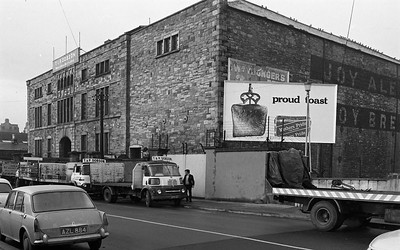
Joy Ale was quite heavily advertised in newspapers as has been mentioned but also elsewhere, as there is also a photograph of people queueing for a tram in 1948 with the words ‘Joy Ale’ written brightly across the front on the Irish Times website. The name was also written in large letters above the breweries name on the side of the brewery itself, as can be seen in this undated (c. 1970) image from Dublin City Libraries.

108_Mountjoy_Brewery

Right up as late as April of 1955 the Irish Press could carry the following piece about the beer:

Joy Ale has proved itself on the hard-fought battlefield of public taste, and has won a special niche in the heart of ale drinkers, not only in [Dublin] city but also a good competitor with cross-channel ales.

But sadly this heart-felt love was not enough to save the brewery and it closed in 1956, and so Ireland lost yet another of its former brewing giants. And one that had outlasted many of its rivals.

-o-

We might wonder what Joyce would have said about the loss of Joy Ale?

Although it probably matters little - as it is unlikely we would be able to understand him …

Liam K

(Here is the link to object #6)

Please note, all written content and the research involved in publishing it here is my own unless otherwise stated and cannot be reproduced elsewhere without permission, full credit to its sources, and a link back to this post.

Newspaper advertisement image © The British Library Board - All rights reserved. With thanks to The British Newspaper Archive (www.britishnewspaperarchive.co.uk) from whom I have received permission to display this image on this site. Label images are the authors own - as are the labels themselves. Embedded brewery image is via Dublin City Libraries Flickr page and copyrighted to them.

Friday, 13 January 2023

More Rare Old Dublin Beer Labels - Manders' Brewery

If you mention a brewery on James' Street in Dublin to most people they will automatically think of Guinness and probably just of them. But back in the late 19th century the street, and this general area of Dublin, was home to quite a few breweries. Indeed Alfred Barnard noted in his famous history-recording books on the breweries of these island back in 1889 that from the top of the nearby-ish Anchor brewery he 'could distinguish half-a dozen-breweries', and almost certainly one of those was the Manders' site, although it had been bought a couple of years previously by its near neighbour The Phoenix Brewery . (Phoenix relaunched Manders as an ale brewery in the middle of 1896.)
Robert Manders & Co. (known as Manders & Powell until 1851) operated from 112-116 James' Street - quite close to its more famous rival - and these stout labels were registered in 1876 and were in use for 'more than 15 years previous' according to to their source - The Brewers' Guardian from June 21st 1881. They show the breweries trademark of a dove and olive branch and also - seemingly - Robert Manders' signature. They pay more that a passing resemblance to Guinness's labels but in truth many labels looked quite similar at that time.

They are yet another nice find and again worth pulling back into our lost brewing history, Manders brewery itself deserves more of its own history to be recorded too but that's a subject for another post ...

Liam K

The referenced volume was sourced via Google Books. All written content and the research involved in publishing it here is my own unless otherwise stated and cannot be reproduced elsewhere without permission, full credit to its sources, and a link back to this post. In other words, don't be that guy ...

Wednesday, 11 January 2023

D'arcy's Extra Stout - A Found (Again) Irish Beer Label

I'm easily pleased.

Actually, that isn't true at all, but there are certain things that do bring a child-like grin of surprise to my face, such as finding the facsimile of a label for a long lost Irish beer. (Acquiring the actual label might even cause a small giggle of pleasure to escape.) I guess we all have our wants, needs and desires ...

So imagine me sitting at my computer researching D'arcy's brewery in Dublin for a new project and suddenly the above image pops up. Okay, so I have posted this image before, but that was a poor quality version from a newspaper source, which I cleaned and sharpened as best as I could. This is a wonderfully crisp and verifiable copy from an interesting source - The British, Foreign, and Colonial Tradesmarks' Directory from 1866 which also contains labels from English and Scottish breweries.

Anyhow, I felt it was worth creating a new post for this new version of the label - now I just need to find the actual recipe and brew it!

Liam K.

(Directory link is here.)

All written content and the research involved in publishing it here is my own unless otherwise stated and cannot be reproduced elsewhere without permission, full credit to its sources, and a link back to this post. In other words, don't be that guy ...


Wednesday, 16 November 2022

Irish Pub History: Mulled Porter on Tap...?

Mulled porter, ale or especially wine are not exactly an unknown concept to most people, as these types of drinks have indeed been around for centuries - I even wrote about them here and listed some recipes - and I would think that very few of you are unaware that the 'mulling' refers to the spicing and heating of an alcoholic beverage. (Incidentally there seems to be no agreement in any online dictionary sources as to where the term ‘Mull’ comes from in this context but surely it comes from a contraction of muddle meaning to mix? Or at least comes from the same original source.) But while looking up references on how beer was served in Irish public houses, I came across repeated references to 'Porter Mulling Machines' right through the second half of the 19th century which got me thinking what form these could have taken, how they would have been heated, and how they worked. The word ‘machine’ can be a bit a little confusing, but my belief is that during this period it did not mean what we think of in our heads these days, of something filled with gears, axles and cogs, it – like engine – was just a general 'something' that replaced a manual form of doing a job or helped someone with that task. A ‘beer engine’ used for serving cask ale is a good and appropriate example of the use of these type of words.

Those mentions I found in newspapers – often for the sale of contents of a public house – often listed the name ‘Merry’ as the supplier or maker. More research uncovered a ‘Lawrence & Richard Merry’ as manufacturers of beer engines, bottling equipment and other barware in this period. They were proficient in a variety of metals such as copper, pewter and brass, and were also gasfitter and plumbers. They had won a gold medal at the Irish National Exhibition in 1883 for the quality of their wares, and I believe they enterprise may have started off as pewter manufacturers. (There is also a Martin Merry mentioned in the 1840s supplying similar equipment and based on Aungier Street, not very far away from where Lawrence and Richard were based at 25 Bride Street.)

Sadly, I can find no mention of their specific ‘Porter Mulling Machine’ but I have found a few English patents and designs for beverage mulling machines which used gas as their heat source, and given the Merry’s expertise with metals and gas, I think it is not unreasonable to assume that the ‘machines’ they supplied were quite like these?

Here is one such design in an Advertisement by Smith & Phillips - Gas Engineers in 'A Shilling Cookery for the People' by Alexis Soyer which was published in 1854. This one appears to have four sections for different drinks and four taps.

There were other patents during that decade too such as this one from Henry Remington from 1856 (English Patent No. 1783) which was gas heated too and contained two chambers for holding the heated beverages as well as a reservoir of hot water that heated the beer and maybe wine or ale, each with separate taps. (I have seen mention of similar in the sale of contents of a spirit grocer in Wicklow in 1873, which mentions that the mulling equipment also had three taps and in 1877 there is an advertisement in The Belfast Telegraph for 'a first class porter muller, all pure copper, well tinned inside, three apartments[sic], for porter, ale and water,' which certainly sounds like the boiler shown here.)

I have no proof that the Merry’s machine was anything like these (so I could be completely wrong) but I think it is reasonable enough to assume it was at least similar in design – like a heated copper barrel with the gas heat source below although if it was just for porter then it may have had just one - or two - compartments. As I stated above, the Merrys were gas fitters too and some of those mentions of the sale of the contents of public houses even list gas fittings with the bar items for sale. I also found a newspaper reference of a fire having been caused by a faulty porter mulling machine in Glasgow in 1881, which would point to gas being the likely heat source for this type of bar equipment. Also, slightly earlier in 1877 a spirit grocer in Newry is selling a 'copper keg, with brass hoops, in two divisions, heated by gas, for mulling porter, and boiling water' according to the town's Reporter newspaper. This seems to confirm that the heat source is indeed gas, and also that these boilers were quite ornate in appearance like the images above.

There other mentions of mullers elsewhere too, The Belfast News-Letter in November of 1867 has a timely advertisement from Bloomfield's in John Street which invites publicans to look at their prize-winning and improved mullers so that said publicans can give their customers 'a pot of mulled porter this winter.' A London maker - Byron - is also mentioned in an advertisement in 1880 in The Belfast Telegraph, and Dublin's Freeman's Journal lists two for sale in 1882, one made by Merrys complete with stand and another three compartment version from a maker called Curtis. James Campbell & Co. of Mary Street and Jervis Street in Dublin had a new design of porter muller back in 1859 according to The Advocate too, so we can see that there were a number of suppliers and makers of porter mullers.

As well as the fire in Scotland mentioned above there was a fire in Dublin in 1884 according to the city's Daily Express, as in April it was reported that

'About twelve o'clock noon yesterday a fire broke out at the publichouse Nos 1 and 2 Wood Quay, the property of Mr O'Kelly. The Fire Brigade were quickly on the scene and within half an hour the fire was extinguised. It is beleived to have originated through a leakage of the gas pipe used for heating the porter muller, the shop flooring thus becoming ignited. The damage done to the property was slight.'

(It is probably worth mentioning that this property is the long gone and much lamented The Irish House ...)

Mulled porter appears to have been relatively popular in public houses Ireland at this time – perhaps less so elsewhere - and there were even specific lemon and spice extracts and liquid spiced syrups available to the publican to quickly and easily spice their porters. It would be great if some of the dispensers still existed in public houses somewhere in the country – if you spot one please send me a photo, as it would be great to see that at least one has survived – ideally with an ‘L & R Merry’ stamp.

It would also be nice to be able to walk into a pub in Ireland now and get a glass of spiced porter in a nice pewter mug on a cold winter’s evening, served from a shiny brass and copper barrel on the bar – perhaps we need to campaign for the reinstatement of porter mulling machines?

Liam K.

All written content and the research involved in publishing it here is my own unless otherwise stated and cannot be reproduced elsewhere without permission, full credit to its sources, and a link back to this post. Images are via Google Books and newspaper research via The British Newspaper Archive.