Showing posts with label Sullivan's. Show all posts

Tuesday, 25 April 2023

100 Years of Irish Brewing in 50 Objects: #6 - A Drayman's Delivery Docket from Sullivan's Brewery (1892)

I could speak of the beer drinking capabilities of some of the Walshe mountain girls - but why should we cavil at the amount of refreshment which is taken after a walk of twelve miles from the hills, another return walk of similar length in perspective, and in addition holding on in the dance "to tire each other down" for some three or four hours? Could we say half a gallon of that washy stuff known in Ireland as "pale butt," was too much for a girl? You may think so, reader, but I do not. The question is, after all, one of stowage.

A Strangers Impressions of County Kilkenny – The Kilkenny Moderator - Saturday 19th July 1851

Those comments were made by a tourist who was staying in Bishop’s Hotel in Thomastown, Kilkenny and were in regard to a fair day in the town, and the people who came in from the countryside for dancing and socialising. Regardless of the comments on the ability of ‘the Walshe mountain girls’ to consume ‘refreshment,’ his description of a drink called ‘Pale Butt’ and it being ‘washy stuff’ is of interest to those curious about Irish brewing history. We must keep in mind that elsewhere in his report to the newspaper he twice mentions drinking Cherry’s Double Stout, so his opinion of other beers might be in relative terms but ‘washy’ can hardly be regarded as a praisesome term for any drink.

-o-

Our related brewing object is a delivery docket for a half barrel of Pale Butt from 1892, brewed by Sullivan’s Brewery which operated from James’s Street in Kilkenny on the site of an earlier brewery being operated by a Mr. Archdeakin in at least 1702. As ever with Irish brewing history the facts are a little muddy but the brewery on James's Street appears to have passed through different hands - for example a John Hennessy was a brewer on this street in 1788 - before the site became vacant in 1790. It was purchased and reopened by William Sullivan and William Loughnane in 1810. Mr. Loughnane appears to have left the business as it was operating as 'Messrs. Sullivans Brewery' in a newspaper article in March 1815 when a fire broke out in the malt house there. (Indeed, a portion of the brewery was destroyed by another fire in October 1880 while the funeral was taking place of the then owner James Sullivan's brother Francis - grandsons of William and sons of Richard Sullivan M.P.) The company - which employed 150 people at one point - actually consisted of two breweries and a bottling store for mineral water and soft drinks when a new brewery was completed not far from the original site in June 1877. This new site was possibly a repurposing of an existing brewery as there was a Hibernian Anchor Brewery on the street in 1859, and that fire in 1880 destroyed part of the old brewery, not this new premises. It appears to have stayed in the Sullivan family until it finally closed in 1919, the brewery being taken over by Smithwick’s and closed with the employees receiving 'a fortnight's notice that their services will be dispensed with.' according to one newspaper. Parts of the premises were subsequently used as a maltings by the Smithwick brewery and the site is now a carpark for Market Cross Shopping Centre. Advertisements from 1895 show that Sullivan’s were brewing a pale butt, a double stout, sparkling ales and hop bitters as well as manufacturing and bottling Mineral waters at this time.*

The half barrel of pale butt was delivered to a Laurence Long who had at this time a public house and grocery store on the corner of Barrack Street and the Castlecomer road, which is now known as Lenehan’s Public House. According to newspapers of the time he appears to have sold the business to Rose Lenehan in 1913 and took over a premises instead on John Street (now called The World’s End Bar) which he ran very briefly until his untimely death that same year.

The drayman who delivered the cask on his route was a J.(?) Dowling and the cask number was 2574. This number ensured that the casks could be tracked and returned to the brewery. It was also helpful if a full barrel of beer was stolen, and a newspaper report in The Kilkenny Moderator on the 26th of October 1892 records that a barrel of pale butt was stolen from a Mr. Grace on Parliament Street in Kilkenny and was tracked to a house on Horse Barrack Lane (which curves from Parliament Street along the front of the Smithwick’s brewhouse that is now the new Abbey Quarter Development Building) where the number confirmed it to be the missing cask. The two thieves who had attempted to sell the barrel to some public houses without success were sentenced to a fortnight hard labour in Mountjoy prison in Dublin.

-o-

The words ‘pale butt’ relating to a type of beer seems to be one of those relic terms which lost favour over time. It is certainly mentioned by William Ellis in the 1737 edition of The London and Country Brewer as ‘pale Butt-beer’ from Somerset, and over here in The Parliamentary Register: Or, History of the Proceedings and Debates of the House of Commons of Ireland in 1793 in an enquiry into brewing and distilling here ‘pale butt’ is mentioned twice as a common commodity before that date.

As we move forward in time ‘pale butt’ appears to be a term that remained much more common in Ireland than in England, Scotland, or Wales if the unscientific method of looking at mentions in the newspapers of the mid-19th to the very early parts of the 20th century is to be used as a measurement. (It was certainly still used elsewhere but it wasn’t quite as common and isn’t the focus of the topic here.) Breweries such as Lett’s. Watson’s, Cherry’s, Keily’s, Smithwick’s, Sullivan’s, Castlebellingham, Dower’s and others were all using the words to describe a beer style at one point or another. And although the term seems to have begun in England, its relative decline outside of Ireland is yet another reminder that although we share a lot with the island to our East, we are remarkably different in many ways, not least how language changed and evolved here or - in cases like this perhaps - stalled. With regard to brewing, this may be because of the large number of English brewers who came over to Ireland to set up and work in the breweries here, and the terminology they brought and left behind in the late 18th and early 19th century stayed here long after newer words and meanings had replaced them across the water, just as some ‘normal’ daily words in common use have remained here too.

From a practical point of view a beer butt is a wooden barrel that is twice the volume of a hogshead at 108 Imperial gallons and in the above-mentioned publication that Mr. Ellis asserts that it was the best size for fermenting and condition beers due to aspects of its physical size and volume and that ‘butt-beer is at this time in greater reputation than ever in London ...’ As we can see from the docket (and the mentions below) the beer certainly wasn't always supplied in a butt-sized barrel.

-o-

To find out where pale butt fitted into an Irish brewery's range of beers we need to return yet again to the advertisements in newspapers of the time in question, which is a somewhat inaccurate method of research in many ways but it is unfortunately one of the few resources we have, given the dearth of old brewing records available to the public. Taken singly they might be unhelpful but by looking at the many mentions and references we have we can begin to build a better picture of what type of beer this was and where it fits into our brewing history.

There are early mentions of Irish brewers brewing the style, for example a David Sherlock on Glover's Alley, a table beer brewer, had 'commenced the brewing of Porter, Ale, Pale Butt and 30s[hilling] Beer' according to The Dublin Evening Post from the 5th of January 1797 and in Saunder's News-Letter on the 9th of November 1799 Thomas Fullam advertised himself as a 'Pale Butt, Ale and Table Beer Brewer' on Constitution Hill in Dublin. (Pale Butt was his dearest beer of the three, which is worth keeping in mind for later.)  In The Hibernian Journal on the 21st of September 1805 William Robinson of 110 The Coombe in Dublin was advertising his ‘Pale Butt, Porter, & Small Beer Brewery’ while in Saunders's News-Letter on the 4th of July 1808 Andrew Maziere of James’s Street also in Dublin was advertising ‘Porter, Pale Butt, and Table Beer.’ An advertisement in Saunders's News-Letter on the 5th of April 1813 for beers from the Castlebellingham brewery mentions ‘strong ale and pale butt’ (in later advertisements table beer is also listed) and in The Tipperary Free Press on the 3rd of January 1829 Greer & Murphy of The Clonmel Brewery were listing double strong ale, pale butt, ale, porter and table beer all as separate products. Where prices are mentioned, pale butt is generally on the cheaper side of things with the odd exception, such as the early mention by Thomas Fullam above.

By 1835 Thomas Cherry of King Street Brewery in Waterford and Creywell brewery in New Ross was advertising what looks like a hierarchy of brewings as ‘XX and X ale, and Pale Butt’ (with ‘Beer’ tagged on to the end of the line up in later advertisements) in The Wexford Conservative of the 23rd of December 1835, and a list of beers for sale in The Drogheda Conservative Journal on the 31st of March 1838 lists pale butt, plain ale, X ale and XX ale in ascending order of price, with all but the pale butt listed as from Cairnes’ brewery in Drogheda, although they were brewing such a product in the previous decade so it may have been theirs too.

Up in Belfast Charles Murison was brewing nine beers in 1842 – XXX, XX and X ales, XX and X Brown Stout, Superior Porter and Pale Butt, Family Pale Beer, and Common Beer, which were listed in that order according to an advertisement in The Belfast Mercantile Register & Weekly Advertiser on the 22nd of February 1842. Most revealing is the following passage:

To those who prefer a stronger article for table use than beer, the Pale Butt will be found a very pleasant beverage, as a medium between Ale and Beer.

This is quite telling as it seems to confirm what we see in other advertisements, that pale butt appears to be a lighter and cheaper type of beer, or had certainly morphed into that by the early-to-mid-19th century. It is worth noting that I have used the word beer in the modern all-encompassing sense often here, but from what I have seen from this and other advertisements in the past we used the term ‘beer’ here in Ireland for the weakest and lightest form of brewed beverage – and this is probably a hangover from the popularity of table beer as a general beverage in the late 18th and early 19th century. It would appear that the name clung on here for a weaker brew, so at this time – and later – ‘ale’ didn’t mean an unhopped product and ‘beer’ a hopped one as it may have done elsewhere (or earlier) the terms were used to signify strength with our pale butt in the middle at this time.

So, just to reiterate, at this time it appears that of the paler brewings in Ireland we had in ascending order of strength and cost - ‘beer,’ then ‘butt,’ then ‘ale.’ (We also had ‘brown beers’ brewed by St. Stephen’s Brewery in Waterford and others, which were probably a lighter version of their ‘basic’ porter.)

If we want more reinforcement of this theory we can look at Sullivan’s rival in Kilkenny, the St. Francis Abbey Brewery of Edmond Smithwick who in 1852, just a couple of decades after commencing to brew on an old distillery site, was producing ‘Double, and Single, Stout Porters; Extra Strong, and Strong Ales, Pale Butt, and Table Beer’ in and advertisement in The Kilkenny Moderator on the 21st of January of that year. Helpfully too, St. Stephen’s Brewery listed their prices in The Waterford Chronicle in December 1874 which starts with a XXXX sweet ale at 21 shillings and drops through India Pale Ale, XXX Mild and Family Ale to Pale Butt at 8 shillings for a firkin of 9 Gallons.

As late as 1900 the brewers of Louth were publishing a list of price increases for their beers in The Freeman’s Journal that once again lists a range based on prices starting with the most expensive with strong mild ales then East India and Amber Ales, followed by Pale Butt and then Dinner and an enigmatic East India Beer and lastly plain ‘Beer,’ and if price equates to the quantities of ingredients used then we can take pricing as being a relatively safe way of judging the strength of the beer.  There are a few exceptions where a Pale Butt mention is prefaced with ‘Strong’ but generally speaking 'Pale Butt' appears to be a weaker brew than ale … ‘washy’ as described by the writer quoted above.

As to its exact taste, St. Stephen’s Brewery were involved in a dispute with a publican regarding the quality of their beer as recorded in The Clonmel Chronicle on the 8th of April 1874, where ‘two kilderkins [of East India pale ale] turned out inferior, and he had to sell all as pale butt.’ This gives an inkling of how it tasted as it was clearly not as strong in relative terms as their IPA. An article in The Freeman’s Journal from the 15th of March 1913 quotes an English writer from 1798 who wrote about ‘a sweetish malt liquor, called ‘pale butt,’ unlike anything I have ever drunk elsewhere,’ which again helps a little with how it tasted and reinforces that the name was not very common in England even at that time. Yet another mention in a court case recorded in The Kilkenny Moderator on the 27th of December 1865 states that ‘it would take a long time to get drunk on ‘pale butt,’' and another in The New Ross Standard on the 20th of September 1907 which mentions that Cherry’s pale butt was ‘not very strong.’

So, pale butt could possibly be best described as a low-hopped, slightly malt-forward beer, pale in colour, low in alcohol and cheap to buy – but still a little stronger and not as cheap as the ‘beer’ available at this time. All of which is of course pure conjecture, but it seems to be the correct assumption.

That term for a style of beer brewed in Ireland seems to have disappeared from the island in the first decade of the 20th century, but did the actual product itself disappear too? Perhaps, but it may have lingered briefly, renamed as a mild or X ale in some breweries, but with the huge popularity of porter and stout here it may have just disappeared, being unwanted and unneeded, and ultimately unfamiliar to a 20th century drinker. It might be argued that it returned in spirit at least in the new beers that appeared in the middle of that century like Phoenix and Smithwick’s Draught – low-ish alcohol beers that were made for drinking in relatively large quantities on social occasions.

-o-

On that note let us return to Sullivan’s Pale Butt and specifically to an account of a Harvest Home feast (a relatively common occurrence in the Big Houses in the past) from The Farmer’s Gazette on the 18th of October 1850 which seems quite fitting to end with …

HARVEST HOME AT FARMLEY CASTLE, KILKENNY

The annual substantial feast came off at this ancient and time-honoured establishment, on Saturday last, when all the workpeople, with their wives and families, were most sumptuously entertained. The rooms were most tastefully decorated with flowering shrubs and evergreens - “Nature's own darling hue;” and when the apartments were brilliantly lighted up, all had a most imposing and thrilling effect - thanks to the superior taste of Brette, the carpenter.
The dinner being over, the musicians poured forth their most soft and enchanting strains, which made the old and feeble forget their infirmities, and the youthful their previous toil, and all joined in the merry dance, which was kept up in the true Irish fashion, until very late hour.
“How gaily, even amidst gloom surrounding,
They still canst wake at pleasure's thrill,
Like Memnon’s broken image sounding,
Amidst desolation, tuneful still.'' 

Even the noble-hearted proprietor and his lady did not disdain to take the hands of their simple-hearted and grateful rustics, and share with them the pleasure of dancing the merry “foxhunter’s jig.” To the eye of the philanthropist, surveying at this moment the happy faces of the entire company, he could not but bless the source whose bounty contributed so largely to make so many of the children of toil and labour delighted and comfortable. Sullivan's pale butt, and Jamieson’s stingo, were done ample justice to, with abundance of tea and coffee for the teetotallers. Great merit is due to Mr. Mclntyre, the intelligent and respectable steward of the establishment, for the orderly manner in which everything was arranged.

As florid and loquacious as this report is it certainly paints a picture of enjoying a nice beer or two to celebrate an occasion, where all are welcome and there is something for everyone – even those wanting a ‘washy’ pale butt ...

Liam K

P.S. I have at times used the word beer in its modern general sense here as well as highlighting where in the past that same word meant the lightest of brewed beverages, and I hope the context of their use differentiates one from the other.

* Adapted from a piece on Kilkenny breweries I wrote about here, which lists any references.

(Here is the link to object #7)

Please note, all written content and the research involved in publishing it here is my own unless otherwise stated and cannot be reproduced elsewhere without permission, full credit to its sources, and a link back to this post. The docket and the attached image are the authors own and cannot be used elsewhere without the author's permission. Newspaper research and images are thanks to The British Newspaper Archive.

Wednesday, 11 May 2022

Giving it Both Barrels: 19th Century Sketches of Smithwick's & Sullivan's Kilkenny XX Porter

The history of brewing in Kilkenny is a topic I keep returning to again and again as there is such a wealth of real history to be mined in old newspapers and publications online, as well as in physical books. Although sadly, I am not aware of any publicly accessible archives for any of the breweries in the city, which is also very much the case for most of Ireland's lost breweries with a couple of notable exceptions such as Perry's in Rathdowney and Murphy's in Cork. My own hometown of Carlow also has some brewing history of course, but its beers and breweries are not as famous and never reached the successes of the two main breweries in the neighbouring city down the road, and although I am still sporadically researching the brewing history of this town - and I have amassed a sizable file about it - it is more often the case that I come across something relating to Kilkenny as far as any local-ish brewing history is concerned.

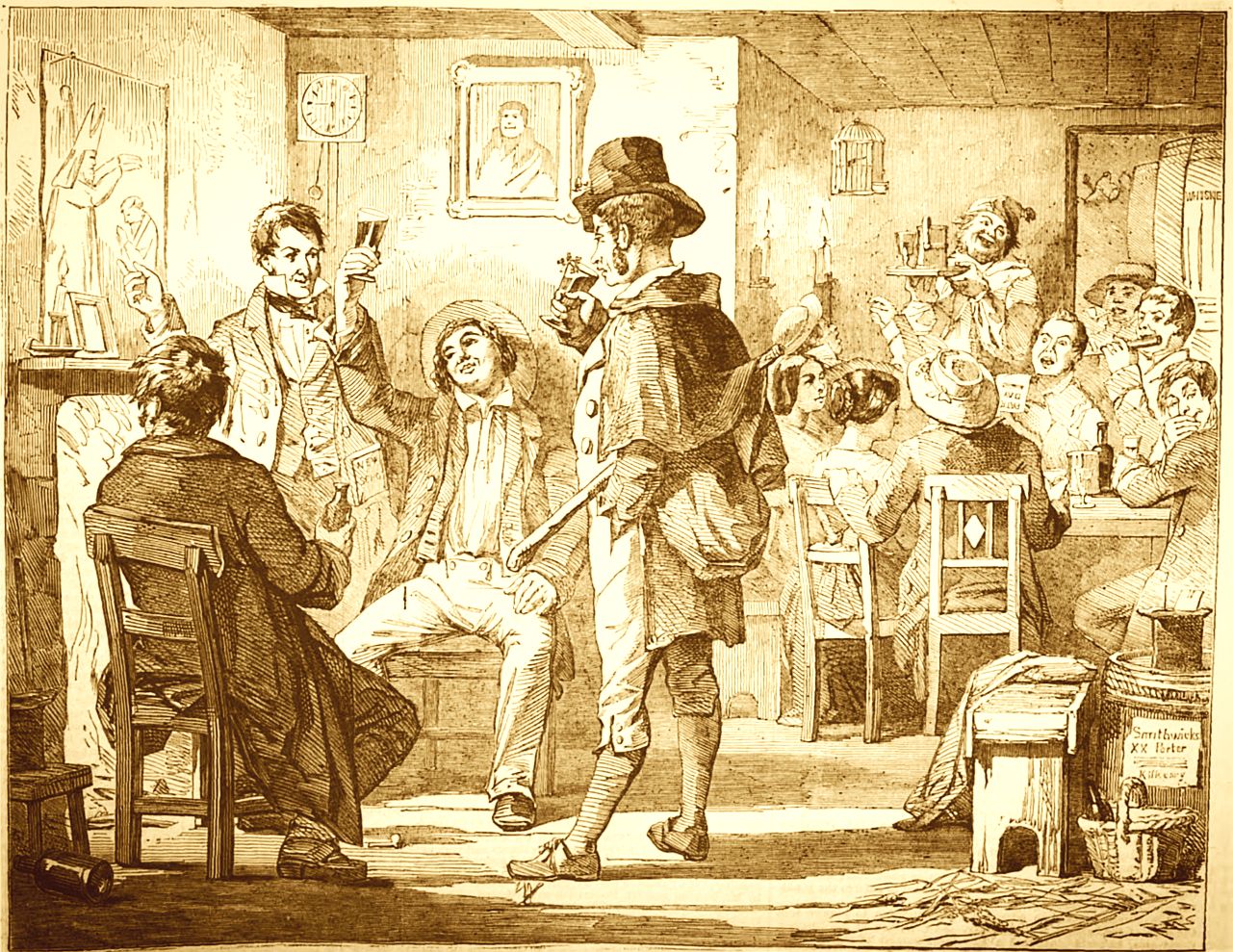
That was the case with two 19th century Irish scenes by Edmund Fitzpatrick that appeared four years apart in The Illustrated London News, and both of which I chanced upon at different times. In both cases my eyes were drawn to the casks in the corner of the illustrations and the names printed on them, names I was quite familiar with from my interest in Kilkenny's brewing history - although you would have needed to be living a very hermitic life to have never heard of Smithwick's St. Francis Abbey Brewery in this country, or further afield. Sullivan's Brewery, which was on James's Street, has been rebooted or reborn in recent years too, although its new brewery tap is on the opposites side of the river.

Edmund Fitzpatrick was and illustrator and painter who was either originally from Freshford in Kilkenny or certainly lived there for a period. According to one source he was born there 1822 and died in London in 1896 and he was certainly residing there in 1858 as he advertised in The Kilkenny Moderator in November that year that he had 'lately arrived from Paris and London' for a short stay and that he was available for commissions. (The Library of Ireland has a short but interesting biography about his life on their website here.) He has some paintings hanging in Kilkenny castle, so his finer artwork was also held in high regard it appears, which is hardly surprising given the quality and dynamism of his newspaper sketches.

He was quite prolific with his work and created many illustrations for newspapers, some of which were Kilkenny focussed so it has hardly a surprise that he was familiar with the two biggest breweries in the city, and that he decided to include them in his works. The first illustration appeared in The Illustrated London News of March 15th 1853 to accompany a piece about how St. Patrick's Day was celebrated in Ireland. It is a joyful picture of someone's home and full of interesting-looking characters and imagined stories. It also perhaps gives an insight to the dress of the day and what people drank, and what they consumed those drinks from - whiskey and porter at the very least, from stemmed glass and pewter tankards. How real or imagined it is I do not know but I quite like the picture when I first came across it and especially when I noticed the 'Smithwicks XX Porter Kilkenny' on the barrel. The accompanying text and other illustrations certainly have issues that I will not raise here, but it is just nice to see a name check for a famous local brewery.

Drowning the Shamrock on St. Patrick's Night - Drawn by E. Fitzpatrick

The second image is also from The Illustrated London News, this edition from January 24th 1857 and it shows a few travelling school masters debating various subjects. Again, it is full of wonderful characters and more importantly for us we can see a cask of 'Sullivans XX Porter Kilkenny' sitting once again in the right hand corner. And again, the accompanying text is full of 'Oirish' words but I quite like the actions and expressions here too, even if the drawing seems a little cruder and perhaps a little more hurried.

The Irish Schoolmaster - Drawn by E. Fitzpatrick
Regardless, it is good to see Mr. Fitzgerald being fair and giving equal advertising space to both of the big Kilkenny breweries! It might raise the question as to whether he was berated by the Sullivan's into including them in an illustration having used Smithwick's porter in the other one?

Of course, we cannot get too excited about these, after all it is not like the are factual records or photographs, but maybe that is not the point.

Perhaps we should just appreciate the illustrations and the recorded anecdotal history for what it is, just another way of getting the information about our lost brewing history out and findable, and in to the public eyeline - highlighting actual beers that really did exist in Kilkenny in the middle of the 19th century.

And they do say a picture is worth a thousand words ... so perhaps I need not have waffled on so much?

Liam K.

The original images and accompanying articles can be found here and here via Google Books. These images were originally posted by me on my Twitter account on the 18th of August 2019 and on the 15th of November 2021.

All written content and the research involved in publishing it here is my own unless otherwise stated and cannot be reproduced elsewhere without permission, full credit to its source, and a link back to this post.

Thursday, 8 August 2019

Brewing History: Some Notes on Pre-Twentieth Century Kilkenny Breweries

From 'The Official Illustrated Guide to the Great Southern & Western Railway' - 1866
[Revised & Expanded - May 2025]
The early brewing history of Ireland is a murky place to visit, especially when it comes to trying to pinpoint the exact position of the breweries and the names of the brewers that operated in any give town. Even finding a mention of their very existence is a tricky job until we get to the era of commercial directories, better record keeping, accurate maps, and - most importantly - the archived content of newspapers. Even after that point the real history and development of breweries can be difficult to track, especially beyond The Pale where much of our brewing history and the actual records of the breweries have become lost or locked out of sight in the many brewery closures and takeovers that occurred over the centuries.

Kilkenny's brewing history suffers from similar issues in one way but is somewhat different in another, as much of that history is difficult to clearly see due to being muddied by decades of marketing spiel which has been repeated and reprinted over the years - ironically - by those business which survived.

But there are a couple of helpful - although not primary - sources that can be used in trying to track down the historic commercial breweries of Kilkenny. The first is ‘The Brewing Industry in Kilkenny’ by T. B. Halpin which was published in the ‘Old Kilkenny Review’ in 1989. The second is the ‘Irish Historic Towns Atlas, no. 10, Kilkenny’ by John Bradley, who references Halpin's article quite often in his own work. Along with these two excellent sources we have other information from both online resources and archived papers which give some interesting insights into brewing in the city in the 18th and 19th century. These are backed up by various commercial directories of the time, where many similar names crop up over the years, often in different locations which adds to the headache of unravelling who brewed where in the city. We also need to be careful with some references, as malt houses can confused with actual breweries by some historians - both then and now. These are often separate entities although both can coexist on the same site of course. When quoting names, it is also worth mentioning that the lessor, lessee and the actual brewer in these establishments were quite often different people, which adds yet another layer of complexity to any research into names associated with any potential brewery sites.
-o-

A snapshot of the ebb and flow of breweries is given by Bradley as:

In 1787 there were ten breweries in the city, by 1824 the number had declined to five, and in 1837 it had fallen to four. There was evidently a flurry of activity in the years immediately following because by 1839 the number had increased to eight, but the expansion was short-lived. In 1841 there were five breweries and by 1856 there were only two — St Francis' Abbey (Smithwicks) and James's Street (Sullivans).1

The earliest reference for a brewery location is on Pudding Lane in 1660, and the earliest mention of a named brewer is for a Miles Lyons in an unknown location in 1691 but the earliest mention by name and location is James’s Street Brewery established by a person named Archdeakin in 17021, and Bradley suggests there was brewing on this site before this date. (Some years later a Mathias Archdekin[sic] occupied a brewery and Distillery near Blackmill up until 18214 which I have not seen mentioned elsewhere.) The brewery on James's Street appears to have passed through different hands - A John Hennessy was a brewer on this street at least in 17883 - before becoming vacant in 1790. It was purchased and reopened by William Sullivan and William Loughnane in 18104. 'Messrs. Sullivans Brewery' is mentioned in a newspaper article in March 181513 when a fire broke out in the malt house there. (Indeed a portion of the brewery was destroyed by fire in October 188014 while the funeral was taking place of the then owner James Sullivan's brother Francis - grandsons of William and sons of Richard Sullivan M.P.) The company - which employed 150 people - actually consisted of two breweries and a bottling store for mineral water and soft drinks when a new brewery was completed not far from the original site in June 187715, the fire three years later destroyed part of the old brewery, not this new premises. It appears to have stayed in the Sullivan family - albeit after becoming a limited company in 1903 - until it finally closed 1919, after being taken over by the rival Smithwick’s brewery and closed with the employees receiving 'a fortnight's notice that their services will be dispensed with.' according to one newspaper17, with parts of the premises being subsequently used as a maltings by Smithwicks4. Unfortunately, most of the site is now a carpark for Market Cross Shopping Centre, although I found a c.1946 photo of the ivy-covered entrance to the brewery in Halpin’s article and online here with another view here. This entrance appears to have been built in 1896 when James's Street itself was widened and this gateway built16.

An interesting aside to the actual brewing process, which helps to point to all the auxiliary jobs associated with breweries that are rarely considered, is that in 18976 only Sullivan’s were using solely local cut corks to bottle their beers, Smithwick’s used a mix imported and locally made ones.

Advertisements like this one from 18957 show that Sullivan’s were brewing a pale butt, a double stout, sparkling ales and hop bitters as well as manufacturing and bottling Mineral waters at this time, and note the plural 'breweries'. We can be relatively sure that they were brewing more than just these styles over the years too.


Here is another from The Kilkenny City and County Directory and Guide from 1884:

---

Curiously there is also a mention of a Hibernian Anchor Brewery18 on James’s Street in 1859 which Bradley suggests may be the same site as Sullivan’s Brewery, and I now believe it was where Sullivan's built their new brewery. The Anchor brewery was owned by a T. Dunphy and Son and were brewing 'superior porter and ales' 19 at this time. There is a George Reade brewing in James' Place in 1839 so perhaps there is some confusion over sites, or the names of the actual brewers working in the breweries owned by others, which - as mentioned - is often the case in brewing history.

-o-
The biggest mover and shaker in Kilkenny brewing was started by Edmund Smithwick who opened St. Francis Abbey Brewery around 1827 after leasing the site of Bren(n)an’s distillery in that year. (Just to note that Brennan is a surname that crops up repeatedly in the names of brewers/distillers in the various commercial directories – although admittedly it if a very common local name.) The site is listed as a distillery at St. Francis’s Abbey run by Patrick Brenan[sic] in Pigot’s Directory of 1824, and the following year he was producing 26,000 gallons of spirit according to custom and excise reports for the period. An advertisement for its letting at this time clearly say it is a distillery that could be converted into a brewery8. Edmund is listed as a grocery and a wine merchants in Pigot’s also in 1824 and was in partnership with and Owen C. O’Callaghan - this partnership was dissolved in July 1827 along with a similar partnership for a corn, flour and boulting business9, so his commercial interests were extensive - as were his fathers - but there appears to be no mention of brewing until after the leasing of the distillery site.


As mentioned, the site was only leased by Edmund in 1827, here is a note of the sale of that lease by Dudley Brennan son of the Michael Brennan above in 1867 via a solicitor's journal. The name William Archebald seems to be the earliest one connected to this lease.


So if there was any commercial ale brewing on the site before this time there is no reliable record of it (which means just that of course), although Halpin – who worked in Smithwick’s - suggests there may have been brewing for personal consumption on or near this site by an ancestor of Edmund - John Smithwick - when he was in partnership with a Richard Cole. [In fact, Cole's site was nowhere near the St. Francis Abbey, it was near the Black Abbey and whose rough location can be seen in a more detailed post referenced below.] A messy article celebrating the brewery’s 275th anniversary10 mentions first brewing dates of both 1706 and 1710 as well as mentioning a free farm grant for a brewery and distillery close to the brewery site given to the above-mentioned Cole. Curiously and article in the same paper 25 years before states that the firm (not brewery) of Smithwick’s was established in 1710 at the same time that Cole established a brewery, although as mentioned this seems to have been a brewery for household consumption if it existed. Any reliable articles I have come across state there is little evidence of beer brewing on the site prior to 1827 and some even point out that the site's connection with the Smithwick’s family was broken with the death of John anyway.11 There is a story that the Smithwick’s could not officially declare their interest in the brewery prior to Catholic Emancipation due to Catholics not being allowed to own businesses, but it does not explain why Edmund, who owned a business in 1824 with O'Callaghan as we can see above, could not have put his name in directories or elsewhere at this time as a brewery owner with a different partner if such was the case? A better claim may be that the Smithwick family were in business in Kilkenny from 1710 but - perhaps - not always in brewing ... maybe others can add more factual information to this. [Please see the link at the end of this section of the article regarding the Smithwick's brewery.]

George Measom in ‘The Official Illustrated Guide to the Great Southern & Western Railway’ mentions a visit to Edmond Smithwick’s brewery in 1866 where he sings the praises of the beer and the brewery while giving a nice description of the premises and supplying an excellent illustration of the site, which I have used at the start of this post. Interestingly he gives the date the brewery was established as 1828, presumably with the brewery's blessing at that time...

Anyhow, in 1897 Smithwick’s were brewing stouts and mild and bitter ales as well as an East India pale ale and a dinner ale12, and like Sullivan’s they also bottled mineral waters.


Here is another advertisement from The Kilkenny City and County Directory and Guide from 1884 where they are showing off their depots both in Ireland and overseas:


It is probably worth noting too that the Smithwick family do not seem to have owned the abbey itself until quite late on in their story, as according to George Henry Bassett in The Kilkenny City and County Directory and Guide:
The outlook from it is into the yard of Messrs E Smithwick and Sons St Francis Abbey Brewery. In this yard many tablets originally belonging to the Abbey are set into the walls. The Abbey itself with a very choice fruit garden and cottage was sold a few years ago for 600 to the late Mr William Morrissey hardware merchant Mrs Mary Morrissey his widow is now in possession. She has had the floor of the chancel laid with a carpet of living green and takes great comfort in her proprietorship.

So it appears that in 1884 it was not owned by the brewery itself, nor was it part of it by my reading of the above, and indeed in a meeting of the Royal Society of Antiquaries of Ireland in 1868 there was concern for the condition of the tower and the following was said:

The ruins of the Abbey including the tower were possessed by a person who had not the means of doing anything to preserve them. Although they adjoined the Brewery of the Messrs Smithwick, unfortunately they did not belong to those gentlemen - if they did, no subscription would have been thought of, for the work would have been done at once without assistance from any other source. The Messrs Smithwick had most liberally headed the subscription list with a donation of £10, and would afford any facility and assistance in their power.
So, generous indeed but not the owner of the abbey...

(The Smithwick's brewery was closed by its then owners Guinness in 2013 with production moved to Dublin.)

[It is worth reading this post for further and expanded information on Smithwick's brewery and the claims regarding its founding date and the age of the current beers brands.]

-o-

There were plenty of other breweries in the city of course, such as St Mary's Brewery, Coal Market (now Parliament Street) ran by Robert Terry & Sons which he bought around 1862 and was up for sale again just two years later in 1864. What is interesting about this is that it lists all of the equipment in the brewery at the time of sale, such as an eight-horsepower steam engine, an O’Reilly’s large refrigerator, a sky cooler and fermenting squares, not to mention 600 casks.


The brewery was being sold by a Thomas Murphy in 1861 under the same name, having been recently renovated20. As a curious aside James Stephens, a noted republican and founding member of the IRB, was thought to be hiding in the remains of the brewery in 1866 while on the run from the authorities21. The brewery dated back to at least 1828, having been ran by a John Meighan until it was put up for sale in 183921

There was also a substantial brewery at Newgate being sold as a going concern in 1837, which 'with an additional fermenting Tun' would be capable of producing 10,000 barrels a year22. An Edward Smith and James Innes are brewing 'Ales and Beer' there later in the year. It is called the New-Street Brewery at that time but is most likely the same location26. The partnership was dissolved early the following year, with Smith carrying on the business on his own thereafter27.

John Street also had a brewery at one time, where a Denis Cormack24 - a surname that appears relatively often in connection with brewing or distilling - was in trouble for letting what was once a brewery, but had been converted into a distillery by this point, end up in a state of severe disrepair. It was described as a 'brewhouse, malthouse, mill and mill-race' when it was leased to a Henry McCreery and John Kinchela in 1786 by an Anthony Blunt's widow before eventually coming into the hands of Cormack via his father of the same name. A brewery in the possession of a Alexander Gray along with a malthouse was being let in 1823 near this location but may not have been the same premises25.

There was an 'Old Brewery' in Irishtown being let in 1812 that had been in the possession of one William Brandish up until late that year, when he passed away28.

Incidentally, according to Halpin4 there is a Kilkenny connection with two famous Dublin brewery names as John Brennan, a brewer in partnership with a Cormick5 in Pennyfeather Lane, who moved to Dublin when their brewery closed in 1841 and became manager in O’Connell’s Brewery. His son Charles later bought the business and it became the Phoenix Brewery.

Many of these premises can be seen on the older OSI maps for those who need to pinpoint them exactly, and this is my no means a complete or exhaustive list, but it gives a good indication of the level of brewing in the city in the past.

Liam K.

(I should point out that I am not a Kilkenny local and have relied purely on sources referenced above and cited below for this post, nor am I a historian so I would welcome clarification of any the issues, dates or comments made here. Please feel free to read any of the articles, newspaper clippings and other sources I reference and get back to me on any points.)


(Expanded 7/1/2020 & again on 27/10/22 & yet again on 14/5/2025)

All written content and the research involved in publishing it here is my own unless otherwise stated and cannot be reproduced elsewhere without full credit to its source and a link back to this post. Research was via my local library, The British Newspaper Archive, Google Books and other sources mentioned. PLEASE DON'T STEAL THIS CONTENT!

References:

1 John Bradley, Irish Historic Towns Atlas, no. 10, Kilkenny. Royal Irish Academy, Dublin, 2000 (www.ihta.ie), text, page 8.

2 Finn’s Leinster Journal – 17/11/1821

3 Lucas’ Commercial Directory

4 ‘The Brewing Industry in Kilkenny’, T. B. Halpin, Old Kilkenny Review 1989, pages 583-591

5 Shearman’s Commercial Directory

6 Kilkenny People – 2/10/1897

7 Kilkenny People – 9/11/1895

8 Finn’s Leinster Journal – 20/1/1827

9 Finn’s Leinster Journal – 7/7/1827

10 Kilkenny People – 27/9/1985


12 The Tuam Herald - 10/7/1897

13 Saunders's News-Letter - Thursday 9th of March 1815

14 Kilkenny Moderator - Wednesday 27th of October 1880

15 Freeman's Journal - Thursday 7th of June 1877

16 Kilkenny Moderator - Saturday 3rd of October 1896

17 Carlow Sentinel - Saturday 25th of October 1919

18 Kilkenny Journal, and Leinster Commercial and Literary Advertiser - Saturday 9th of April 1859

19 Kilkenny Journal, and Leinster Commercial and Literary Advertiser - Saturday 16th of April 1859

20 Kilkenny Journal, and Leinster Commercial and Literary Advertiser - Wednesday 6th of February 1861

21 Kilkenny Journal, and Leinster Commercial and Literary Advertiser - Wednesday 10th of January 1866

22 Kilkenny Journal, and Leinster Commercial and Literary Advertiser - Saturday 8th of June 1839

23 Kilkenny Journal, and Leinster Commercial and Literary Advertiser - Saturday 11th of March 1837

24 Kilkenny Journal, and Leinster Commercial and Literary Advertiser - Saturday 1st of August 1846

25 Dublin Evening Post - Saturday 30th of August 1823

26 Kilkenny Journal, and Leinster Commercial and Literary Advertiser - Wednesday 27th of September 1837

27 Kilkenny Journal, and Leinster Commercial and Literary Advertiser - Wednesday 10th of January 1838

28 Kilkenny Journal and Leinster Commercial and Literary Advertiser - Saturday 9th of May 1964

Thursday, 22 November 2018

Beer History Kilkenny: James's Street Breweries - Sullivan's Selection...

(Tweet-to-Blog-Conversion-Project)


Back on the 6th February this year I posted this Tweet as a follow up to a post I did about Smithwicks...

'... not wishing to leave the reincarnation of @SullivansBrewCo out, here's an advert from 1895. A Sullivan's Pale Butt is probably out of the question but how about a rebrew of a Double Stout?'


Kilkenny People - 1895,

If nothing else it's nice to remind people yet again that the brewing history of Kilkenny doesn't just involve red ales, and worth posting permanently here for those researching the city's brewing history. I have more information on James's Street Breweries and a couple of its neighbours that I'll try and compile into an original and longer post soon...ish.

In the meantime here's another advert...

Waterford News and Star - 1870

Although I can't guarantee that Sullivan's solicit sample orders anymore ... but who knows?

Oh, and regarding the original Tweet, they did brew a single stout recently...

Liam


Part of my Tweet-to-Blog-Conversion-Project to give a slightly more permanent and expanded home to some of my previous Tweets.

With thanks again to my local library for their newspaper archive access.

(All written content and the research involved in publishing it here is my own unless otherwise stated and can not be reproduced elsewhere without full credit to its source and a link back to this post.)

Thursday, 1 February 2018

Beer & Travel History: A Grand Day Out in Kilkenny - October Ales & Orchards


A couple of weeks ago I wrote about William Cobbett's visit to Kilkenny and his thoughts on the city, people and the beers of Ireland in general ... and while down my rabbithole of beer history research I came across an article about a visit by a group of Waterfordians to Kilkenny that I thought would be a nice follow up for balance ... with a more positive slant for Kilkenny and for the local beer.

It was published in The Waterford News and Star in September 1873 and I've included the article in its entirety below ... but a couple of intriguing parts stood out to me with relation to the  Smithwicks brewery, which they visited...

'... the Black Abbey Brewery, otherwise St. Francis's, owned and worked by [...] E. Smithwick...'
The Black Abbey is a completely different site to St. Francis's Abbey and it's a little strange that a visitor should confuse the two ... furthermore at this time Sullivan's would have then been the closest brewery to The Black Abbey. Perhaps the writer of the article had one too many on the trip and confused the two, or did someone not want the visitors to know there were two breweries in close proximity to one another in the city, and choose to amalgamate both in our visitor's mind? The writer had visited the city on a number of occasions so either way it seems a strange comment. (I can't of course rule out that it was also known as the Black Abbey Brewery but I can't find any reference to this name, and it would seem highly unlikely...)

We'll never know but it's a lesson to all researchers to be wary about what you read in old newspapers...

---

'We were taken into what may be termed the "Refreshment Room" on these annual visits, into a large cellar filled with October ales, eleven months old, clear as amber when filled out, ardent as malt when imbibed. [...] with a measure of strong ale in hand and it had to be drunk... '

I wonder if that 'Refreshment Room' is still in use? I confess I've never done the tour so I don't know...

The comments on the storage time, colour and strength - both in flavour and, presumably, alcohol are interesting to read, and sound a far cry from the Smithwick's of now apart perhaps from the colour - but there was a red-ish ale in Kilkenny even back then it would seem ... if not what we think of as an 'Irish Red Ale'!

Not that we should think that Smithwick's have always just brewed one beer - and they don't anymore anyhow, and nor do they brew in Kilkenny of course - as beer history books list the varied output from the brewery in its early days...

But again it's nice see some of this information in print and I came across an advert from The Munster Express in 1866 with regard to Smithwick's opening a store in Waterford to help satisfy demand in the city, although it was possibly a logistical help with exports too.


It also shows that there was a good connection between Waterford and the Smithwick brewery, which would make sense given their relatively close proximity on the new-ish railway, and explains why our visitors would make a point of visiting the brewery on their trip to Kilkenny. (Beresford Street was what is now Parnell Street in Waterford.)

{Edit} Here's another advert showing more detail of what they were brewing in 1897 ... Stouts, Mild, Bitter plus an IPA and Dinner Ale ... and a good amount for export too it appears.


---

'... we were taken my Mr. McGrath through the extensive orchards, under the experienced Mr Hayes, and I must say I never saw anything to near equal the great profusion of luxuriant crops of apples and pears I there witnessed. The crop proves Mr. Hayes to be one of the top of his luscious profession.'

I never thought of there being an urban orchard at the back of the brewery but the Ordnance Survey maps of around this time do indeed show a great deal of space down towards the river. Top quality apples and pears in the Smithwick's orchard it appears - non for cider or perry?!

... and wouldn't we all like a 'luscious profession'?


So, it looks like Kilkenny has been a tourist destination for quite a while, and although Smithwick's site is no longer a working commercial brewery, the new, reborn Sullivan's Brewing Company do a few specials in the small kit in their tap room and Costellos Brewery have a full production brewery just out from the city centre, which is great for a city with such a brewing history. (I've written previously about beery places in the city too...)

I wonder will either make an eleven month old, amber, strong October ale that I can quaff in a cellar?

I can dream I suppose...

Liam


Thanks as ever to my local library...