Showing posts with label Beermats. Show all posts

Wednesday, 17 May 2023

100 Years of Irish Brewing in 50 Objects: #7 - Time Beermats from Smithwick's Brewery (1962)

'The manufacturers of Time Beer have produced a number of new drip mats with some very amusing little designs, all based on well-known and popular Irish tunes such as ‘The Mountains of Mourne,’ ‘Come Back Paddy Reilly,’ ‘The Pride of Petravore’ and ‘Phil the Fluter’s Ball.' These Percy French melodies are as popular throughout the country as ever and it is certain that they will be known even more so now through this original idea of these manufacturers.
The Drogheda Independent - 2nd July 1962

Beermats are a part of pub paraphernalia which are very much taken for granted these days, as the hold very little interest to most drinkers apart from their practical use in absorbing spills from overloaded pints, or for soaking away the condensation that forms on a cold glass. They also have less obvious uses such as their use in letting others know you’ll be back shortly to finish your pint if you place one on top of your glass in a pub, not to mention their extremely important use as dewobblers for tables. And as much as they are still used for marketing beer and other products and services, they really have become just a practical object stacked on the bar with the paper straws and swizzle sticks.

The history of the use of beermats in Ireland probably goes back to the early part of the 20th century in one form or another but it was only in the 1950s and 1960s that the became more commonplace in Irish pubs, where as well as being used to reinforce establish brands, they were also used to tout a plethora of new beers that were arriving on to the Irish market from home and abroad to satisfy the changing taste of the modern drinker.

And one of those beer brands was called Time.

Smithwicks – or St. Francis Abbey Brewery to give them their proper title – launched the ‘Time’ rebrand of most of their ale range in March of 1960 to coincide with their "250th" anniversary celebrations. During this upheaval their best-selling 'No. 1' pale ale would remain unchanged but their ‘Export Ale’ would become ‘Time Ale’ and their ‘SS Ale’ would become ‘Extra Time Ale.’ Their barley wine would also be rebranded in October of the same year to ‘Time Barley Wine’ and a few years later in 1963 a new lager called ‘Idea’ was launched and these five beers would form the Smithwicks’ range at that time.

The rebranding appears to have been an attempt to bring the brewery’s image into the modern world of the sixties, which was a time of huge change in Ireland and not least on the brewing side of consumerism, when many of our breweries were about to go through changes and launch new beers, and English brands - some brewed in this country - were starting to creep into public houses around the country. Phoenix with its modern image had been launched in 1956 and it was making inroads into the sales of some of the established ale brands, which - keep in mind - were relatively small to begin with compared to the volumes of the bigger porter brands.

There was a further minor attempt and modernisation around 1962 when the word ‘ale’ was replaced by ‘beer’ in advertisements, labels and other marketing material. It could be assumed that the former was seen as too old-fashioned - stuff that your grandfather drank - whereas the latter sounded fresh and modern to the trendy ears of that era. Smithwicks also had an eye on the export market so a name and branding such as this would certainly have been helpful in that endeavour, as it was easy to communicate, not to mention simple to pronounce.

There are few records remaining of what these beers looked or tasted like but advertisements from this time describe Time Ale as 'full of golden goodness', while Extra Time was 'so smooth, so mellow,' and Time Barley Wine was 'rich, ruby and heartwarming'. Time Ale itself was served in half-pint bottles and on draught, Extra Time came in half-pint bottles, and Time Barley Wine in smaller bottles again.

In 1964 Guinness announced that they had acquired 99% of the ordinary shares in Smithwicks brewery and around this time public tastes were changing from paler relatively sharper ales towards those that was darker and sweeter, and Smithwick’s Draught was created by Guinness the following year to meet this demand. This was probably driven by the introduction of Watney’s Red Barrel (first imported and then Cork-brewed in Murphy’s Lady’s Well Brewery) and other similar keg ales to this country, and with the launch of this new beer the Time branding disappeared, leaving behind just a reasonable amount of marketing baggage, beermats and labels to show that it existed for a short period in the first half of the 1960s. The Guinness controlled Smithwicks’ Brewery continued to operate in Kilkenny until 2013, when it was closed and the production of all St. Francis Abbey Brewery beers was moved from their home as part of a consolidation of their total production.*

These beermats were issued in 1962 around the time that the minor rebrand from ale to beer occurred and feature part of the lyrics of songs by Percy French combined with illustrations by Bob Fannin. They appear to have been launched in two batches with the second set of four differing from the originals by including a copyright notice for 'Keith Prowse, by arrangement with Piggott’s' instead of just a copyright for the beer brand, and also with the word ‘Printed in Germany’ now appearing under the brand. Percy French lyrics were handled by a number of publishers including Piggot & Co. in Dublin and Keith Prowse in London, hence their mention. In addition to the lyrics printed on the first batch the second are comprised of the following of French’s songs ‘McBreen’s Heifer,’ ‘Little Bridget Flynn,’ ‘Are ye Right There, Michael!’ and ‘Slattery’s Mounted Fut.’

They are quite substantial compared to modern beermats being twice as thick and around ten percent wider. There is embossing around the lines of the drawings and the logo adding to that sense of quality. and they are - obviously - similar to some of the beermats produced for the German domestic market at this time. It is curious that given the contemporary feel of much of the other marketing for the range that these seem to be more traditional in tone and content, although perhaps the cartoons were perceived as having a modern look in the sixties which is harder to gauge from this vantage point. Another set of beermats produced for the brand feature football, bowling, golf and hurling and are also printed in Germany, and they certainly have a more modern feel with a similarly very well designed and produced look. That batch were designed by Adsell Ltd. in Dublin and the Percy French/Bob Fannin range were most likely designed by the same company, as they handled much (or probably all) of the marketing and advertising for Smithwick’s around this time. There were also square beermats being produced with just the brand name which were being printed in England, as well as a round version - both of these are lighter in quality than the German made mats and may date from later in the brand's brief history. (By the way, Smithwick’s lager brand - Idea - used at least some beermats printed in Ireland.)

But this wasn't the first time these lyrics and cartoons were used by Smithwicks, as with a little detective work it can be seen that they were first published by them in a calendar in 1960 to mark that alleged 250th anniversary of the founding of the St. Francis Abbey brewery, and at roughly the same time as the range was rebranded. It contained twelve illustrations some of which were used for the beermats two years later, although the brand itself appears to get no mention in the calendar. The illustrations are all signed by Bob Fannin, whose signature is sadly missing from the actual beermats and this calendar might be the only record remaining of who drew these illustrations outside of a dusty folder in a lost filing cabinet in Kilkenny or Dublin.

William Percy French was born in Roscommon in 1854 and was a prolific writer and entertainer. He was educated in both Ireland and England, and lived in the latter for a time, as well as travelling to America and Europe to perform. He is probably much better known in Ireland than in England as most of his more famous songs are very much Irish in content, humour and language and he is probably best known for ‘The Mountains of Mourne’ and ‘Come Back Paddy Reilly’ which have been sung by many artists, the former was even covered by Don McLean in the 1970s. Percy French died in 1920 and is buried in Lancashire in England.

Limerick born Bob Fannin produced cartoons for publications such as The Irish Field and The Evening Herald and should perhaps be better known given the level of detail and expressiveness of these drawings. He died at the age of 75 in late 2000.

-o-

Given their physical qualities as well as their design, these illustrations and verses from a now defunct brand are arguably the finest looking beermats ever produced in this country. There are few if any other examples that have all the qualities that these possess, and if the business and brand history of the St. Francis Abbey Brewery had taken a different turn they might be being touted, reproduced, and exalted in the timeline of Irish brewing history. These illustrations might adorn t-shirts in shops and poster in pubs around the country, instead of falling into the large bin of discarded Irish beer history - a purged part of our brewing heritage from the early sixties that doesn’t quite fit into a prescribed and promoted timeline.

They are perhaps a fitting symbol of the Irish brewing history that we lost but which we can rediscover, champion and promote - given time, research and access to the right material.

Our brewing history isn’t dead, it sits on shelves, and in binders, drawers and cupboards - just waiting to be rediscovered.

(Here's the link to object #8)

Liam K

* Adapted from a piece on the Time brand I wrote about here, which lists any references from this section.

References:

The William Percy French Collection in Roscommon County Library

Smithwicks Calendar - De BĂșrca Rare Books Catalogue 130 Summer 2017

Bob Fannin obituary via The Irish Times

Further Beermat Reading:

Boak & Bailey - FAQ: When did beer mats come in?

Martyn Cornell - Beer Memorabilia published by Apple 2000 ISBN 1-84092-214-1

Please note, all written content and the research involved in publishing it here is my own unless otherwise stated and cannot be reproduced elsewhere without permission, full credit to its sources, and a link back to this post. The beermats and the attached image are the authors own and cannot be used elsewhere without the author's permission. Newspaper research was thanks to The British Newspaper Archive.

Tuesday, 7 January 2020

It's Smithwicks TIME! A short history of a forgotten Irish beer brand...

 Image Source - Author's own collection, do not reuse without permission

Smithwicks have never been very good at promoting their not-so-recent history, or at least not if it varies from the fake-lore and new-stalgia that's created by their marketing department goblins, as they weave their wicked magic over the actual history of the brewery to create some quasi-real world where their red ale is the same as one that was produced a 300 hundred odd years ago in a (possibly mythical) brewery from that age. I've written before of my doubts regarding their self-promoted history and how even that has changed over the years, it's as if they feel uncomfortable about anything that deviates from that arrow-straight history that springs from 1710 to the present, so I feel duty bound to write about a period not terribly long ago when yet another Smithwicks marketing department decided that the company needed a rebrand for the swinging sixties - and so was born their Time brand.

-o-

 © Independent News and Media PLC

In March of 1960 - which appears to be the launch month - the following piece appeared in a write-up in the Kilkenny People about Smithwicks 250th anniversary. (The same article appeared in the Waterford News & Star, so unless both papers were owned by the same parent company I surmise that this was a press release direct from the Smithwicks marketing department.)

NEW PRODUCTS
Not strictly "new" products, but old favourites in modern dress. Up to now, Smithwick's ales were sold under a variety of labels and names These were: Smithwicks No. 1 Ale; Smithwicks Export Ale; Smithwicks SS Ale; Smithwicks Barley Wine. To celebrate their 250th anniversary, Smithwick’s decided to modernise the whole series of their brands. One decision was to use one name to describe the various brands. The name chose is: "TIME" From now on, all you have to do is ask for “Time" or variations on the name. For the moment. only two of the most popular products will be released this new guise: "Time" Ale — formerly Smithwick’s Export Ale; "Extra Time" Ale—formerly Smithwicks SS Ale.
Besides their new names, "Time" and "Extra Time" ales have new labels, completely modern in style, bright and attractive, and immediately distinguishable — you'll have no trouble in identifying your favourite from now on.
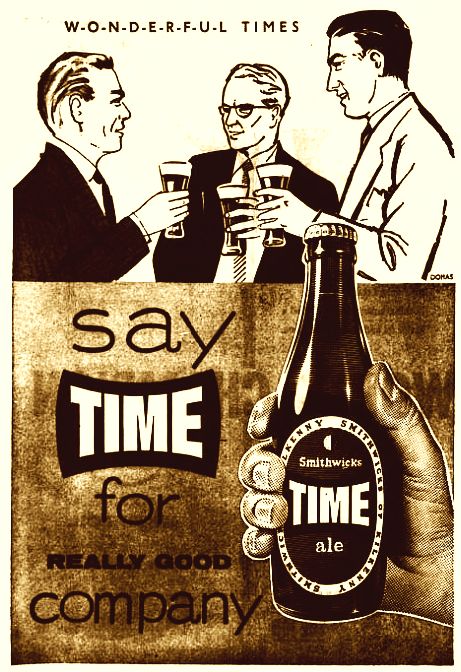
The name "Time" was chosen because it was in keeping with the celebration of Smithwicks 250th anniversary; also because it is a good name, easy to remember and say. Next time you drink a bottle of ale you'll be able to say – “I'm having a wonderful TIME”!
  Source - Kilkenny People March 1960 via local library

So, it would seem from this that this was almost a complete rebrand with Export becoming 'Time Ale' and the SS (I've no idea what this stood for ... Special Stock was suggested by Edd Mather. ) becoming 'Extra Time'. The barley wine was to follow later in October of 1960, just branded as 'Time Barley Wine' or later 'Barley Beer'. This wavering between the words ale or beer can be seen on the below labels, although I can't be sure they were all used in actual production. Time 'beer' sounds more modern so perhaps this was used in certain export or domestic regions, it was certainly used on beer mats (see below) at some point. Their No. 1 pale ale continued in production without any major branding changes.


 Image Source - Author's own collection, do not reuse without permission

The same article also mentions this:
Smithwicks are actively pursuing increased sales abroad. The new “Time” theme will be of great assistance to them in foreign markets and greatly expanded sales are anticipated.
And more:
And Smithwicks brewery is eagerly engaged in gaining an increasing share of [the] expanding world market at home and abroad. The policy of Smithwicks is to sell beer, sell Irish beer, and sell Ireland, wherever the markets are. Under an able and farseeing board and management, Smithwicks brewery, Ireland’s oldest, looks like being one of the brightest stars on the future markets of the world. TIME will tell!
So it was perhaps with an eye to foreign markets, as well a modernisation, that the rebrand took place, added to by the fear of mispronunciation of the name 'Smithwicks' by foreign tongues. They certainly had ambition but as we will see, perhaps the board weren't quite farseeing enough...

 © Independent News and Media PLC

In 1964 Guinness announced that they had acquired 99% of the ordinary shares in Smithwicks brewery1. At that time both Guinness and Smithwicks stated that there was no intention of closing down the Kilkenny brewery or cutting down on production. On the contrary they were confident that they expected the brewery and the city to benefit, which it did for a period until they stopped brewing there in 2013. Also at this time - in 1964 - it is stated that they were brewing Time ale, Smithwicks ale and Time barley wine1. I wonder was there a kick back from punters that called for a reinstatement of the Smithwicks brand in the intervening period, although Smithwicks No. 1 never went away and was certainly being advertised in 1965/66 as an ale with a 'Rich Golden Colour', so definitely not red!

 © Independent News and Media PLC

-o-

So what did these Time ales look and taste like? Well we can glean a little from a Christmas advertisement from this period. Time Ale was 'full of golden goodness', which was a rebrand of the Export, Extra Time was 'so smooth, so mellow' and Time Barley Wine was 'rich, ruby and heartwarming'.

 Image Source - The Irish Press via local library


Also worth noting here, is that according to a newspaper article2 from 1985 for the brewery’s 275th anniversary, it seems that by 1965 public tastes had changed towards an ale that was darker and sweeter and that’s when Smithwicks draught keg beer was developed by Guinness to meet this demand. This was possibly driven by Watney’s Red Barrel (first imported and then Cork-brewed) and other similar ales. (If nothing else this blows a huge hole in the marketing of when the current iteration of Smithwicks red ale was first brewed, although it can still possible claim the crown of Ireland's oldest if it has been reformulated since 1965 - MacArdles aficionados might disagree but that's research for another day. Certainly one of their main productions in 1866 was 'Pale or India Ale' according to George Measom, but there was also an enigmatic Kilkenny ale. Perhaps this is also a discussion for another post...)

(No mention is made in the 1985 article of the company's flirtation with the Time brand so it appears that by the eighties Smithwicks had sadly taken the history of that particular beer-related Kilkenny cat and put it into a brick-laden bag before throwing it over their back wall into the river Nore.)

 © Independent News and Media PLC

-o-

I'm not sure exactly when the brand was wound up but it seems to have disappeared in very late 1965 or 1966, but thanks to the interest of breweriana collectors and glass hoarders I have got my hands on labels, glasses and beer mats, which show how much commitment Smithwicks put behind the brand. The beermats are particularly interesting as each one has a Percy French song along with a cartoon illustration and seem to have appeared in two iterations, one batch at least printed in Germany and both saying beer not ale. It's interesting that given the modern feel of some of the other marketing that these are patently traditional Irish tone including the images - unfortunately I don't know the artist, which is annoying as there is something vaguely familiar about the images. The last set features football, bowling, golf and hurling and are also printed in Germany, they certainly have a more modern feel - all are very well designed and produced.


 Image Source - Author's own collection, do not reuse without permission


 Image Source - Author's own collection, do not reuse without permission


 Image Source - Author's own collection, do not reuse without permission

-o-
So how was Time served? Well apart from the bottles shown by the labels above and pictured in the adverts, I came across a photo of this cute little dummy barrel sitting on the bar in O'Toole's pub, Chamber Street, Dublin in 1964 for Time Draught, I suspect the logo may have been gold and white out of a red background but that's just guesswork based on the labels.


What's also interesting is that this may have been a direct dig at Watney's Red Barrel, which also had a similar - if less traditional looking - barrel shaped beer font and had been in Ireland since the previous year.
-o-
Below is a selection of Time branded glassware from the period, the tankard is verification stamped for 1965, right at the end of the brands life. I believe all are from the enigmatic 'Waterford Domestic', which I assume was a volume production wing of Waterford Glass.

Image Source - Author's own collection, do not reuse without permission


The tall jug is an anomaly as the only other place I've seen something similar is in a Guinness advert from 1965. The logo and wording below it that says 'Time for a Chaser' are washer-worn - or possibly scratched off - on the two in my possession but still legible in the right light.

Image Source - Guinness via Brian Sibley's The Book of Guinness Advertising

(There's also a nice advert showing these Time glasses in an advert from 1964 on the excellent Brand New Retro website.)

-o-
Regardless of what you think of Smithwicks, Diageo, or their marketing department the fact is that this is a part of our country's brewing history and deserves to be recorded and what little that I know of the story needed to be told, and if no one else will do it then I'll do my best to collect, record and regurgitate it. Some of the above is guesswork and conjecture as you can see, so if anyone has any additions or corrections please feel free to contact me and I'll add it to this article.

Liam

(All written content and the research involved in publishing it here is my own unless otherwise stated and can not be reproduced elsewhere without full credit to its source and a link back to this post. Please be aware that my own photos are watermarked.)

All advertisement so marked are © Independent News and Media PLC and I have received permission to reproduce them here. All rights reserved. Sourced via The British Newspaper Archive (www.britishnewspaperarchive.co.uk). 


References:

1 The Irish Press - June 27th 1964

2 Kilkenny People - September 27th 1985

 © Independent News and Media PLC