Tuesday, 6 September 2016

Travel: Mainz, Germany - Part 2 - Bibles, Brews and Feeling Blue

(Part 1 is here)


My love of books, and reading in general, has influenced my life since I was a kid. One of the first books I got seriously immersed in was Tolkien's The Hobbit, which led me on to The Lord of the Rings and then on to the brilliant, melancholy-inducing and often ignored stories in The SilmarillionTerry Pratchett too, still gives me huge entertainment on rereads, and I got my kicks from Bob Shaw in the past, although his books were hard to source.

And not just books of course, as I grew up in the heyday of the weekly comic. I evolved from The Beano to Tiger, and then on to drooling over 2000AD's Halo Jones in my teens, drawn by the brilliant Ian Gibson. (My only other print related crush was -  perhaps bizarrely - Estella in Great Expectations, which perhaps tells a tale in itself.)

My tastes changed over the years and at this point I'm reading Bill Bryson repeatedly and letting a deeply disturbing John Connolly haunt my thoughts and dreams in a thoroughly creepy fashion with his novels and short stories ... and there are many others too.

So with this in mind you can imagine my interest in the Gutenberg Museum in Mainz, the city where Johannes Gutenberg was born and died, as this was a shrine to one of the greatest innovations and perhaps innovators of all time. Like many inventors I'm pretty sure it's better to say he improved on the the idea of using movable type and the printing press more so than inventing it. Either way he was responsible for revolutionising how books were made and therefore who could access - and learn from - them. Gutenberg and his 'invention' influenced the thought process of many and in the long run probably inspired, directly and indirectly, more people than any other inventor in history in my opinion.
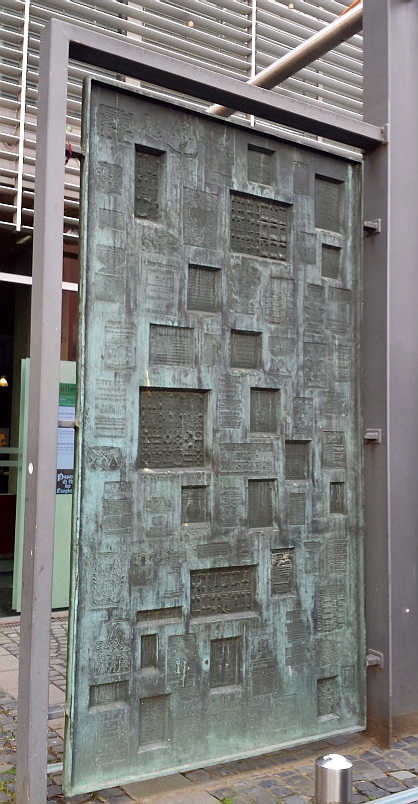

My other travelling companions decided to head off and do some shopping so it was just myself and my other half who headed across to the east side of the cathedral to the museum. It was founded in 1900 in honour of Gutenberg and has since been expanded to include all type(!) of printing methods and examples from ancient to modern times. We excitedly headed in and paid the entrance fee, eager to learn more and enthusiastic to see the history of printing and of Gutenberg himself.

But my was it hard going...

I love the idea of recording information and disseminating to the greater world and I have always had an interest in how printing came to be. I'm not knowledgeable enough to know how and where the concept of writing, painting, stamping, imprinting, etc. began but this place goes a long way to answering that, although obviously the main focus is on the Gutenberg and post Gutenberg era of printing. My downfall was the amount of information, printed texts, images and items on display. Straining to see gorgeous lithographs, interesting books, early newspapers, beer bottle labels, and tons of other printed items take their toll on your eyes, spine and brain until you feel weary and exhausted from doing nothing but ... well ... looking at minute texts, many in languages you can't comprehend, but driven to continue by your interest in the topic.

As fascinating as it all was, they could really do with a bar or café half way through!

But I still really, really enjoyed it all so much. The highlight was getting to see two of Gutenberg's original 42 line bibles from the 1450s. These were the books that started the printing revolution as they were the first to be printed with his moveable type system and the first to be mass produced - relatively speaking, as only 150 were produced. To view the books we headed into a secure, guarded, safe-like room where the bibles along with other rare texts are displayed by spotlight and treated with the reverence they deserve, which is less about their content and more to do with their rarity and actual existence.

It was the highlight in every way of the museum, and although the  actual printing process has moved on from Gutenberg's process the basic concept remains the same.

Ecstatic but tired we wandered on through some more rooms showing printing and script from the Middle and Far East but at this point we were physically and mentally exhausted, and ready for food, rest and a well-earned beer.

(This image of the bible was provided by the museum and is subject to their copyrights and permissions of use.)

We met up with the rest of our crew and headed to the south of the city, back through the altstadt. A short but pleasant walk took us to Eisgrub Bräu on Weißliliengass. It's not the easiest place to find but we soon spotted the sign outside a very pretty building with bags of character, and we wandered across the road and headed inside.


My first impression was that this was very much a sports bar, as there were televisions showing football and plenty of noisy people decked out just like all all other sports fans from every part of the world. We passed beautiful copper kettles to our right on the way in, strategically placed to catch the eye and reinforce that we were in a brew pub. We made our way toward the back and found some seats close to the bar where we were quickly attended to by an efficient member of staff who apologetically informed us that they had just changed their menu and that they hadn't any English versions yet. He gave us English copies of the old menus and promised to guide us through the new menu if we needed it. Tired and thirsty we chose our beers first, with my choice being a Märzen, which arrived quickly in a branded glass.
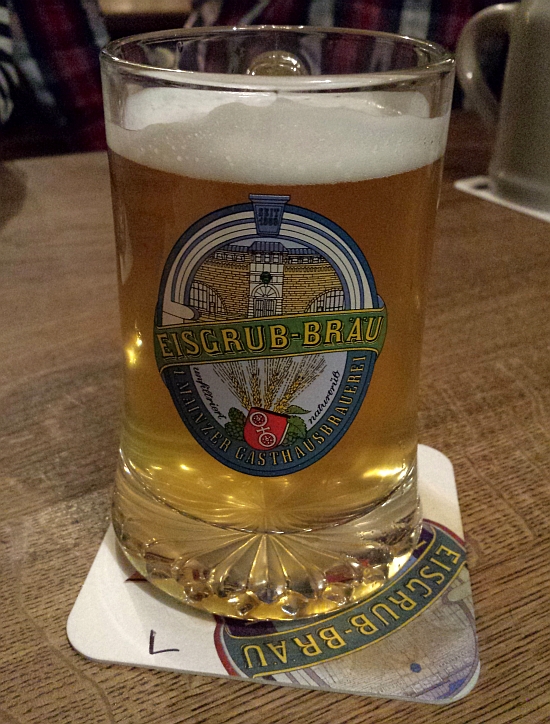

I would hardly claim to be an expert on the style but this was certainly clean and dryish with a taste of malted milk biscuits and a touch of cane sugar, with sparing hop use ... a fine beer and exactly what I wanted at that point.


The bar area itself was clean and tidy, and surprisingly devoid of customers as most seemed to be eating at tables while engrossed in the match, which I now realised was being played by a local team. This also explained the lively crowd and all the noise!

The whole brewpub was very well laid out - decorated with copper fitting, those midcentury enamel lampshades that have become so popular, and comfortable wooden furniture. The curved ceilings gave the place an intimate feeling and added to its charm and enhanced that 'comfortable' feeling I get when I find a place that syncs with my mood and eclectic taste.


After looking at the menu, and with help from our friendly staff member, we made our choices and chatted for a while. Nige had finally shown up after getting slightly lost but he too was in good form. As the others filled him in on our day so far I went for a self-guided tour of the bar and brewing process, from the aforementioned kettles at the front all the way through to the storage tanks, which appeared to be feeding directly into the taps at the bar. I was surprised by the open fermentors on display, although they are in their own isolated room, as I had just assumed that they would be closed, or at least covered ... but from tasting the beer the system obviously works. After a good nose around I headed back to my table to be greeted by my food...


As you can imagine from the picture I was more than a little disappointed...

I had ordered meatloaf with and egg and potatoes and I had imagined a slice or two of moist, minced pork meatloaf, with a poached or lightly fried egg and some oven roasted potatoes, perhaps some relish and bread on the side - not a fried slice, crispy egg and crinkle chips. The sachets of mustard and ketchup added little to the image.

But looking to my right I saw that my other half had chosen more wisely...


She had picked the smoked sausages which came with gherkin, a gorgeous fresh salad with sweetcorn, brown bread and the seemingly ubiquitous condiment sachets. As often in my life I was filled with food envy, especially when I sampled her meal, as those sausages were tubes of smoky wonderfulness.

To be honest my own meal was okay ... the meatloaf was nicely seasoned and when combined with the chips and a little mustard was actually quite tasty, if a little stodgy.


I ordered another beer to wash this all down and this time went for the Schwarzbier, which tasted of mild, milk chocolate. It was sweet and easy drinking with a fluffy head with very little bitterness - very fresh and enjoyable, an ideal dessert.

Don't be put off by my meal ... this is a nice bar and restaurant. It's lively, interesting and full of character and characters. The beer is fresh and very drinkable, and you can see the brewing process in action. The service was excellent and most importantly we had a great afternoon. My other half even bought me a souvenir glass because ... well ... you know, she's comfortable with my healthy love of glassware.

Time was pressing on and the light was beginning to fade so we made our way out, as I was afraid we would miss out on what I hoped would be one of the highlights of our Mainz trip.


I must admit that I knew very little about Marc Chagall before researching this trip, outside of the fact that he was an 20th century 'modern' artist that dabbled in various media from paint to ceramic to stained glass. I don't plan on outlining his biography here but there has been a lot written about him so a quick web search will tell you more.

St. Stephan's Church to the west of the city, and just a short uphill walk from the brewpub, is the only German church that has stained glass by Chagall. We headed there now as quick as our beer and pork-filled bodies could wobble, in order to see the church while it was still bright outside. The building itself is relatively plain with little ornamentation. Like the Dom this church has seen more than its fair share of damage, so repairs are ongoing and varied. It sits in a good location looking down towards the city centre and the Dom, with the Rhine in the distance.


Walking inside I was immediately struck by the surreal feeling of being underwater, it felt harder to move ... as if someone had pressed the slow-motion button on my body and I was now walking at half my normal speed. The sound of an organ playing a sluggish, morose hymn added to this subaquatic feeling as the sounds reverberated around the building. I sat down and felt more peaceful and relaxed than in any building I had ever been in before, even the organ pipes seemed to be floating in midair. It felt like you could almost reach out and touch the colour blue itself - feel it, capture it and hoard it.


The stained glass windows that were causing this effect were beautiful and ethereal.Words - and certainly not mine - can't really describe properly how wonderful it looked and felt. It was possibly the highlight of that German trip...

But eventually we had to go, and we trooped out the door and made our way back to the train station, full of chatter, emotion and exuberance for a city I had only recently heard of and whose surface we had barely scratched, as we'd missed the Landesmuseum, Kunsthalle and the Zitadelle to name but three.

But it has left some large positive imprints in my mind and memory and if I'm ever back again I'd go back to all these sites, and more too.

I might not order the meatloaf though...

Liam

Mainz is easy to get to from Frankfurt city or airport, with a regular and efficient train service. We stayed close by in Wiesbaden, about which I will post soon.

(Apologies for picture quality)


Monday, 29 August 2016

Travel: Mainz, Germany - Part 1 - Frog Kings and Crownless Saints


Germany has always held a strange fascination to me. It's a lot to do with its long and turbulent history, plus something about the bustling cities, the enigmatic people and their often maligned food and drink culture that seems to draw me back there every year or so. This is the land of pretzels, pork knuckles, big beers and ferociously strong mustard.


I like the old-look Germany with its tall, timber framed houses, cobbled streets and gigantic churches that contrast with the new post war, so-called Brutalist buildings that bear a striking resemblance to overgrown bunkers. (Apparently without a hint of irony...) Plus the sleek, steel and glass uber-sexy structures jar your brain and makes you consider how Germany, and the rest of Europe, might have looked if history had taken a road less travelled - one of peace and tolerance...

Both of which are issues that we still face albeit from a different standpoint and perspective, and ones that were faced by every nation over the millennia that stretch back from the point of our own existence, and will no doubt affect us again in the future.


But crossing the Rhine on a cold and overcast day my mind snapped back to the present, as the excitement of heading to another unknown city had me gleefully smiling out the window as we passed over the shipping container laden bank of that broad river and on towards the city of Mainz. (I've discovered that the best way to learn how to pronounce the names of towns and cities in any country is by listening to how the train announcer says each stop. In this case I discovered it's pronounced 'Mientz.'


A giant frog with a crown was staring out over the Rhine from his perch on a pillar - a Mona Lisa-esque smile on his face - looking longly towards the river. The image was repeated in a more stylised form on the building that surround and almost hid him from view as we passed through the industrial area on the outskirts of the city. He's the logo of a chemical/electronics firm but I presume he has a longer history than the company, as frog kings or princes are in many fairy tales and folk stories. It would be interesting to find out how he came to be connected with the company, but that was research for another day I decided, as the train pulled into Mainz Hauptbahnhof.

As usual I wasn't travelling alone. As well as Pete, my other half had come on this trip with her sister and her other half, so a quintet of Irish people made their way towards to main entrance to the station and stood blinking in the newly arrived sunshine as it shone on the grubby and unattractive buildings that surrounded us - the station itself the only building of interest or note within our sights. Nige, my other usual travelling companion had elected to stay in bed for another hour or two with the promise of catching up with us later.

The station sits on the North-West side of the city centre but for some reason my internal sat nav shut down when I stood on the plaza at the front of the station, with no maps visible we asked a man standing waiting for a bus for directions to the city centre, he shrugged at me so I said 'Aldstadt?' to which he pointed vaguely in the direction of one of the street radiating out from the station logically called Bahnhoff Strasse, which we hoped led to the old town.

We thanked him, which elicited another shrug, and set off up an ugly street that we hoped led towards the city centre, Aldstadt and Dom - the large cathedral that is one of Mainz most famous sights. It was a short walk into the city proper and soon we saw signs for 'Dom' pointing our way from every junction.


The feel and look of the city improved as we walked toward the city centre. The streets broadened and the shops and business became more stylish and better maintained. We passed a memorable statue in bronze of a small fat guy with a cheery expression and a tankard of beer in his hand near the Carnival Museum - Fastnacht Museum - on Schillerstrasse, who certainly lightened our mood. Further on there was a fantastic tower made up of all manner of elves and imps (See the picture at the top of the post) and beyond that the figure of a drummer, again all in bronze.


And from there the Dom appeared in all its beige-brown glory, giving off a slightly Disneyesque quality to my mind and eye. Not that I can explain that feeling but it was probably down to the towers and turrets. Nor can I express the huge, hulking size of the building - or its brilliance of design, apparent even here as we stood gazing at it from the entrance to the market square in which it sits.


St. Martin's Cathedral's story goes back over a thousand years and due to fires, bombardments and rebuilds it comes across as a mish-mash of styles but mostly Romanesque, all pulled together in brown sandstone and greyish slate. It appears to be in a constant state of renovation, improvement and repair for the last millennia, but that could just be my poor translation of its history and assumptions based on the weathering of sandstone. Somehow it all worked, although the brown colour seemed strange and alien to me for a building such as this, but then again that's because I'm used to churches of granite, limestone or marble.


There was a service on when we entered so we made our way quietly to the courtyard, and into an actual oasis of peace within a theoretical oasis of peace. A beautiful cedar stood in perfect scale to the garden itself with its trimmed hedge and too perfect lawn. We strolled around the portico looking at the time-worn and foot-eroded tombstones and features. It was a nice brain calming process after the busy walk into the city and the bustle of the square outside.


When the service ended we wandered back into the Dom. Standing still in its centre you could finally appreciate its true size, with vast columns stretching into the void above our heads. The light had a liquid almost oily quality, accentuated by the stained glass, creating splotches and blotches of colour on the pillars, carvings, and floor.


We wandered around taking in the splendour and majesty of it all, and every now and again a little macabre grotesqueness would catch my eye, perched on a pillar or pew would be a skeletal angel or winged skull. Perhaps religion needs these reminders of death and our eventual end in order to keep the congregation focussed on the job in hand, timely reminders to them of what their fate will be in order to keep their faith instilled within them.


One statue was particularly arresting, depicting a martyr with the top of his head missing, although he's calmly cradling it in his hands so he wasn't too perturbed by the incident. My research on this led me to a new word - cephalophores. These are the head-carrying martys such as St. Denis and others who are depicted in art with their tranquil looking heads under their arms or held out in front of them. This peaceful looking soul must be a subset of these called, perhaps, demicephalophores, who carry just half of their heads around ... they might even pass as normal with a jaunty hat - and a carrier bag.


I took my time strolling around the rest of the building looking at more statues, carvings and features before wandering down underneath the main church and there discovered a small, beautiful chapel behind a locked gate. Its significance was lost to me and in many ways I felt intrusive even being down here looking in ... so I moved on, up  and out, catching up with the others with just a cautious glance back at one of the creepier statues, which I'm pretty sure tilted its skull a fraction. Perhaps I read too many of the wrong books...


We emerged back on to the the square squinting in the bright light and wandered through the market looking at the produce and stalls. It excited me to see local wine for sale at a stall. I have no idea if it was actually local, or any good, but the idea of being able to sell something like this amongst cheeses, vegetables and jams pleased me greatly. I hope that some day we'll be enlightened enough in this country to do the same with local beer and ciders.


Next we wandered out to the Iron Tower, an interesting and striking building sitting amongst boring modern structures. It was one of three gates still standing that formed part of the old city walls, the others being the Wood Tower and the Alexander Tower. Like many structures it was badly damaged in the war and rebuilt in the 60s, which explains its slightly clinical and clean appearance.


Wandering back into the city centre we headed towards the oldest part of town, or at least the only section of the city that was left standing after the war, or required the least reconstruction I'd imagine. It's just south of the Dom and there was a different feel to this area, as it was calmer and looked more affluent and exclusive. I felt a little grotty wandering around here I must admit, as if the style-police would tap me on the shoulder and frogmarch me back to the cheap department stores and kiosks on the other side of the square. Luckily - or perhaps surprisingly - this never happened. We spent a happy hour or so looking at the buildings and taking in the atmosphere, peering through windows and doors and enjoying the traditional - faux or not - feel to the place.


Time was pressing on and we still had three sites to see, so we wandered back to the north of the Dom to our next destination and a date with some old books...

Next time - Part 2: Bibles, Brews and Feeling Blue


Tuesday, 16 August 2016

Cheap Food, Cheap Shots...

I don't get into arguments...

Although I do get into animated discussions quite often because I'm an opinionated person, and I tend to call shenanigans when I see them. Also, I don't normally post about stuff like this ... in fact I haven't posted anything in a few months as you can see.

But last week something happened that has awoken me from my recent blog coma.

---

It all started with a Tweet that I disagreed with, which I felt was a sweeping statement and only partially correct...


You can read the whole discussion on my Twitter account but my point was as follows:


...

---
This all ended in a not exactly agreeable manner with one of the parties in the discussion but certainly without any expressed or perceived animosity on my part, perhaps we were even arguing over semantics...

... but during the night my Twitter feed exploded with a stream of explosive abuse from a chef in a restaurant with a connection to the original poster, and less so from the restaurant's account itself. I'll give you a little taste of it here, but more is available on my Twitter feed - there were around 15 or more in total I think. I've nothing to hide so check back on my Twitter account if you want to, you can see the dates above and below.

...

...
...


The Tweets are a little bizarre to say the least and written by someone who obviously knows nothing about me or my ethos and history ... not to mention the abusive language they contain. Being passionate about a subject is one thing but a vicious, rhetoric-ridden tirade is another thing altogether.

Hardly the professional response of a business owner, and chef of restaurant I thought. So I responded...


As you can see, I pulled the restaurant and its owners up on these unjustified mistruths and defamations, with one of them then saying it had nothing to do with him/her. Perhaps not ... but if you're the owner of said business and you are not condemning the odious, abusive behaviour of the chef then you're condoning it in my book. Not great for their own PR image either judging from the support I received...

It would be a lie to say it didn't bother me a little but I didn't reply to any of his comments and I had started to forget it. But then I thought more about it and I decided you should never let bullies away with abuse. Isn't that what we were taught and what we try to teach our kids? If it happened to my son I would tell him to stand up for himself so why shouldn't I do the same? So I decided to put pixel to screen to highlight it, as anything else would be hypocritical and there are enough of those kind of people around. If nothing else it records it for the future and might prevent it happening to others, or can be cited by someone if it happens again.

Okay, enough about that - this isn't a 'Poor me, listen to my woes!' post, there are also enough of those written by other bloggers. I'm big and ugly enough to look after myself, thank you very much!

The point of this blog goes beyond all of that...

---

Eating cheaply doesn't have to mean eating poorly or not supporting Irish products. Indeed the word cheap has taken a bashing in recent years, but it still means 'affordable' or 'reasonably priced' to many.

So what's wrong with the concept of eating cheaply in general anyway?

I was brought up in an average Irish household where every meal was important and appreciated, because at a certain age you realised how much your parents had to work to put it on the table. It was mostly Irish products back then anyway, either bought in the small local shop or by a trek into the local town, or harvested like the spuds in our garden or the extra veg in my grandfather's. Back then people appreciated the value of the cheaper cuts of meat that might take more time to prepare and cook but were the most flavourful - chicken thighs, pork shoulder, stewing beef were the norm in our home, apart from Friday when we had a glorious fish pie bulked out with eggs and peas! We used tinned and frozen products, and gratefully tried new exotic produce like mandarins and yogurts when they arrived in affordable quantities on our shores! Ah, the 70s and 80s, I loved them - as I said, don't feel sorry for me I had a wonderful childhood!

This all stayed with me, the use of cheap but honest foods, using veg and other produce to bulk out meals and that constant need to try new things. And surely this is what we need to be teaching - at home not in schools - that so-called cheap food goes beyond ready-meals and frozen dinners. Food economy is about using all of the animal, it's about using those not-so-perfect vegetables, it's about reducing waste and knowing 'Best Before...' is not a magical cutoff point in food safety. It's about imparting practical, meaningful knowledge, and avoiding food snobbery and ignorance.

So nowadays I cook for my own kids, and I try to pass on the same ideals, tricks and recipes to them, although they are still quite young and not overly interested at the moment. We eat mostly healthy, nourishing foods - with the odd splurge or treat of course. I buy a lot of meat from the local butcher, although I do shop in certain supermarkets for veg and tinned goods, and exotic treats - and, yes, occasionally so-called junk food...

I pickle and ferment my own foods and, goddamit, I even use local Wexford malt in my homebrews, and some hops from my back garden!

And by doing all of this we also save some money so that we can get away on a good few family trips around the country, and perhaps splurge a little if we need to.

If you can afford to buy expensive products that's fine, but don't belittle others who choose not to or can't afford to.

---

The other issue I have is that just because a product is local doesn't mean it's good. I'm sure we have all had dodgy, locally produced food and drink products - not to mention the fact that local pork could be intensively raised whereas the wild boar from foreign shores could have had a happy life foraging in a forest! Given a choice of both, which is the better choice? I gave an extreme example there but it gets my point across I think - don't eat local just for local sake.

If your only criteria for eating local food is the fact that it is local then you might be eating substandard or poorly raised or grown produce. To be honest the whole 'Eat Local!' shoutout can often smack of hollow marketing speak and nothing else.

Not to mention the fact that I can't comprehend how you can prepare meals without the wonderful ranges of imported spices, exotic fruits and veg, and wonderful cured meats, etc. that are freely available. Tinned tomatoes are always best for pasta, and proper Italian pasta itself is a staple in our house. I use passata and the above mentioned spices in my curries as otherwise surely they would be bland and flavourless. There are no local turmeric growers or cumin farmers near me anyway!

Also, if we hadn't tried these exotic products we probably wouldn't have the wonderful locally made produce we have in the country at the moment. No hoppy Irish pale ale, no nettle pesto, no local biltong  .... and no Italian, Chinese or Indian restaurants.

Don't get me wrong, I do have plenty of time for restaurants like Sage who clearly define the parameters of what they mean by sourcing 'local' by applying a measure of 12 miles to it, (and they are honest enough to point out this isn't always possible)  but I have less belief and faith in restaurants who champion so-called 'local food' but have sea fish on their menu when they might be 40 km or more from the sea!

So my mantra is buy decent, honest, reputable food when you can, preferably local but it doesn't have to be, indeed if you're being honest it just can't always be! And don't be hypocritical, you can't say you only support local, artisan produce and then go to the local pub and drink foreign owned macro-beers or knock back spirits from other shores.

I try to get to know the people who grow, raise and prepare my food, it's easier now because of social media.You can learn alot about someone by looking them up on Facebook, Instagram or Twitter, and then you can be better informed as to whether this is the kind of person you want to support.

I've always believed that the sign of a good chef is how well they can cook a fillet steak, but the sign of a great chef is how well they can cook tripe - not spout it.

So now you know a little more about the real me...

Here's to cheap eats!

Liam


Friday, 15 April 2016

History: Adulterated Porter - Fine ... or Dandy?


While looking through some old papers in the local library in Carlow, as part of my ongoing research into a couple of long closed breweries in the town, I came across this article from The Carlow Morning Post dated October 22nd 1818.

On one hand it shows that the quality of beer in the early 19th century probably left a lot to be desired, and might have added to the demise of certain breweries when something cleaner or better came along. On the other hand it shows that experimentation with adjuncts in beer is nothing new, although perhaps not for purely experimentation sake.

I'll leave it up to you to decide whether Mr. Gernon with his Liquorice & Molasses Beer, and Mr. Codd with his Bitter Orange & Cayenne Porter were ahead of their time ... or not.


Although I think that the green vitriol is probabaly best left to treating moss in lawns...

Liam

Thursday, 17 March 2016

History: Carlow's Lost Breweries - The Search Begins...

Yesterday I had my first taste of trawling through microfilm in the local library - an eye-wearying but interesting task.

My subject was a local brewery that once existed on the site where now stands Carlow town hall. The earliest information I can find names it as 'Hamilton's Brewery' in the late 18th Century and it is known as 'The Old Brewery' in the late 19th century, although by this time it had been used as an overflow to the local workhouse and nothing was being brewed here as far as I can tell.

I found this advert, which ran for a number of weeks in early 1854


It sounds like breweries were scarce in the town and so far I can't find reference to any others at this time. - although the Historic 6" OSI map for 1839 shows two including this large one.

(The other was situated closer to the Burrin river and its memory remained in the name of 'Brewery Lane' until the area was demolished to build the monstrously ugly post office and social welfare offices in the 50s/60s ... but more about that in another post.)

I don't imagine I'll find brewing records but I hope to find out more about when it was first built and its owners over the hundred or more years it existed in one form or another - I have a few of those names already thanks to various historical directories and other publications

I had better bring my glasses on my next trip to the library!

Liam


Thursday, 7 January 2016

Leftovers - Best Beer/Food/Travel Nonposts 2015

Okay.
I admit it.
I'm a lazy, lazy Blogger sometimes.

Last year my Blog should have had perhaps 10 more posts but the Lethargy, Apathy and Fatigue Fairies worked their wicked ways on me and some of the most important posts of the year were left behind in dog eared notebooks, worn receipts and cloud-loaded photos.

So to right-a-wrong I've decided to do a short post about my best nonposts of 2015!

Best Meal Out


Although our meal in Sage was excellent, Bodega in Waterford probably topped it fractionally. (And anyway I did a post about them during the year so they don't count for this!)


A gorgeous tapenade appetiser, fantastic salt cod and chorizo cake for starter and the best, most tender pork belly I've ever tasted for main course, served with sauerkraut and mash.


Combined with a quick and efficient service, great wine and beer menu, and a shot of sublime Blackwater Distillery/Blacks of Kinsale Curious Still Hopped Vodka (My spirit of the year btw!), which tasted of parma violets, it was an evening I still rave about to any who will listen.


Best Meal In

This was a rabbit, mushroom and chorizo pie with mascarpone and puff pastry I made over Christmas. Sadly I forgot to take any pictures of it, so I've an excuse to make it again and post the recipe!

Best Beer Out

This is a tricky one but of all the beers I've had in various festivals and bars the best one I never Blogged about was in a Yellow Belly beer brewed by Declan in Simon Lambert & Sons in Wexford town. More surprisingly - for me - it was their lager. My notes read:

'Wow! Meaty, chewy lager, malty peanuts(?) and real lemonade. *****'


Make of that what you will but I don't give 5 stars lightly! I do remember it had loads of biscuity body and a fat feel to it that lingered just long enough on the tongue. I was still talking about it on the journey home the following day.

Best Beer In

Another really tricky one, and although I've had some fantastic Irish and foreign beers this year I went for a Belgian for a number of reasons.


Hanssens Oude Gueuze struck a chord with me as it reminded of the first time I had it in Ghent - my favourite Belgian city - and it freaked out my extended family over Christmas as I sat drinking it after dinner one evening. Many thought it a cider and couldn't understand how anyone could drink it, given its peculiar qualities.

It was fantastic with that gorgeous cheese-ridden farmyard funk and cider vinegar that I love, and paired well with the various cheeses I was stuffing myself with...

I sipped it, raved about it and admired it for about an hour.


Best Trip Away Ireland


Another tricky one but the place I should have blogged about and didn't was Wexford Town. With its busy main street and bucket loads of history it's a great spot ... although when darkness falls it becomes a bit of a ghost town but with beery refuges in the shape of the above mentioned Simon Lambert & Sons and the closeby The Sky & the Ground.


Getting a tour of the brewery in the Yellow Belly's cellar lair was a high point too. Declan gave us a rundown of how their brewery operates and their plans for the future while he was actually brewing. I doubt there is a more passionate, enthusiastic and hardworking brewer in the country, and this shines out in the quantity and quality of beer he produces. His Pale Stout, which we cajoled from the barman in The Sky & The Ground was sublime, with subtle, peaty smokiness combined with golden syrup and a malty nuttiness that I've just failed to describe adequately.


There's loads to see and do too, from the quays to the walls and even the twin churches, one of which has a  stunning Harry Clarke stained glass window. I'd highly recommend it as a weekend away destination. I really need to revisit soon and give it more time and Blogspace.


I have a few posts to catch up on so no mention of Best Foreign Trip Away for 2015, I might squeeze them into 2016!

So there you have it ... I feel a little better now after getting these leftovers off my plate.

Happy New Year!

Liam