Thursday, 24 November 2016

History: Carlow's Lost Breweries - The Story so Far...


My Tuesday mornings have become predictable...

At 9am I grab a coffee at the optimistically - but in truth accurately - named Tea & Coffee World on Castle Street in Carlow town. It helps focus my mind for the task in hand as this is one of the sites of the town's lost breweries, and it's ironic that I still get to enjoy a brew here ... albeit with more caffeine and less alcohol. They stock a wonderful range of coffees that I've started to work my way through and tag on Twitter with #coffeeticking - and they stock a huge range of teas too of course. (Ironically my other haunt is across the river at The Lazy River Cafe in Graigue at the site of another local brewery ... and they do great poached eggs and bacon!)

With my coffee fix swirling through various parts of my body I walk 3 minutes up the street to the local library and get ushered politely up the stairs to the local study room where I start up the microfilm viewer and load up a newspaper reel. I get my eyes in focus - my newly acquired glasses don't seem to work on a pixelated screen - and trawl through the columns looking for keywords such as 'Beer', 'Brewery','Distillery' or any other brain-imbedded keywords that cause me to pause my scroll and click on the zoom button.

I've become an organic search engine...

I started this research last March after a seeing a video on old Dublin breweries by The Beer Nut on The Irish Craft Beer Show and some correspondence on old Irish breweries with Barry Masterson ... and something that I thought would take a few weeks to compile has become a drawn out affair, and perhaps a labour of love/hate. There are days when I find nothing, and these can be a bit defeatist and deflating, but generally I find some nugget of information or at worst get sidetracked by other unrelated information that catches my eye.

But I havent given up and nor do I intend to, as I currently have 3 folders of information from various sources such as the aforementioned papers but also from commercial directories, various books and a few other online resources. Some of these are questionable - and require further research - but at least they are providing me with a world of information about the breweries in Carlow that existed in the eighteenth and nineteenth century. And so from having just a vague knowledge about two I now have names of breweries and brewers, what they brewed and their approximate locations.

From talking to local historians and contact with the local museum it seems that this kind of research has never been attempted before for the town and the information I am recovering has never seen the light of day, and possibly never would ...  and this keeps me motivated every time I spend fruitless hours on research that turns up very little concrete evidence.

But here are a few snippets of the information I have recovered so far...

  • I knew that there was a brewery where the town hall now stands but in 1849 during the famine it was closed, used by The Guardians of the Poor as a workhouse for 661 girls and had just 2 school mistresses.


  • The Bridewell Lane brewery changed hands on a number of occasions, and at one time had a 'Mr. Arthur Darcy late of Anchor Brewery in Dublin' employed as head brewer, when it was called the Shamrock Brewery. I doubt any Carlow people knew a brewery of this name existed in the town...
  • What about the aforementioned brewery on Castle Street which was sold after the illfated 1798 rebellion in the town when the owner was forced to sell up and leave the country in haste, having been implicated in the uprising? It was news to me anyway...
  • In Graigue, just across the river from Carlow town, there was an impressive distillery that was producing almost 40,000 gallons of spirits in 1828 and had capacity for over twice that when it was sold 1840.
  • There was a brewery on - probably - the same site as the above distillery that was producing 'Brown Stout Porter, Stout Ale, Pale Ale (Bitter) [&] Table Beer in 1862.


  • There was an attempt to set up 'The Carlow Brewery Company Ltd.' in 1863 on the Graigue site. (This failed to materialise, and I have a listing of the equipment in the older brewery it was to redevelop when it finally went bankrupt in 1865, but that's not the end of its story...
  • I have breweries and brewers listed on Tullow Street, Burn-Street[sic], Chapel Lane and Dublin Street that need research and corroboration.
  • Plus information on the Irish barley and malting trade, the effect of the Total Abstinence Society on brewing, trade on the Barrow river, imported beers for sale in the town from Dublin, Waterford, Enniscorthy, Mountmellick, Drogheda and beyond.

Plus I still have a lot of information to dig through, disseminate and record before I can produce anything of real note or interest.

What will I do with this information? I'm not sure at this point, as I still haven't found the exact endpoint of some of the breweries, not to mention the beginnings...

I guess you will all have to wait and see.

As will I...

Liam

[With thanks to the Local Study Room at Carlow Library]


Thursday, 17 November 2016

Travel: Christmas Market, Wiesbaden, Germany - Sated Senses, Steam and Sustenance


The spectacular living Poinsettia Tree in the Kurhaus, Wiesbaden

I'm not a big Christmas fanatic...

In fact I have a slight Scrooge-like attitude to all the spending and nonsense that's associated with the so-called festive period. This is probably due to spending too long in retail, purchasing and then selling all the shiny Christmas tat that people feel obliged to cover every surface of their house in at that time of year.

But if I'm being honest then I must admit that there are parts I enjoy too, such as seeing how much kids enjoy Christmas, the chance to unashamedly cook goose, wear loud jumpers and play with lasers, LEDs, fibre optics and other ways of lighting up the house and causing my hair to stand on end.

The other big Christmassy thing I do is visiting European Christmas markets, and it's something I really look forward to every year. It's probably because of my deep seated wanderlust, combined with all of the new sights and sounds of course but it's also because a good market waylays your other senses too. The taste of new food, the smell of various roasting meats, or spiced aromas of Christmas tipples ... and the feeling of being wrapped up snuggly in folds of cotton and wool, mingling with my own layer of bacon-laden fat.

But I tend to shy away from the more traditional Christmas market destinations in Germany such as Cologne, Berlin, Stuttgart and Munich and instead try to seek out places off the beaten track, as I hope that these will be slightly less commercial(!), cheaper and most importantly more interesting than the larger ones. I prefer markets that are more local than touristy, which I know is tinged with irony given I am a tourist..

This means that I've seen Düsseldorf, Augsburg, Hamburg - which was a big one admittedly - amongst others, and now Wiesbaden - pronounced 'veece-bah-den'. I visited Vienna too but it was too large for a short trip and although I enjoyed it immensely, I regretted too much the things I had missed ... but vowed to get back there again.

Wiesbaden wouldn't be first on many people's list of Christmas market destinations but that was one of the appealing things of course. It also helped that it is easily and quickly accessible from Frankfurt airport, as a key part of these trips is finding somewhere with early flights in and late flights out to make the most of my precious few days. It's not full of the traditional wood framed house one expects from certain parts of Germany and instead is a pleasant and striking mish-mash of neo-gothic, baroque and other classically flouncy styles.

Okay, I won't bore you with too much detail but here are a few photo highlights from the trip with a few notes...


Marktkirche - An imposing and dramatic brownstone edifice in the centre of the city.

A beautiful art nouveau mural on Bahnhofstraße close to our hotel. It's great to see this type of accessible art sneak into Irish cities too like Limerick and Waterford.


A fantastic food market with a great range of unusual and colourful produce. I'd love it on my doorstep!

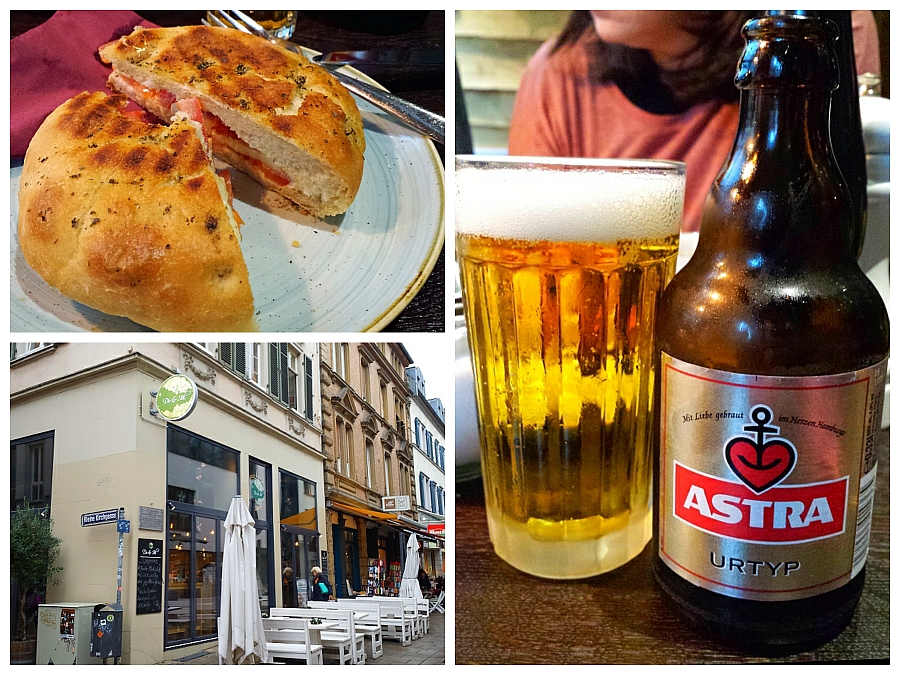
Nice brunch in the trendy  Du & Ich - Focaccia with a bottle of Hamburg's finest Astra Urtyp with its mild but bitterly acrid taste.

A Giant cuckoo clock outside a shop whose staff followed us around as if we were shoplifters! Needless to say we bought nothing in the place but I had fun picking stuff up and walking around with it before putting it back on a different shelf, much to the annoyance of said staff.

The remains of some Roman - and not-so-Roman - ruins tucked up a side street, interesting viewing tower too.

One of the many gorgeous buildings dotted around  the city.

We took a break in Der Andechser in the Ratskeller under the Neues Rathaus. I enjoyed a very nice Andechser Dunkel with an ubiquitous pretzel -  my dunkel tasted of bitter malt and ginger, with an acidic-metallic quality and a dash of cola perhaps. The very cool bottling machine sits in the entrance hall, ignored by all but me it seems!

Neues Rathaus and Marktkirche looking elegant on a winter day, viewed from Warmer Damm.

Church doors with the now familiar brownstone of this area of germany.

The fantastic thermal spring on Kochbrunnen Platz. This also explains why we spotted steam escaping from manhole covers around the city, and the rotten egg smell that lingers in this spot!

Bäckerbrunnen - A nice old fashioned bar where I had a very drinkable Diebels Altbier with its very mild ginger and digestive biscuit flavour. 

Extremely well merchandised christmas shops with an obvious slant towards European tastes.

Sternschnuppenmarkt -  The Twinkling Star Christmas Market was packed every evening and full of the usual foods, novelties and decorations. It sprawls in a good way along a number of streets but is easy to get around and well laid out.

Beer and a burger in the excellent Nassau Burger & Beef Company - They stock both German micro beers and a few foreign imports. Its a rustic spot with loads of wood and very friendly staff. I had a Wiesbadener Pale Ale that was mild for the style but extremely tasty with hints of cardamom and ginger biscuit too. I followed this with a Hanscraft & Co. Nizza Wheat Pale Ale  that had a lovely balance of clove and citrus with a bacon-like aftertaste. I paired it with a bacon jam burger cooked medium with the most fantastic fries. The burger itself was nicely pink but a little bit over seasoned, even for me. I finished up on Hanscraft & Co. Backbone Splitter - one of my favourite beers of the trip, bitter as hell with a big kick of spicy grapefruit hops. 

Dunkel in Weihenstephaner on Taunusstraße - It tasted of sweet barley sugar and clove, with brown soda bread. I was also given the Possmann Frau Rauscher Speierling cider by someone who hated it. It was extremely bitter after the beer but really refreshing, reminding me of a Belgian Oude Gueuze!

Maisel & Friends in Spital Bar (Now Closed) - We shared these three Maisel & Friends bottles - The Bavarian Ale was all mandarin oranges, clove and funky cheese with a chewy-sweet finish. The Chocolate Bock tasted of of cocoaed Bovril with maybe a hint of smoked bacon -  rich and chewy too with tons of body. The Pale Ale had a whiff of old cheese with some lemongrass and perhaps custard cream biscuits. All three were excellent, as the suited the mood and company. We also bought a couple of those cool glasses to bring home!

My final morning breakfast of bacon and eggs - naturally - in La Maison du Pain.

The fantastic walk way under Gustav-Stresemann-Ring near Wiesbaden Hauptbahnhof - This reminded me so much of the Chagall stained glass windows in Mainz that I posted about here.

So that's a quick photo reel of some of my highlights of Wiesbaden. It's certainly an excellent city to visit for its Christmas market and makes a change from the timbered old-style german towns we normally frequent. It's easy to get to and you'll have plenty to do, we missed out on a couple of places such as Baron von Richthofen's grave and the Russian Orthodox Church of Saint Elizabeth to mention just two! Don't forget Mainz and Frankfurt are close too...

You'll find more information on the city here.

Auf Wiedersehen!

Liam


Thursday, 3 November 2016

The Fine Art of Well Timed Travel


I would never class myself as a seasoned foreign traveller (... pickled maybe?) but I've certainly fell beneath the spell of wanderlust over the years, and found myself on a few planes, boats and trains. Some of these trips were so-called sun holidays lasting a week or two but over the last 10 years or so my travel has become short-burst city visits. I try to fit all my 'must-dos' into a stupidly small amount of time, like squeezing a size 9 foot into a size 8 brogue, while wearing too-thick socks - it's possible but requires planning, persistence and perhaps a small amount of pain!

Over time I've perfected this shock and awe (... and occasionally, 'Aw!') method of travel to a point where I have formulated a few golden rules that suit my demeanour, budget and my beer-food-travel wants when I feel the tug of travel.

What I've learned can be broken down into one main point...

Ready?

Time is Your Enemy!

So, how do we combat it? Well here are a few quick pointers:
  • Stay in the city centre, or close to the sights you want to see. Even if it costs a little more you'll save time, and feel more a part of the city itself. Think of the three Cs ... cheap, clean and central when looking for accommodation.
  • Fly to an airport that has early flights inward and late flights outward, this will give you a few extra hours to see that last museum or gallery.
  • Get up early! An obvious one but often disregarded. My favourite time to walk a city is early Sunday morning. Sure you get more rubbish stuck to your shoes but you see the city in a different light, often literally.
  • Avoid long sit-down meals. Graze instead in good bars, from street food vendors and at decent fast-food places.
  • Download offline maps of the city to your app and highlight your must-sees, these you can access while away without incurring costs. Also, make sure the place you want to see is at that location - streetview apps are your friend here.
  • Note museum, gallery, restaurant and bar opening times via their web pages, Google isn't always up to date, and many places close on Mondays too. Check before you plan your days.
  • If travelling as a group, an airport transfer can cost less than public transport and get you to and from your hotel quickly, depending on your location and the airport's. And these days pricing and booking can be done online.

Those are the main time-based pointers I can think of, but here are a few other things to remember:
  • Ignore the actual ratings on travel, restaurant and bar review sites but read any relevant 'facts' when choosing somewhere to go. Immediately discard and very high or very low ratings.
  • Bring a shoulderable handbag/manbag to keep your notebook and pencil (If you're a blogger or writer...), water, phone powerpack, and a change of shirt, plus plasters, deodorant, wipes, etc. - be prepared!
  • Wear practical, light walking shoes/trainers with cushioned insoles, and comfy unrestrictive clothes.

There you go, those are the main ones but there are others that I've probably forgotten...

And don't do anything stupid like drink too much, especially without a wingman, or lose your bearings late at night. Be safe and relatively sensible ... and most importantly, enjoy your trip!

Liam


Wednesday, 26 October 2016

Recipe: Pulled Pork Shoulder - Real, Cheap, Slow Food...


I thought it was time to share a favourite recipe of mine, although one that I have changed - and continue to adjust in different ways - over the years.

I've bought pork shoulder from the same local butchers for a long time, and I buy it there because of the quality, price and convenience as much as - logically - the local aspect. Not all butchers have it in stock but most should source it for you easily.

As I say, the recipe has changed a bit over the years and I've cooked it on the barbecue and in a slow cooker, but this is the oven method, as it will suit more people. As ever, remember I am not a trained cook so use common sense when handling food and follow best practice when cooking anything.


Ingredients:

1.5-2kg  Pork Shoulder - deboned, and if it's tied up untie it.
1 Apple - Sliced
1 Onion - Sliced
1 Garlic Bulb - Split and cloves slightly crushed
6 sprigs of Rosemary or 2 tsp of dried
I tsp of Caraway Seed
1 tsp of Fennel Seed
1 tsp of Juniper Berries
1 tsp of Yellow Mustard Seed
1 tbsp of Cider Vinegar
Salt
Pepper
Water

1 tbsp of Mustard
1 tbsp of Tomato Sauce
1 tbsp of Barbecue Sauce
1 tbsp Brown Sugar
1 tsp of Smoked Paprika

+

Anything else you fancy!


Method:

  1. Set the oven to 150°C.
  2. Make a bed with the apple, onion and garlic in a large, deep roasting tray and place the shoulder, skin side up, on top.
  3. Put good splash of water in the tray, enough to cover the 'vegetables' half way up then add the cider vinegar, caraway, fennel, juniper, mustard and rosemary into the water.
  4. Season the pork with salt and pepper, and cover with two layers of tinfoil. Place in the oven and cook for at least 4 and preferably 6 hours.(Check when cooked that the inside temperature is at least 185-190°C.)
  5. Remove tinfoil and put the shoulder on a rack on a new tray, remove the skin and place on another tray. Place both in the oven at 200°C for 20-30mins until the shoulder starts to brown a little and the separated skin is crisp and blistering.
  6. While this is happening heat the tray that has the vegetables, spices and liquor on a hob until it starts to boil. Mash the vegetables and add the mustard, tomato sauce, barbecue sauce, smoked paprika and brown sugar, stirring constantly. Add more water, or pork - or chicken - stock if necessary to prevent the tray from burning.
  7. Sieve contents into a saucepan and boil on the hob, reducing to a thick gravy consistency, skimming off any fat. Adjust flavour to suit your palate by adding more of the core ingredients.
  8. Remove pork from oven and let sit for 15 to 20 mins, then shred using two forks. (I cheat by cutting the beef into large, thick slices first!) Discard any large pieces of fat.
  9. Place meat in a large saucepan and add the reduced, hot gravy. Let sit for a few minutes.
  10. Remove crackling and let it cool, season to taste.


That's it!

Serve whatever way you like, but I prefer it in a bread roll or or a wrap with mustard coleslaw and bacon jam, with a serving of roast veg, stuffing and the crackling on the side.

It's great the next day in a pie too, just add peas and parboiled potatoes. (Make up a little stock and add it to the mix to keep it moist.)

Kids love it on a sambo for lunch too with tomato sauce and mustard!

It should do you for 4 to 5 meals at the very least, just be sensible about its storage, so it works out great value for money.

Enjoy your cheap meat!

Woo hoo!

Liam

Wednesday, 19 October 2016

History: Potato Beer? A Whole New Meaning to 'Mashing In'...

At the risk of overdoing the whole beer history thing here's another curious one that caught my eye during my research...


'NEW BEER FROM POTATOE STALKS - The progress of M. Kircoff, for converting the amylalecus faculae (starch) into sugar, by means of sulphuric acid, has already received some useful applications, but the most useful, is doubtless, the conversion of this sugar into Beer, mingles in a proper quantity of water, set in fermentation and hop'd according to the method of Brewers. This syrup furnishes a beer which is light, brisk, strong, and of an agreeable savor; this refreshing and healthy beverage may be prepared any where; it requires neither mill nor expensive vessels, so that the cultivator and artisan may make it in their dwellings. Already two manufacturers are employed in preparing it in quantities, and the estimate that it will cost them only a sentine the livre. (1/4 d the gallon.) - Journal de Parmacie'

[Carlow Morning Post – 1818 via Carlow Library Local Studies Room]


A hopped potato stalk beer? Any brewers try this or fancy giving it a shot?

Not sure about the whole sulphuric acid bit though...

Liam

Wednesday, 12 October 2016

History: Brewing a 'Scotch Ale' in 1837 - More Questions Than Answers?


I came across this today in the library and felt it was postworthy...


'SCOTCH ALE - I would also say a few words on the method of brewing beer, lately introduced from Scotland, which English farmers may find it convenient to adopt. The wort is made and also boiled with the hops, in the usual manner, adding three fourths of an ounce of ising-glass to every hogshead of wort; but instead of cooling it, and adding the yeast to produce fermentation, the hot liquor is put immediately into the cask, and in some days it cools, and then ferments in a peculiar manner, without the addition of any ferment, and in the usual time is found to be converted into an excellent liquor, quite fine and mellow. I am told it generally turns out to be superior to beer brewed in the usual way, at the same time there is a saving of one-fourth part of the malt, three bushels producing as good a cask of beer as four by the old method. - Correspondent of the Buck's Gazette'

[Carlow Sentinel – 1837 via Carlow Library Local Studies Room]


Notwithstanding the fact that I am a not-very-successful homebrewer with a poor understanding of fermentation, I have a few issues with this piece...


Would the near-boiling heat of the wort not kill off any yeast - or other fermentation bacteria - in the barrel and therefore produce a sterile environment? Could yeast re-enter the barrell somehow?

Would this be a Brett, Pedio or Lacto strain?

How would this method actually reduce the quantity of malt required?


Allowing that this is a repost, of a repost, of possible hearsay, from 1837 perhaps something got lost along the way. I'm also aware that this is not the 'normal' definition of a Scotch Ale and I assume here it just means an ale from Scotland ...

I'd be interested in any comments anyone might have on the process and how it could work.

Liam

Tuesday, 4 October 2016

History: 'Spontaneous Combustion of Drunkards' - Bloody, Burnt & Blue, with a Twist...

My now regular trawl through the papers in the local library throws up some interesting snippets of information every now and again that distract me from my research. Here is one example that seems too bizarre not to post.

It brought forth images of some kind of vampirical sambuca-like shots with a legion of bloodsuckers lining up to drain the poor rum gorged victim.

Is Bloody, Burnt & Blue a good name?


'SPONTANEOUS COMBUSTION OF DRUNKARDS – It appears well authenticated that a confirmed drunkard is as combustible as a powder house, and as liable, every moment of his life, to blow up. His safety only depends upon the contingency of not coming in contact with some material of ignition. Mr. Hanson, a student of medicine at New York, lately tried a curious experiment. A fellow who had drunk two gallons of rum in the five preceding days, came staggering into the office where Mr. H. was a student. Mr. H. told him he was in danger of exploding by spontaneous combustion and persuaded him to be bled, in order to avoid such a tragedy. He was bled, and a lighted match being applied, the blood burnt blue, and continued to burn freely for 30 seconds.'

[Carlow Sentinel – 1836 via Carlow Library Local Studies Room]