Tuesday, 25 April 2023

100 Years of Irish Brewing in 50 Objects: #6 - A Drayman's Delivery Docket from Sullivan's Brewery (1892)

I could speak of the beer drinking capabilities of some of the Walshe mountain girls - but why should we cavil at the amount of refreshment which is taken after a walk of twelve miles from the hills, another return walk of similar length in perspective, and in addition holding on in the dance "to tire each other down" for some three or four hours? Could we say half a gallon of that washy stuff known in Ireland as "pale butt," was too much for a girl? You may think so, reader, but I do not. The question is, after all, one of stowage.

A Strangers Impressions of County Kilkenny – The Kilkenny Moderator - Saturday 19th July 1851

Those comments were made by a tourist who was staying in Bishop’s Hotel in Thomastown, Kilkenny and were in regard to a fair day in the town, and the people who came in from the countryside for dancing and socialising. Regardless of the comments on the ability of ‘the Walshe mountain girls’ to consume ‘refreshment,’ his description of a drink called ‘Pale Butt’ and it being ‘washy stuff’ is of interest to those curious about Irish brewing history. We must keep in mind that elsewhere in his report to the newspaper he twice mentions drinking Cherry’s Double Stout, so his opinion of other beers might be in relative terms but ‘washy’ can hardly be regarded as a praisesome term for any drink.

-o-

Our related brewing object is a delivery docket for a half barrel of Pale Butt from 1892, brewed by Sullivan’s Brewery which operated from James’s Street in Kilkenny on the site of an earlier brewery being operated by a Mr. Archdeakin in at least 1702. As ever with Irish brewing history the facts are a little muddy but the brewery on James's Street appears to have passed through different hands - for example a John Hennessy was a brewer on this street in 1788 - before the site became vacant in 1790. It was purchased and reopened by William Sullivan and William Loughnane in 1810. Mr. Loughnane appears to have left the business as it was operating as 'Messrs. Sullivans Brewery' in a newspaper article in March 1815 when a fire broke out in the malt house there. (Indeed, a portion of the brewery was destroyed by another fire in October 1880 while the funeral was taking place of the then owner James Sullivan's brother Francis - grandsons of William and sons of Richard Sullivan M.P.) The company - which employed 150 people at one point - actually consisted of two breweries and a bottling store for mineral water and soft drinks when a new brewery was completed not far from the original site in June 1877. This new site was possibly a repurposing of an existing brewery as there was a Hibernian Anchor Brewery on the street in 1859, and that fire in 1880 destroyed part of the old brewery, not this new premises. It appears to have stayed in the Sullivan family until it finally closed in 1919, the brewery being taken over by Smithwick’s and closed with the employees receiving 'a fortnight's notice that their services will be dispensed with.' according to one newspaper. Parts of the premises were subsequently used as a maltings by the Smithwick brewery and the site is now a carpark for Market Cross Shopping Centre. Advertisements from 1895 show that Sullivan’s were brewing a pale butt, a double stout, sparkling ales and hop bitters as well as manufacturing and bottling Mineral waters at this time.*

The half barrel of pale butt was delivered to a Laurence Long who had at this time a public house and grocery store on the corner of Barrack Street and the Castlecomer road, which is now known as Lenehan’s Public House. According to newspapers of the time he appears to have sold the business to Rose Lenehan in 1913 and took over a premises instead on John Street (now called The World’s End Bar) which he ran very briefly until his untimely death that same year.

The drayman who delivered the cask on his route was a J.(?) Dowling and the cask number was 2574. This number ensured that the casks could be tracked and returned to the brewery. It was also helpful if a full barrel of beer was stolen, and a newspaper report in The Kilkenny Moderator on the 26th of October 1892 records that a barrel of pale butt was stolen from a Mr. Grace on Parliament Street in Kilkenny and was tracked to a house on Horse Barrack Lane (which curves from Parliament Street along the front of the Smithwick’s brewhouse that is now the new Abbey Quarter Development Building) where the number confirmed it to be the missing cask. The two thieves who had attempted to sell the barrel to some public houses without success were sentenced to a fortnight hard labour in Mountjoy prison in Dublin.

-o-

The words ‘pale butt’ relating to a type of beer seems to be one of those relic terms which lost favour over time. It is certainly mentioned by William Ellis in the 1737 edition of The London and Country Brewer as ‘pale Butt-beer’ from Somerset, and over here in The Parliamentary Register: Or, History of the Proceedings and Debates of the House of Commons of Ireland in 1793 in an enquiry into brewing and distilling here ‘pale butt’ is mentioned twice as a common commodity before that date.

As we move forward in time ‘pale butt’ appears to be a term that remained much more common in Ireland than in England, Scotland, or Wales if the unscientific method of looking at mentions in the newspapers of the mid-19th to the very early parts of the 20th century is to be used as a measurement. (It was certainly still used elsewhere but it wasn’t quite as common and isn’t the focus of the topic here.) Breweries such as Lett’s. Watson’s, Cherry’s, Keily’s, Smithwick’s, Sullivan’s, Castlebellingham, Dower’s and others were all using the words to describe a beer style at one point or another. And although the term seems to have begun in England, its relative decline outside of Ireland is yet another reminder that although we share a lot with the island to our East, we are remarkably different in many ways, not least how language changed and evolved here or - in cases like this perhaps - stalled. With regard to brewing, this may be because of the large number of English brewers who came over to Ireland to set up and work in the breweries here, and the terminology they brought and left behind in the late 18th and early 19th century stayed here long after newer words and meanings had replaced them across the water, just as some ‘normal’ daily words in common use have remained here too.

From a practical point of view a beer butt is a wooden barrel that is twice the volume of a hogshead at 108 Imperial gallons and in the above-mentioned publication that Mr. Ellis asserts that it was the best size for fermenting and condition beers due to aspects of its physical size and volume and that ‘butt-beer is at this time in greater reputation than ever in London ...’ As we can see from the docket (and the mentions below) the beer certainly wasn't always supplied in a butt-sized barrel.

-o-

To find out where pale butt fitted into an Irish brewery's range of beers we need to return yet again to the advertisements in newspapers of the time in question, which is a somewhat inaccurate method of research in many ways but it is unfortunately one of the few resources we have, given the dearth of old brewing records available to the public. Taken singly they might be unhelpful but by looking at the many mentions and references we have we can begin to build a better picture of what type of beer this was and where it fits into our brewing history.

There are early mentions of Irish brewers brewing the style, for example a David Sherlock on Glover's Alley, a table beer brewer, had 'commenced the brewing of Porter, Ale, Pale Butt and 30s[hilling] Beer' according to The Dublin Evening Post from the 5th of January 1797 and in Saunder's News-Letter on the 9th of November 1799 Thomas Fullam advertised himself as a 'Pale Butt, Ale and Table Beer Brewer' on Constitution Hill in Dublin. (Pale Butt was his dearest beer of the three, which is worth keeping in mind for later.)  In The Hibernian Journal on the 21st of September 1805 William Robinson of 110 The Coombe in Dublin was advertising his ‘Pale Butt, Porter, & Small Beer Brewery’ while in Saunders's News-Letter on the 4th of July 1808 Andrew Maziere of James’s Street also in Dublin was advertising ‘Porter, Pale Butt, and Table Beer.’ An advertisement in Saunders's News-Letter on the 5th of April 1813 for beers from the Castlebellingham brewery mentions ‘strong ale and pale butt’ (in later advertisements table beer is also listed) and in The Tipperary Free Press on the 3rd of January 1829 Greer & Murphy of The Clonmel Brewery were listing double strong ale, pale butt, ale, porter and table beer all as separate products. Where prices are mentioned, pale butt is generally on the cheaper side of things with the odd exception, such as the early mention by Thomas Fullam above.

By 1835 Thomas Cherry of King Street Brewery in Waterford and Creywell brewery in New Ross was advertising what looks like a hierarchy of brewings as ‘XX and X ale, and Pale Butt’ (with ‘Beer’ tagged on to the end of the line up in later advertisements) in The Wexford Conservative of the 23rd of December 1835, and a list of beers for sale in The Drogheda Conservative Journal on the 31st of March 1838 lists pale butt, plain ale, X ale and XX ale in ascending order of price, with all but the pale butt listed as from Cairnes’ brewery in Drogheda, although they were brewing such a product in the previous decade so it may have been theirs too.

Up in Belfast Charles Murison was brewing nine beers in 1842 – XXX, XX and X ales, XX and X Brown Stout, Superior Porter and Pale Butt, Family Pale Beer, and Common Beer, which were listed in that order according to an advertisement in The Belfast Mercantile Register & Weekly Advertiser on the 22nd of February 1842. Most revealing is the following passage:

To those who prefer a stronger article for table use than beer, the Pale Butt will be found a very pleasant beverage, as a medium between Ale and Beer.

This is quite telling as it seems to confirm what we see in other advertisements, that pale butt appears to be a lighter and cheaper type of beer, or had certainly morphed into that by the early-to-mid-19th century. It is worth noting that I have used the word beer in the modern all-encompassing sense often here, but from what I have seen from this and other advertisements in the past we used the term ‘beer’ here in Ireland for the weakest and lightest form of brewed beverage – and this is probably a hangover from the popularity of table beer as a general beverage in the late 18th and early 19th century. It would appear that the name clung on here for a weaker brew, so at this time – and later – ‘ale’ didn’t mean an unhopped product and ‘beer’ a hopped one as it may have done elsewhere (or earlier) the terms were used to signify strength with our pale butt in the middle at this time.

So, just to reiterate, at this time it appears that of the paler brewings in Ireland we had in ascending order of strength and cost - ‘beer,’ then ‘butt,’ then ‘ale.’ (We also had ‘brown beers’ brewed by St. Stephen’s Brewery in Waterford and others, which were probably a lighter version of their ‘basic’ porter.)

If we want more reinforcement of this theory we can look at Sullivan’s rival in Kilkenny, the St. Francis Abbey Brewery of Edmond Smithwick who in 1852, just a couple of decades after commencing to brew on an old distillery site, was producing ‘Double, and Single, Stout Porters; Extra Strong, and Strong Ales, Pale Butt, and Table Beer’ in and advertisement in The Kilkenny Moderator on the 21st of January of that year. Helpfully too, St. Stephen’s Brewery listed their prices in The Waterford Chronicle in December 1874 which starts with a XXXX sweet ale at 21 shillings and drops through India Pale Ale, XXX Mild and Family Ale to Pale Butt at 8 shillings for a firkin of 9 Gallons.

As late as 1900 the brewers of Louth were publishing a list of price increases for their beers in The Freeman’s Journal that once again lists a range based on prices starting with the most expensive with strong mild ales then East India and Amber Ales, followed by Pale Butt and then Dinner and an enigmatic East India Beer and lastly plain ‘Beer,’ and if price equates to the quantities of ingredients used then we can take pricing as being a relatively safe way of judging the strength of the beer.  There are a few exceptions where a Pale Butt mention is prefaced with ‘Strong’ but generally speaking 'Pale Butt' appears to be a weaker brew than ale … ‘washy’ as described by the writer quoted above.

As to its exact taste, St. Stephen’s Brewery were involved in a dispute with a publican regarding the quality of their beer as recorded in The Clonmel Chronicle on the 8th of April 1874, where ‘two kilderkins [of East India pale ale] turned out inferior, and he had to sell all as pale butt.’ This gives an inkling of how it tasted as it was clearly not as strong in relative terms as their IPA. An article in The Freeman’s Journal from the 15th of March 1913 quotes an English writer from 1798 who wrote about ‘a sweetish malt liquor, called ‘pale butt,’ unlike anything I have ever drunk elsewhere,’ which again helps a little with how it tasted and reinforces that the name was not very common in England even at that time. Yet another mention in a court case recorded in The Kilkenny Moderator on the 27th of December 1865 states that ‘it would take a long time to get drunk on ‘pale butt,’' and another in The New Ross Standard on the 20th of September 1907 which mentions that Cherry’s pale butt was ‘not very strong.’

So, pale butt could possibly be best described as a low-hopped, slightly malt-forward beer, pale in colour, low in alcohol and cheap to buy – but still a little stronger and not as cheap as the ‘beer’ available at this time. All of which is of course pure conjecture, but it seems to be the correct assumption.

That term for a style of beer brewed in Ireland seems to have disappeared from the island in the first decade of the 20th century, but did the actual product itself disappear too? Perhaps, but it may have lingered briefly, renamed as a mild or X ale in some breweries, but with the huge popularity of porter and stout here it may have just disappeared, being unwanted and unneeded, and ultimately unfamiliar to a 20th century drinker. It might be argued that it returned in spirit at least in the new beers that appeared in the middle of that century like Phoenix and Smithwick’s Draught – low-ish alcohol beers that were made for drinking in relatively large quantities on social occasions.

-o-

On that note let us return to Sullivan’s Pale Butt and specifically to an account of a Harvest Home feast (a relatively common occurrence in the Big Houses in the past) from The Farmer’s Gazette on the 18th of October 1850 which seems quite fitting to end with …

HARVEST HOME AT FARMLEY CASTLE, KILKENNY

The annual substantial feast came off at this ancient and time-honoured establishment, on Saturday last, when all the workpeople, with their wives and families, were most sumptuously entertained. The rooms were most tastefully decorated with flowering shrubs and evergreens - “Nature's own darling hue;” and when the apartments were brilliantly lighted up, all had a most imposing and thrilling effect - thanks to the superior taste of Brette, the carpenter.
The dinner being over, the musicians poured forth their most soft and enchanting strains, which made the old and feeble forget their infirmities, and the youthful their previous toil, and all joined in the merry dance, which was kept up in the true Irish fashion, until very late hour.
“How gaily, even amidst gloom surrounding,
They still canst wake at pleasure's thrill,
Like Memnon’s broken image sounding,
Amidst desolation, tuneful still.'' 

Even the noble-hearted proprietor and his lady did not disdain to take the hands of their simple-hearted and grateful rustics, and share with them the pleasure of dancing the merry “foxhunter’s jig.” To the eye of the philanthropist, surveying at this moment the happy faces of the entire company, he could not but bless the source whose bounty contributed so largely to make so many of the children of toil and labour delighted and comfortable. Sullivan's pale butt, and Jamieson’s stingo, were done ample justice to, with abundance of tea and coffee for the teetotallers. Great merit is due to Mr. Mclntyre, the intelligent and respectable steward of the establishment, for the orderly manner in which everything was arranged.

As florid and loquacious as this report is it certainly paints a picture of enjoying a nice beer or two to celebrate an occasion, where all are welcome and there is something for everyone – even those wanting a ‘washy’ pale butt ...

Liam K

P.S. I have at times used the word beer in its modern general sense here as well as highlighting where in the past that same word meant the lightest of brewed beverages, and I hope the context of their use differentiates one from the other.

* Adapted from a piece on Kilkenny breweries I wrote about here, which lists any references.

(Here is the link to object #7)

Please note, all written content and the research involved in publishing it here is my own unless otherwise stated and cannot be reproduced elsewhere without permission, full credit to its sources, and a link back to this post. The docket and the attached image are the authors own and cannot be used elsewhere without the author's permission. Newspaper research and images are thanks to The British Newspaper Archive.

Friday, 7 April 2023

Opinion: Guinness and Me – Love and Hate at the Heart of Darkness …

My first encounter with Guinness was as a small child in the very early seventies when my father would on occasion bring home four or so half-pint bottles after work from the local grocery shop that doubled as a public house - as many still did in rural Ireland in the last century and well before that too. I was only three or four years old but I can still clearly remember sitting on the floor at his feet playing while he sat on an armchair beside our Stanley cooker. He'd pour one into into a glass before placing the empty bottle beside the chair leg with a clink of glass on tile. I’m sure this ritual happened on a Friday because my mother would be baking as she normally did on that evening and the smell of soda bread filled the kitchen along with the heat from the stove. Under his watchful eye (and out of my mother’s) I would pick up the small, stumpy bottle and put it to my lips, before tipping it back and letting the tiny dregs of stout coat my tongue and cause my mouth to pucker. I guess I just wanted to be part of his Friday night tradition of enjoying those hard-earned bottles at the end of a long arduous week. He wasn’t much of a drinker in truth so it’s curious that this is one of my earliest remembered interactions with him, and although small parts of it might be misremembered and embellished by the progress of time and a need for joyful memories, the basic elements are true.

For my next serious encounter we need to fast-forward a few years to the late eighties. While listening to a gig in a local bar in town a friend persuaded me to order a draught Guinness as a change from the usual pint of Harp, as that was what he drank. I certainly didn’t take to it at the first sip, as taste-wise it was radically different from my lager, but something must certainly have appealed to me as I continued to drink it for almost two decades. It might have been the influence of my drinking partner, who also introduced me to smoking - although that was a habit I thankfully didn’t take up - or maybe I liked how it looked, or perhaps I felt I was cool to be drinking it - as if I had finally grown up? I’m really not sure. Certainly – at first anyway – the actual taste didn’t play a part and I doubt any nostalgic longing to my childhood did either.

But I grew to love my pints of Guinness.

I drank it all over Ireland, in parts of England, and a lot of Europe too. I savoured pints from Dublin to Kerry, and Mayo to Cork. I drank it gladly in pubs in Islington and Hounslow, Birmingham and Manchester. I even consumed it on cold nights in Irish bars in Innsbruck and Bruges, and on summer holidays in Greece and Italy and many other too-hot countries. To me it always tasted much the same, apart from some (perceived) exceptional pints served to me on a particularly memorial night and early morning in The Strand guesthouse on Achill, and a dreadful one I had when hungover in the middle of a ridiculously hot day in Protaras, Cyprus.

I would not say I drank it exclusively, and I was never a huge drinker, but it was certainly my number one beer by quantity.

But around 20 years ago I fell out of love with Guinness and I can’t remember exactly when or why, it was certainly a case of ‘it’s-not-you-it’s-me,’ as apart from the dreaded and still linger legacy of Guinness Extra Cold I don’t believe the beer in my glass changed much? I moved back to lagers - usually foreign - often in bottles and rarely to same brand twice, as I was interested in trying new drinks as part of a journey into expanding my food and beverage palate. In my defence back then it was mostly strange lagers which were available apart from one local microbrewery which I certainly flirted with off and on. This change might also have coincided with a camping trip we made around Europe where four of us would bring a case of lager back to our campsite to share, and every night it was a different localish brand, so variety and variation of a sort became the norm.

But then came a trip to Belgium with a group of friends in 2008 and obviously after that I became an insufferable beer snob for a short while as I trod a path well worn by many before me. I wasn’t trying to be that sort of person but somehow the waves of Belgian beer and its culture – however tourist-focussed relatively new it was – washed over me and I was born again, baptised in sour ales, blondes and tripels. I became ‘That Guy’ in the bar who was always trying to persuade others to drink ‘craft’ beers from the newly emerging scene here, or dusty bottles of German bocks, Trappist ales or whatever wasn’t mainstream. I did succeed in converting many of my friends and family along my apostolic-like journey, but I cringe somewhat now as I look back on that early time of shunning certain beers and wonderful bars based solely on their line-up. I spent so much time making meaningless scribbles in notebooks and on apps and finally on a blog, notes that rarely mattered as I would never drink that beer again. I continued to look for the next beer, the new beer, the rare beer.

I won’t say it was a waste of time as such, as I did enjoy every minute of it to be fair, but a small part of me regrets spending so much time on analysing beers and less time experiencing and enjoying them more with the company I was with in some fantastic places.

But soon enough I began to mellow and instead of instigating a talk about beer in a pub I’d let others ask me about what I was drinking (and ask why I spent so long taking pictures of it – more wasteful time!) and used that as a way of getting people to initially talk about beer and then often to trying one, because I really do like to talk about beer and brewing, often to the point of not recognising the abject boredom in my friends faces. More recently I developed a taste for cask ales, which I had only previously tried and somewhat dismissed in England decades ago, and I also began to appreciate lighter styles like mild ales, lager and porters, although mostly from local or small breweries. I also started frequenting 'normal' pubs more often instead of forcing others to my craft-centric places, and there I revisited Guinness Draught again for the first time in decades …

I was underwhelmed. It was fine, there was certainly nothing wrong with what I was poured. It tasted just like it was supposed to, quite mild and slightly bitter, but it lacked … something? Depth and character perhaps? Possibly because I’ve had my palate assailed by the uber-sour, the ultra-hoppy and the over-sticky beers for too many years so I didn’t appreciate the nuanced flavours of this iconic brand – and maybe my age played a part – but how come I could pick these up in cask ales or even understated lagers?

I was certainly disappointed, as part of me wanted it to be a beer I could like because it would make my drinking life and choices in non-craft pubs much easier and maybe more enjoyable. Sadly, that was not the case – there would be no returning of long-lost love into my life. I even tried it again elsewhere but there was no connection, no grĂ¡. Nothing.

The romance was truly over.

-O-

Now let me be clear, there is absolutely nothing wrong with draught Guinness. Taste-wise it isn’t dreadful or crap or any of the other words that some have called it. It’s certainly – and ironically – plain for a stout, but no doubt that is its appeal to many. Like Coors, Rockshore, Smithwicks and a host of other macrobrewed beers it is the simplest of its genera and that makes perfect sense, as most people aren’t like those of us who feel the need to talk almost constantly about what we are drinking. Macrobrewed beers are the lubricant to the cogs of conversation and socially enjoyment for the vast majority of beer drinkers, and drops of anything thicker would jam the mechanism or at least slow it down - and I’ve come to appreciate and understand that at least.

I have no objection to nitro-served beers either, in fact I’m quite partial to them at times. But it must be noted that nitrogen does dull – or soften let’s say - the flavours of beers and it certainly changes their taste profile, taking the edge off of it. Therefore if you want (and you may not of course) a nitrogenated beer with any kind of pronounced flavour then – for me, and only me – it needs to start from something with a stronger and fuller flavour profile than Guinness, so for my palate that means stouts which are a little less dry, such as Murphy’s and Beamish on the macro front. For me, both of these are better as nitro-served products, with Guinness and Island’s Edge both on the drier side and relatively similar.

Of course, microbrewed nitro stouts are generally speaking a cut above any of those for my palate, as again – to be clear – personally I am looking for more flavour in my beer these days.

(And yes, I have done a blind tasting.)

But I still drink Guinness by the way, although only in bottles when I’m ‘stuck’ in places where there is no option for something with more flavour and usually only if bottles of Macardles ale are not available – as it at least has some sort of pronounced flavour. This version of Guinness – ‘Original’ or XX, or Extra Stout – is  quite different to Guinness Draught, being just ‘normally’ carbonated apart from anything else. When served at shelf temperature it is a much more appealing and beguiling product than its draught cousin – although it is still far behind most microbrewed bottled stouts. (Again, I have blind tasted a selection of bottled stouts.)

And I certainly don’t love it ... but I do like it.

-O-

These days I don’t generally push microbrewed beers over macrobrewed, as I no longer feel it is my vocation to preach to others regarding what they drink, but I will more often than not favour microbrewed (‘craft’) beers over macrobrewed ones purely on taste. This coupled by the fact that I’m drinking more homebrewed beers these days due to experimenting with Irish historic beer recipes and the need to brew and sample the same. I’m more of a drink-and-let-drink sort of person now, apart from some gentle and expected ribbing of friends and family when it comes to their choice of beers.

But there are beer related matters that irk me and cause me consternation.

The first – as many of you know - is how many Irish restaurants and chefs or butchers and bakers will shout loudly about ‘Artisan’ and ‘Local’ with all the produce the cook and bake with - apart from beers of course, where most will happily include Guinness in their steak pies or brown bread, and baste their locally sourced fancy beef joint in Smithwicks. Some will get into bed with any drink multinational who waves a cheque at them, or they will promote their love of pints of certain mass-produced beers on social media, while in their next post telling their followers not to go to chain cafes, international fast-food restaurants or to eat anything that hasn’t been sourced 10km from where we live by a small farmer or grower. The worse thing is that neither they or their followers can see or appreciate the irony and hypocrisy because, ‘It’s just beer, isn’t it?’ It doesn’t seem to count because beer, perhaps, has always had a stigma attached to it that spirits and wine do not. This is why most restaurants will carefully curate a wines list and have a literal showcase of proper Irish spirits but have three taps of ‘big’ beer on, or worse still a rebadged microbrewed beer under the house name. Which perhaps shows the lack of pride and confidence that some breweries have in their beers, plus the lack of integrity that the restaurant has for its customer – a complete absence of respect for the product and drinker. Would they lie about their meat and other produce too? It makes me wonder about the producers' names on their menus, are they fake too? (It surprises me that practically all craft beer drinkers think this is an okay practice – as long as it isn’t a 'big' brewery doing it …) I am generalising here of course and it is a road I have gone down before but it is worth reiterating here for context.

The other group that infuriates me are the beer drinkers who preach about drinking from small producers and supporting craft, but make an exception for pints of draught Guinness – and only Guinness I might add.

Let me be clear – yet again – this isn’t every beer drinker out there or even craft beer drinker, as there are many beer omnivores who just drink (and write) about beer in general and don’t pontificate – but some do indeed lecture us about big beer versus small and those are the drinkers whose Guinness exception I cannot understand. I am indeed one of the much maligned ‘drink what you like’ brigade who at this stage in their journey through life - probably aided by age - really agrees in that mantra, even if others think it trite. And age has also turned me into a grumpy cantankerous creature who is likely to call out what can only be classed as insincere and contradictory behaviour.

In Animal Farm one of the rules painted on the barn walls is famously ‘All Animals are Equal’, which – spoiler alert – had the words ‘… But Some are More Equal Than Others’ added to it. This attitude looks to also apply to certain ‘craft’ beer drinkers who will embrace the joy of a macrobrewed nitro stout but would be quick to jeer their drinking partners if they ordered a pint of Coors, Tuborg or even Heineken no doubt. As I have mentioned above, these beers are no worse or better than Guinness at face value, all just being the less flavoursome versions of their styles.

I also firmly believe that if any of their beloved small breweries produced something with such a basic flavour profile it would get very few stars on certain drink apps and get called out as boring at the very least on social media by those who appear to worship craft beer even as they not-so-secretly drink from the well of St. Arthur within the Gate.

I have tried to get me head around this apparent aberration and misplaced need, simply because it appears out of kilter. Is there something comforting in the colour and texture - perhaps? Is the heritage a factor (although most beers have that)? Is it the taste in itself (as discussed above I don’t think it can be that either)? Perhaps it’s the marketing? Maybe it’s the ritualistic process of the pour? It certainly isn't price related. In truth I don’t know but I do know that, like with the food gurus already mentioned, there should be a degree of self-awareness as to how this looks. To return to a previous topic, imagine if a respected food writer, who focussed entirely on local artisan products was seen eating and waxing lyrically about a Big Mac? There would be uproar and condemnation from all sides of the food sector.

Yet it’s accepted for beer.

As ever, none of this applies to you dear reader unless you feel it does, and only you can decide that ...

-O-

It is also worth reiterating that I don’t dislike Guinness in general, it would be quite difficult to take that stance give how much I read about it and how much I have written about aspects of its history.

But I do hate the drink equivalent of the Cult of Personality that has arisen around it.

I hate some of its drinkers, specifically those who genuinely mock others for their glassware or how their beer was poured – especially on social media.

I hate how some people seem to think they have a psychic ability to know what a Guinness tastes like from a picture alone.

I hate all the marketing guff that has been spouted over many years.

I hate how - by accident or design - it has completely taken over Ireland’s brewing history and eclipsed any hope of our real beer history from shining through.

I hate how it seen as such a huge part of out tourism industry to the detriment of other smaller enterprises, regardless of how lucrative this is for us as a whole.

I hate how it is normally the only stout available in a bar in Ireland outside of the bigger cities.

I hate how people have turned St. Patrick’s Day into ‘St. P-Arthur-ick’s Day’ and how the whole day now revolves around drinking Guinness in every part of the world where that day is celebrated. (I’d almost prefer more green beers!)

I hate how it has become ubiquitous with my country, a place I truly love. Ireland isn’t Guinness and Guinness isn’t Ireland.

And mostly I hate that 'Brand Guinness' – more often not pushed by Guinness themselves, but its followers – has (figuratively) left a sour taste in my mouth, even as I write about it, research it, and on occasion drink it in one form or another, and perhaps in doing so making me just a big a hypocrite as those I have issue with …

-O-

But there are also a few other uniquely Irish reasons for some on this island to dislike the brand, the company, and the beer itself, whether rightly or wrongly.

Back in the day it gained the moniker ‘Protestant Porter’ and catholic drinkers were encouraged to shun it and to even destroy barrels of it on occasion for reasons I won’t go into here. There are many anecdotes and possibly some falsehoods as to why this happened but the term and the tales are still remembered and repeated for right or wrong in certain circles.

They are also blamed by many for closing down most of the other breweries in Ireland and buying them up, or sometimes vice versa. It could be argued that it was shrewd business practices and a better and more consistent product, coupled with a better logistical infrastructure that closed the other breweries, and that Guinness just mobbed up the detritus. My own feeling is that it was a little of both, but that resentment is still there for an albeit small minority of people here.

Some have still not forgiven them for ‘supplying’ the British with truck beds on which the army built armoured cars in the Irish rebellion of 1916. (Some sources report they also used Guinness fermentation vessels on the back of the trucks but this is untrue as it can be clearly seen in photographs that these were the front ends of locomotive engines, although from what source I know not.) There are also those who argue that these trucks were requisitioned from Guinness against their wishes, but either way you can see how all of this might stick in the craw of those of a certain age and historical bent.

Its parent company’s brand monopoly – along with others in fairness – on the bar counters of this country is somewhat unique, as every establishment has had almost the same line-up (give or take a couple of brands) for decades here until the slow rise of the new brewers. Those microbreweries have had immense difficulty getting their taps on display for various reasons, although in truth not all of these issues can be laid at the feet of the big drink companies - as some blame must be apportioned to the bar owners and the punters too, but it explains the dislike it has by many in the microbrewery sector. (I am aware that this lack of choice in Irish pubs is the reason why some feel 'forced' to drink draught Guinness too – as it is perceived to be the best option where the choice of something more flavoursome is missing. Although many of you dismiss The Large Bottle much too quickly in my opinion ...)

These are issues that those from outside Ireland who don’t know much about our beer scene or real brewing history are possibly unaware of (and the huge majority of tourists who drink here wouldn’t care anyway) as they honestly just want to try one brand of beer when they visit – regardless of its past or present image.

-O-

But I truly do believe you should drink what you like, but we also need to be aware of honesty, truth and hypocrisy. To be partisan in the beer world is a difficult thing, as nostalgic needs, marketing and just the plain love of a brand can make you wobble on your high horse and end up under its hooves. You can be fooled by mood, location and your fickle palate – the Guinness I drank in Achill and in Protoras came out of a barrel that originated from the same brewery and, not withstanding a dodgy beer line, the biggest variable in the equation by a wide mile was me, my palate and mood.

If you want to celebrate Guinness by all means do so, but then praise all beers and don’t mock other people’s choices and preach to them about the inadequacies of Coors Light when you are drinking what could be argued is its equivalent in the stout world. (I am acutely aware that all of this may come across as preachy here, but this wasn’t the intention – or not completely anyhow – clarity was.)

Finally, just remember that as much as it is okay for people to like and enjoy Guinness, and millions do as it is a consistent and ‘quality’ product, it is also okay for others to dislike certain aspects of the brand and its drinkers, although ironically many of us are indifferent to the actual product itself at this stage of our beer-soaked journeys …

Love beer. Love all beer …

Liam K

Please note, all content published here is my own unless and cannot be reproduced elsewhere without permission, full credit to its sources, and a link back to this post.

Thursday, 16 March 2023

100 Years of Irish Brewing in 50 Objects: #5 - Mountjoy Brewery's Dublin Pale Ale Bottle Label

... after the cad came back which we fought he wars a gunner and his corkiness lay up two bottles of joy with a shandy had by Fred and a fino oloroso which he was warming to, my right, Jimmy, my old brown freer? - Whose dolour, O so mine!
Finnegans Wake - James Joyce (1939)

For readers of Irish literature there are few books as chaotically incomprehensible as Joyce’s Finnegans Wake, where even having a glossary at hand which helps give meaning to the odd words barely makes a dent in the reader’s understanding of what is actually unfolding between the pages given the unfathomable grammar and syntax. But, from the point of view of Irish brewing history, it has permanently recorded what may be a reference to a lost Dublin pale ale into a famous work of fiction, as the words ‘two bottles of joy’ are believed by some to be a reference to an ale brewed by the Mountjoy Brewery in the first half of the 20th century. This may not be the case of course, as a ‘bottle of joy’ could be taken to mean a bottle of any alcoholic drink to many people, and said brewery were more famous for their porters and stouts than their ales for the earliest parts of their history.

-o-

According to Findlaters: The Story of a Dublin Merchant Family by Alex Findlater, Mountjoy Brewery came about when six businessmen decided to establish a brewery on Russell Street on the north side of Dublin in 1852. The era they were about to enter was perhaps the heyday for the bigger Irish breweries, one reason for this was that the temperance societies were a little more subdued than they had been in previous decades, and anyhow had driven people away from strong liquor towards beers and weaker alcoholic drinks which were seen as somewhat less harmful. There was less competition from smaller local breweries too, as they went into a decline - one from which they have just recently recovered. Exports of beer from the island was also relatively high so it was certainly a good time to consider establishing a new brewery, and at this time porter and was in the ascendency so that was what the brewery initially supplied to both the local and export trade. Indeed, Alfred Barnard visited the brewery around 1888 for his books on the breweries of these islands and at that time could say with some authority that Mountjoy brewery only brewed porter and stout at this time, and a few years later in Ireland: Industrial and Agricultural published in 1902 the author also says that only porter and stout were ever brewed there up to that time.

Obviously ale – as distinct from porter - was being brewed in Ireland during this period and for many centuries before, and beers termed ‘pale ale’ had been brewed in the previous centuries. A Jonathan Herrod opened a brewery in Dublin in 1786 ‘exactly on the Burton plan’ to brew ‘Strong Pale Ale’ as reported in Saunders's News-Letter in February of that year, and the same publication notes that a C. Dubois was brewing an amber and a pale ale amongst other styles in 1805 in a brewery on Mecklenburgh Street also in Dublin. There is little doubt that beers which were pale in colour were being brewed in Ireland before these examples but seeing the words in print certainly add weight to its prevalence. (It is worth noting that there were no beers called ‘Red Ale’ at this time, that term was used in certain historical publications referring to poetry and prose from ancient history, and only came into use again in the latter part of the 20th. century, although amber ales certainly existed by name.)

The term ‘Dublin Pale Ale’ dates from at least the end of the 19th century as, Alexander, Perry & Co. of the Greenmount Brewery were brewing a beer by that name in 1870 according to advertisement in newspapers such as the Croydon Chronicle and Newry Telegraph. This could be classed as just a descriptor more so than a style or brand name as such, but it again is a nice early example of the wording in print.

It seems likely that Mountjoy Brewery first starting brewing ales around 1916 as that is when the registered the word ‘Joy’ to be used as a trademark in conjunction with their beers according to the Brewery History’s website entry for the brewery. This date is backed up by some similar but slightly earlier label designs in Niall McCormack’s book of labels - ‘Grand Stuff’ - which offers the opinion that two of the earlier labels date to the 1910s. Those labels do not have the word ‘Mount’ sitting above the word ‘Joy’, and this may be a later redesign as a way of reinforcing the name with the brand. Items like this can be quite difficult to date but the label shown above may be from the 1930s or a decade later, and the brewery were advertising their ‘Joy Ales’ in newspapers from at least 1930 so, we can be sure that they existed at this date at the very least. They were brewing more than one style of ‘Joy Ale’ too, as along with the ‘Dublin Pale Ale’ they brewed a ‘No.1 Strong’ and also a barley wine, as well as a short-lived brown ale from 1953.

Their ales – or at least some of them, were available on draught as well as bottle to the consumer, again according to newspapers of this time which evokes the wonderful idea of being able to ask for a ‘Pint of Joy’ in your local public house.

This mental image brings us on to a catchy jingle published in Brian O'Higgins’ Wolf Tone Annual in the 1930s that goes as follows:

I’ll tell you what, sir –:
There’s nothing surer,
For all man’s worries,
It’s a perfect curer.

It wipes the blues out,
At a single sitting,
And sends high dudgeon,
To the dickens flitting.

With its pleasant presence,
Sweet peace comes stealing,
It promotes good humour,
And a friendly feeling.

Joy Ale its name is,
See it brightly bubblin’
It’s the Joy of Ireland,
And it’s made in Dublin.

(It is worth noting that Dublin certainly rhymes perfectly with bubblin’ when the former is spoken in a certain Dublin accent!)

Sligo Champion - September 1933

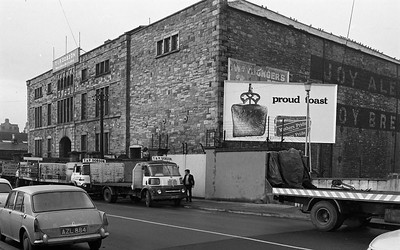
Joy Ale was quite heavily advertised in newspapers as has been mentioned but also elsewhere, as there is also a photograph of people queueing for a tram in 1948 with the words ‘Joy Ale’ written brightly across the front on the Irish Times website. The name was also written in large letters above the breweries name on the side of the brewery itself, as can be seen in this undated (c. 1970) image from Dublin City Libraries.

108_Mountjoy_Brewery

Right up as late as April of 1955 the Irish Press could carry the following piece about the beer:

Joy Ale has proved itself on the hard-fought battlefield of public taste, and has won a special niche in the heart of ale drinkers, not only in [Dublin] city but also a good competitor with cross-channel ales.

But sadly this heart-felt love was not enough to save the brewery and it closed in 1956, and so Ireland lost yet another of its former brewing giants. And one that had outlasted many of its rivals.

-o-

We might wonder what Joyce would have said about the loss of Joy Ale?

Although it probably matters little - as it is unlikely we would be able to understand him …

Liam K

(Here is the link to object #6)

Please note, all written content and the research involved in publishing it here is my own unless otherwise stated and cannot be reproduced elsewhere without permission, full credit to its sources, and a link back to this post.

Newspaper advertisement image © The British Library Board - All rights reserved. With thanks to The British Newspaper Archive (www.britishnewspaperarchive.co.uk) from whom I have received permission to display this image on this site. Label images are the authors own - as are the labels themselves. Embedded brewery image is via Dublin City Libraries Flickr page and copyrighted to them.

Wednesday, 8 March 2023

100 Years of Irish Brewing in 50 Objects: #4 - The 'Irish' Tulip Pint Glass

Aesthetical judgments can be divided just like theoretical judgments into empirical and pure. The first assert pleasantness or unpleasantness; the second assert the beauty of an object or of the manner of representing it. The former are judgments of sense; the latter are alone strictly judgments of taste.

A judgment of taste is therefore pure only so far as no merely empirical satisfaction is mingled with its determining ground. But this always happens if charm or emotion have any share in the judgment by which anything is to be described as beautiful.

Critique of Judgment, Immanuel Kant - 1790 (As translated by J. H. Bernard)

It would be extremely difficult to have a discussion on the history of the tulip pint glass – sometimes called the ‘Irish Pint Glass’ or ‘Irish Tulip’ – as it pertains to beer in Ireland without mentioning how it is the glassware of choice for almost every Guinness drinker to the point where it is also thought of as ‘The Guinness Glass.’ Rightly or wrongly, words such as ‘Classic’, ‘Traditional’, and ‘Iconic’ have been attached to this glass style for some time, and from a purely practical point of view it is certainly fit for purpose for nitrogenated beers, as the distinctive inward curve helps force the head to form a bump over the top edge of the glass to create the somewhat meaningless ‘domage’ revered by stout drinkers. The narrow, curvy waist is appealing too from a tactile point of view, it being a reasonable circumference to feel comfortable in the hand and makes for a balanced feel when lifted to the lips. So, it is quite easy to see its charm as a vessel for holding such a product, and perhaps shows why it became so popular in this country compared to other regions of the world.

But it could be argued that the belief that this is the only glass that Guinness Draught should be served in lies at the feet of the marketing people who are responsible for the image that is so idolised of a ‘Perfect Pint’ and, since the advent of image-laded social media, is reinforced by influencers and others who have taken up the mantle of ersatz marketeers for their favourite pint. This in turn has led to the demonisation of pints that are deemed to be badly poured or are served in anything other than a tulip pint glass by a certain section of Guinness drinkers, where the viewer’s palate is swayed enough by this image to declare it a ‘bad pint’ without actually using any of their taste buds. And although this may seem absurd and laughable to many a rational mind there is no doubt that rightly or wrongly this mind-set prevails in a certain sector of beer drinking society. It is explainable up to a point, as many have their favourite glass style for whatever beer they drink, but most do not believe it radically changes the actual taste in any real way.

And the opposite-if-similar effect might be argued for those who look at a photogenic pint and assume that it will taste excellent based on its appearance alone, perhaps deceiving their tastebuds into believing that a stout tastes better than the same thing from a straight tumbler, stemmed glass or tankard. 

I doubt Kant ever thought that his words would be used in a discussion on the aesthetics of a pint of stout but nevertheless they do perhaps hold true with regard to how we judge what may or may not be a good or bad drink – charm and emotion do perhaps affect the literal judgement of taste.

Conversely it could be argued that appearance and the subjectivity of opinion should be used as part of our general consumption and appreciation of beer – it does anyway as we have seen – and that there is no great harm in this belief. After all, this is a trick that food purveyors and restaurants have used for many years where the image presented on the plate in front of you fools your palate into believing and accepting that taste-wise the meal you are eating is greater than the sum of its parts. We eat and drink with our eyes and all other senses, and this does indeed taint our fickle palates for good or bad.

-o-

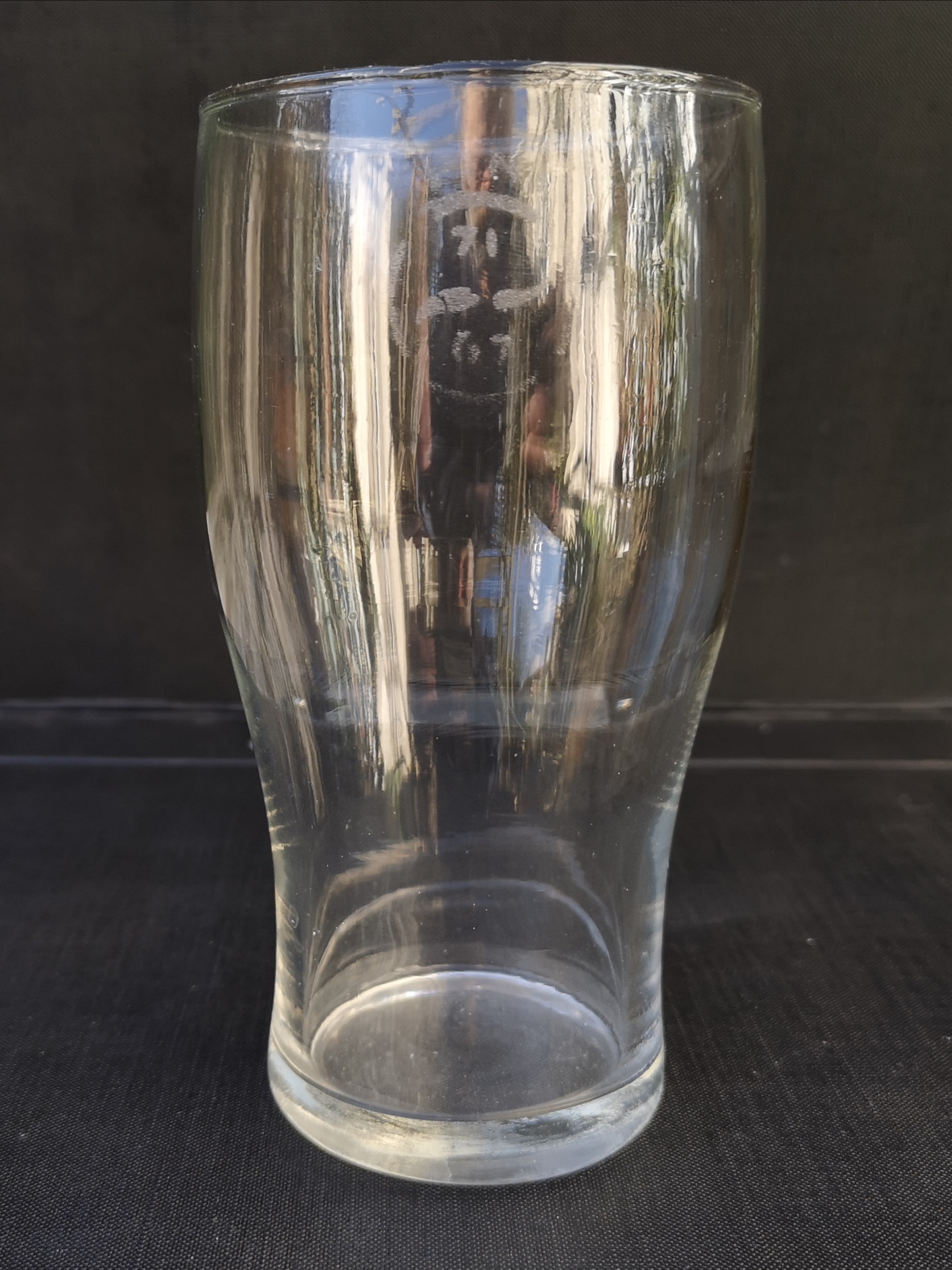
The tulip pint glass is a relative latecomer to the world of beer glassware, arriving in public houses after the straight-but-angled conical pint (Shaker), and the Nonic with its practical if hated bump. Dating evidence for this type of social history object is quite difficult to pin down, as descriptions of glasses in books, newspapers, and other printed media rarely if ever mention a glass’s shape apart from differentiating occasionally between a tumbler and a handled mug. Catalogues from glassware suppliers are also hard to come by so we are left with photographs of drinkers and barmen in public houses and similar establishments to guide us as to when certain shapes first arrived in Ireland. The shape appears in photographs taken in Kelly’s bar in Belfast in 1963, and it would be fair to assume that they were also available down south around this time. Very early examples of date verified tulip pint glasses appear relatively rare too, with the earliest in the author’s collection dating to 1967. Given this evidence we at least have a rough date for its introduction to these shores (and quite probably to pubs in general) as the early sixties or perhaps a little earlier, although as the oft repeated adage goes, absence of evidence is not always evidence of absence.

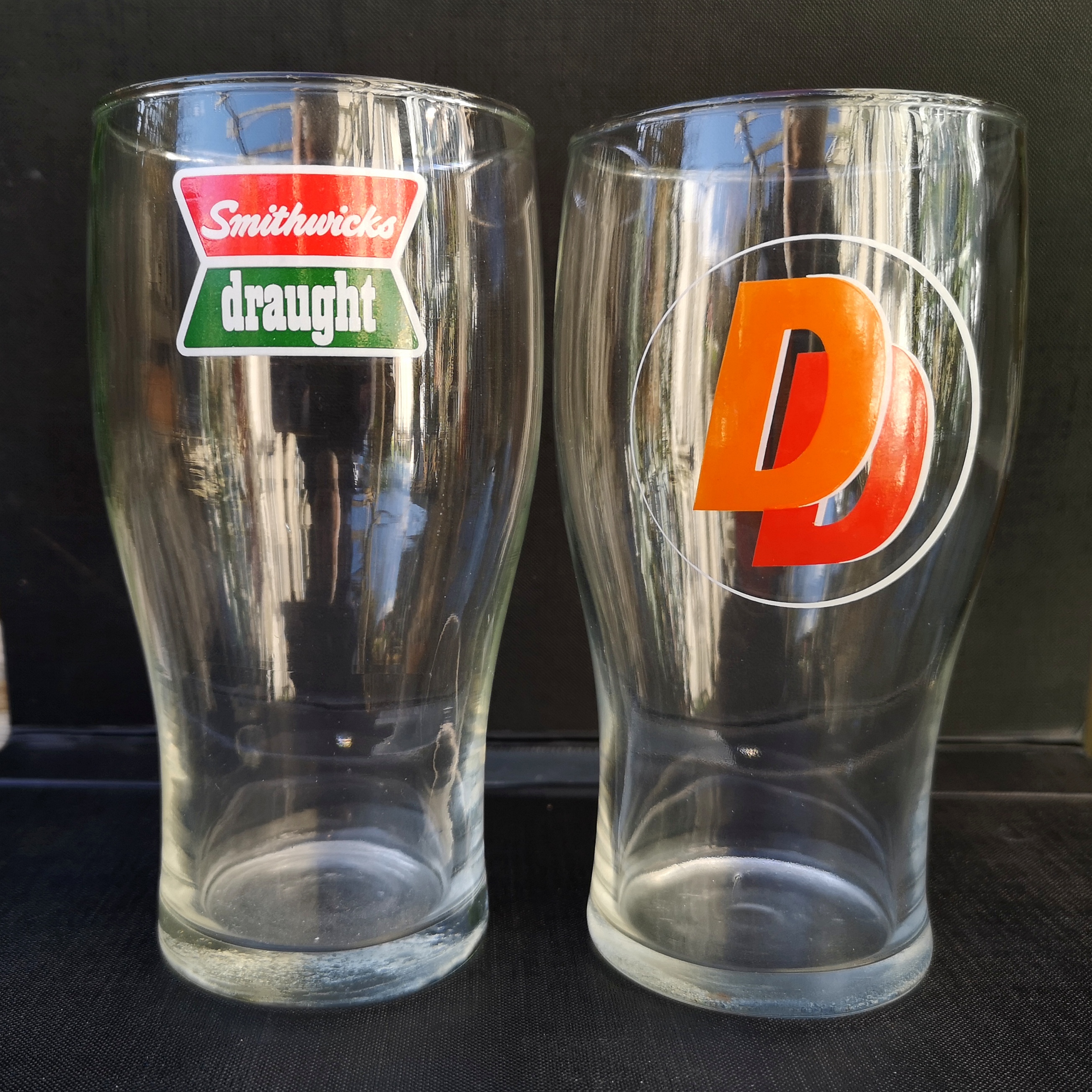
Branded tulip pints appear around 1967 and it is highly likely that they were first used – along with, or not long after, the pint glass tankard – for Smithwick’s Draught ale in Ireland, although there is a need to be wary about this assumption, as glasses can be branded years after their verification marks have been applied. Nevertheless, the brand used by Smithwick’s product on this glass appears to match its earliest design, and not long after this time Double Diamond had their own branded version in Ireland, as there exists pint glasses with verification marks for 1972.

Although there can be no doubt that Guinness was being poured into tulip pint glasses from when they were first introduced - as attested by that photo taken in Kelly's pub flagged above - the earliest evidence found of a branded Guinness glass being used in Ireland dates from 1976 in a FĂ¡ilte Ireland promotion shot of the interior of The Derragarra Inn in Co. Cavan, but Guinness were still using their branded tankard as well as conical glasses at this time too. This branded tulip may be very much an outlier but it at least gives us an indication of when such glasses were available.

The most notorious early use by Guinness of a branded tulip pint was for the ill-fated launch of Guinness Light in 1979, and it was not really until the 1980s and beyond that Guinness – as well as a host of other beer brands – began using branded versions of this style and variants of it in any major way. (It is possibly of interest to mention here that the updated version of the much-loved tulip launched by Guinness a few years back is yet another bone of contention for some Guinness drinkers.)

It is debatable whether it could be said that this shape is the ‘iconic’ glass for Guinness purely from a history point of view, as surely the famous tankard – that features prominently on those retro bar fonts still seen in pubs around the country – or the conical glass that graced much of the early advertising for more than half a century are equally as worthy of selection, not to mention the myriad of other Guinness glassware that has been used over the decades. It if fair to say that the age of the drinker plays a part in their believe regarding which glass should reign supreme – I think many of a certain age (although not necessarily old) might prefer the tankard in looks if not in actual usage.


It is worth noting that there were two half pint versions of the tulip produced but the taller version shown below appears not to have fared as well as its more popular brother and may have disappeared by the 1990s. Its heavy base made it a little unwieldly and perhaps there were thoughts it could be used as a formidable weapon!


 -o-

There is currently no information as to who first made this shape of glass but there is a good chance that it was from the prolific Ravenhead glass company, and they were certainly making them in the 1980s as attested by the logo on the bottom of glasses from this period. Also, Celtic Glass who were decorating glassware for Guinness and others were using Ravenhead as its supplier from when they commenced business in the 1970s, but here is no actual proof that they were first to introduce the design.

It is also worth highlighting that there may be something more to the popularity of glasses with curved sides (either outwards or inwards), as studies showed that the consumer drinks more quickly from a curved glass that from a straight-sided version. We need to be wary of such claims but this might explain the love by both breweries and the publicans for this shape, as the customer will drink more beer which is of course to the benefit of both of those enterprises!

Perhaps whether we follow the musings of Kant or the practicalities of science, all parties can end up as winners in the pub by using a tulip pint glass if they so wish? Either that or many drinkers have been fooling themselves as well as being fooled by those who supply beer and glasses for half a century or more!

Fool me twice…?

Liam K

(Here is the link to object #5)

(This is certainly a post that might need editing if more information comes to light ...)

Please note, all written content and the research involved in publishing it here is my own unless otherwise stated and cannot be reproduced elsewhere without permission, full credit to its sources, and a link back to this post. Glass and Glass images are the authors own and cannot be used elsewhere without the author's permission.

Wednesday, 1 March 2023

100 Years of Irish Brewing in 50 Objects: #3 - Cask Label for Perry's IPA

P
erry’s “Indian Ale” has the reputation of being stronger and better in quality than any other pale ale, whether manufactured in England or Ireland. And having once tasted that particular beverage one is inclined to be in complete agreement with that claim. In point of fact, the fame of this ale has extended to England and Scotland and large quantities of it is found in the wine cellars of connoisseurs in those two countries. […] There is one great advantage in drinking Perry’s Indian Ale; one cannot drink three glasses of it without feeling happy. Neither is it possible after so many glasses to remain unmoved; but better still, there are no “after effects” from this beer – and that is the verdict of one who knows.

Leinster Leader - 27th May 1933

Unlike bottle labels, which are a relatively common find for the small number of Irish breweries that survived into the first few decades of the 20th century, cask labels seem to be much rarer. This is of course because they were produced - and needed - in smaller quantities, and because they ultimately ended up back in the brewery who issued them or they became detached from the casks during handling or cleaning, but they do become available at times and facsimiles litter the internet on various sites, perhaps from stock acquired from closed breweries. It is at this point even difficult to know which breweries used them and which used coloured rims to differentiate their various beers – like Guinness did – or used other methods. This relatively rare survivor measures 164mm (6 7⁄16") in diameter and possibly dates from the late 1920s or the 1930s.

I am sure that some of the more casual drinkers in Ireland would be surprised that there was an Irish IPA available in this country at this time, as many see them as a recent phenomenon over here, but as many will also know, the history of calling a certain style of beer ‘India Pale Ale’ or something close to that, dates back over a century from the time when this label was issued, and its history in this country dates back almost as far.

For example, Eliza Alley, Sons & Co. in Townsend Street in Dublin were selling their ‘East India Beer’ in 1842 and declaring it similar to ‘Hodgson’s Pale Ale’ which was one of the more popular versions available in England – and beyond of course – at this time. Pale ales were available well before this date but this is an early reference to something that was at least implied to be an IPA, to use its modern moniker. This style of beers was brewed by various breweries in various guises for the next hundred or more years in this country and the last brewery to brew a beer under this name was the shown label’s owner - Robert Perry & Son Ltd. of Rathdowney in Laois, who were still brewing a version as late as 1964 according to their brewing records, although by this time it may have just been called ‘Perry’s Ale.’

Freeman's Journal - 12th August 1842

The brewery visit quoted above mentions that Perry's only used Irish malts and no adjuncts and that appears to be true at this time but in later recipes for their IPA they were using Californian barley, inverts sugars, malt extract, and caramel, as well as the usual Oregon and English hops. Their range in the 1930s consisted of a Pale Ale, IPA, X Ale, XX Ale, X Stout, XX Stout, and on at least one occasion a Special Stout.  There is another version of this label that shows that there was a bottling IPA being shipped to independent bottlers and public houses as well as a draught IPA that was served straight from cask, and indeed the source quoted above mentions ‘four varieties of draught ale being available and two varieties of bottled ale' – the two bottled probably being their IPA and the XX ale based on surviving bottle labels from this era.

The barrel sizes used by Perry’s around 1900 were 52 Gallon hogsheads, 32 gallon barrels, 16 gallon ½ barrels and 8 gallon ¼ barrels to use their own terminology from showcards showing their range and size from that period. These are different to Imperial barrel sizes used elsewhere on these islands, where a ‘Barrel’ was 36 gallons, and it may have created havoc for those who needed to keep account of barrels and returns back to Ireland from England and elsewhere, unless they had 'export' barrel sizes? These Irish volumes were a leftover consequence of Ireland having their own system of measurement in the past, and that obviously included other volumes like pints and gallons too - so the Irish pint was a smaller serve than an Imperial pint at one time, and this may have had other consequences as will be seen when we discuss glassware at a later point in the series.

Somewhat later, in June 1950, a photograph appears in the Waterford Standard that shows part of a ‘big cargo of beer casks from Liverpool’ that has been loaded onto ‘one of a fleet of lorries’ being readied for dispatch to the brewery in Rathdowney, and gives an idea of the volume and size of a ‘barrel’ of used at this time, and by now Perry’s may have changed to the Imperial barrel size of 36 Gallons.

Finally, here is another quote from The Leinster Leader writeup from 1933:

During my visit to the Brewery I witnesses an incident worthy of narration. I was seated in the office when an employee entered and spoke to my host who offered him some money. This the man declined and spoke in undertone to Capt. Pim who nodded his head and with a smile wrote something on a piece of paper and [I] must have betrayed my curiosity for Capt. Pim explained that the man and two others had for personal services rendered requested that they be given as payment a glass each of Perry's Indian Ale; and the paper he had given was an order to that effect. It was then I decided to sample that ale for myself and came to the conclusion that those men were rare good judges of an excellent drink.

What this says about the quality of the beer over the need or want of the employees to drink on the job is a subject that could be up for debate, but it certainly sounds like a ringing endorsement for Perry's IPA, although any editorial advertisement such as this needs to treated with at least a hint of scepticism.

(The Captain Pim mentioned here ran the brewery at this time and may be related to the Pim in Jameson, Pim & Co., the brewing company that merged with Watkins brewery in Dublin in the early 1900s, and possibly to the Pims who had a brewery in nearby Mountmellick in the 19th century. Perhaps not, but it would seem that the brewers of Ireland were a quasi-incestuous lot, as the same names appear time and time again in various breweries and related enterprises throughout the country.)

-o-

The idea of being able to buy a pint of Irish-brewed IPA poured from a wooden cask is certainly of great nostalgic appeal to those who enjoy our Irish beer history and would love to taste any connection with our long-lost brewing past. And it can be sampled in some ways, as certain homebrewers have repeated those recipes with minor success (and albeit with some changes, interpretation and substitution), all they need is a wooden cask, a nice brass tap - and a label to stick on its end for that last piece of authenticity ...

Liam K

(Here is the link to object #4)

Please note, all written content and the research involved in publishing it here is my own unless otherwise stated and cannot be reproduced elsewhere without permission, full credit to its sources, and a link back to this post.

Newspaper images ©The British Library Board - All rights reserved. With thanks to The British Newspaper Archive (www.britishnewspaperarchive.co.uk) from whom I have received permission to display these images on this site. Label and label image are the authors own and cannot be used elsewhere with out the author's permission.

Thursday, 16 February 2023

100 Years of Irish Brewing in 50 Objects: #2 – Guinness’s Brewery Guide Book (1914)

There is a constant stream of visitors passing through the brewery. A special office and staff is set aside for their reception. They come in from the street, and hand over their permit to a clerk, who in return for it supplies them with an illustrated guide book to the works, containing at the end a packet of half a dozen beautifully finished post cards of various parts of the works.

A visitor to the Guinness brewery reporting in The Kirkintilloch Herald - 19th August 1914

The Guinness Storehouse and the attractions contained within have been consistently topping the most visited places in Ireland for many years, and regardless of what people think of its history, heritage and beer there is no doubt that it has been a huge success from a tourism standpoint, enticing many a visitor to these shores and to the city of Dublin since it opened in 2000, replacing the older visitor’s centre in the Guinness Hop Store. According to Guinness’s own marketing, at The Storehouse you will ‘experience the history, heart, and soul of Ireland’s most iconic beer’ by means of multiple floors filled with all thing Guinness and Guinness related.

Visiting the famous St. James’s Street Brewery is not a new phenomenon and dates back quite far, as there were visitors getting a look inside those famous gates, and right into the brewery itself, well over a century ago at the very least. The guidebook shown here dates from 1914, the very year of the above quotation and sounds extremely like the one described in it, although sadly this one is missing the six postcards and the envelope from the back. The well-worn embossed cover with its wonderfully scrolled decoration and even the text itself evokes that era just at the start of the Art Nouveau period and this design appears to have been in use until a more durable and substantial hardbacked guidebook was introduced in the 1920s. There were earlier versions too such as one form 1897 titles “A Visit to St. James’s Gate Brewery Dublin” published by the London Stereoscopic and Photographic Company in England mentioned in the Dublin Daily Express in August 1897 and an earlier one with the same title in the National Library of Ireland dated 1889 printed by Wilson, Hartnell & Co. of Dublin - incidentally, a company which is still operating today under a somewhat different if related guise.

The 1914 publication was printed by James Walker Ltd. from Rathmines, Dublin who claimed to be ‘Printers to the Brewery’ according to the end page of the booklet. The small volume features a brief history of the brewery as well as a description of what the visitor will see as they journey through the works. The brewing process is described in reasonable detail within its 16 printed pages of text as the visitor is taken through the newer of the two breweries on the site. Interestingly that journey included a visit to the then new fermenting house which was built in 1907, this is the building that currently houses the modern visitor’s centre with the Gravity Bar where people can try the beer perched on top. That 1914 tour also ended with some beer sampling, with four types being offered – ‘”Foreign” Stout for export to foreign countries; “Export” Stout for special trade; ordinary Double Stout, generally called Extra Stout; and Single Stout generally called Porter.’ Some facts are listed in the back of the booklet too, including that the brewery covers 50 acres; uses 180,000 acres of barley and 8,000 acres of hops; they were selling close to 100 million gallons of beer a year; the amount of duty paid by the company in 1913 was £1,368,355, which was almost triple what the next largest brewer on these islands paid; staff numbered 3,650; and the number of bottle labels issued daily put end to end would reach from Dublin to the Isle of man, and the total quantity issued in 1913 would stretch 26,000 miles, ‘or more than round the world.’

The descriptions and facts in the guide book had been written, assessed and vetted by Guinness and although they give quite a lot of interesting detail, it perhaps lack some of the more entertaining descriptions and interesting nuggets of information we might crave. For that we must turn to the words written by those who went on these tours and then wrote about them in newspapers and in other publications.

The Journal of the British Dental Association, Volume 9 published in 1888 does not at first glance seem to be somewhere to find a poetic and dramatic recount of a visit to the brewery but it contains a wonderful report of a visit to the Guinness site by someone who signs themselves ‘Stout and Mild’ regarding an excursion by the association to the James’s Gate Brewery in August of that year. It is peppered with the flowery prose that was quite common at this time.

“In companies of twenty the members of the Association, and their friends of both sexes, were led off by courteous guides holding high office in the establishment and were initiated into all its mysteries. Mysteries there were, sufficient even to satisfy a modern romance writer. Indeed, the wanderings of Rider Haggard's mysterious ‘She,’ in the bowels of her rocky African fortress, or of Virgil and Dante's in the infernal regions, sink into comparative insignificance when compared with the wanderings of the British Dental Association through this weird region of booming machines, steaming cauldrons, colossal mash tubs and frothing seas of darksome liquid.

Forward went the little companies, soon falling apart, by foaming torrents of sweet-wort dashing side by side with cooling streams, on either side endless plains of germinating grain. High above head advance parties could be seen threading their way across narrow bridges and looking small at the dizzy height, like roped gangs of mountaineers when viewed through telescopes from some Alpine valley. Onward still now peering through the Stygian darkness of unfathomable reservoirs filled with the fermenting liquor, whose heavy froth could dimly be seen rising and falling in sullen gloom as it emitted its deadly gaseous poison. On again now letting the eyes wander at leisure over veritable oceans of tranquil stout, calmly awaiting the right moment for ‘cooling down.’”

It would be quite difficult to find a more remarkable description of a tour of any brewery, and the writer continues …

“At this point the Association reassembled, and a dainty little railway train awaited. All being seated, the diminutive engine started off at a merry pace, but soon however entered a darksome tunnel which led by a spiral descent to a part of the establishment, on the level of the Liffey, where a new world opened up. Here the barrelling process held sway. Barrels in thousands were everywhere. Barrels were being made, mended and filled the stout being conducted in pipes from the storage vats. Little railways, both broad and narrow gauge, intersected in all directions. It was amusing to see the way in which the narrow gauge engines were made serviceable on the broader gauge when necessary. These little creatures were lifted bodily into the air by a sort of crane, where they snorted with evident delight at the prospect of their promotion, and were then let down into trucks on the broad gauge line, whose wheels by an ingenious arrangement they were able to keep in motion. 

But one thing remained, and that was to taste the result of all this outcome of human ingenuity, skill and enterprise. The Association tasted and pronounced the result excellent.”

It is fascinating to hear amongst all of that flamboyant description how the narrow gauge engines were used on the larger gauge system – not to mention that wonderfully imagined thought of a ‘snort’ of delight that they gave at the knowledge of moving up in size!

Another professional group, The Society of Chemical Industry also reported on a visit to the brewery in 1891, which was published in The Pharmaceutical Journal and Transactions in 1892, and although quite matter-of-fact compared to the above piece it relays some interesting ‘facts’ - although we must be quite wary of anything reported by visitors.

“About one tenth of the whole is roasted malt, giving the beer its characteristic colour and flavour, the rest being the ordinary dried variety Irish, Algerian and Tunisian barley are all used.”

So our writer is reporting that at this time 10% of the grains used in the brewery were roasted malt, and that some of the pale malt, or most likely the barley used to make the malt, was North African in origin. That same Algerian and Tunisian barley is mentioned as being used by Power & Son’s distillery, a place they visited before heading to Guinness’s. Indeed, a messenger had to be sent from the Guinness brewery to Power’s to find out where the visitors might be as it was feared they might have gone astray!

The writer continues the tour into the fermentation area.

"The requirements of the work [in cooling the fermenters] however made another machine necessary, and one with liquid carbon dioxide was put in. In order supply this it was suggested that the carbon dioxide given off during fermentation should be collected and compressed. This was done and the surplus sold other users of freezing machines worked by liquid CO2."

It appears from this report that Guinness were harvesting and reusing the carbon dioxide that was a by-product of brewing in their cooling systems, and were also selling it elsewhere at a price reported to be 4d per lb. and in bottles containing 25 lbs. each. This is certainly an ingenious and profitable way of making money from something that is essentially a waste product, and is something that is still being done by breweries to this day.

The report of the tour contained more information too, such as how the casks were cleaned in an ingenious way …

"The cask is placed in a cradle, is partly filled with hot water and closed by a bung to which a spiked iron chain is attached inside. The frame communicates a tumbling motion to the cask and at the same time rotates it about its major axis, so that the washing action of the water and the scraping action of the chain take place at every part of its interior."

The writer also goes on to mention how the rims of the casks are colour coded depending on what they contain, single stout (porter) being white, double stout the familiar red, and the export yellow. (Something that was reported by Alfred Barnard on his visit to the brewery for his books on the breweries of these islands around this time too, and Alfred goes into much more detail on the brewery, buildings, process and other details than any other author at this time.)

Our starting quote referenced a visit by an unknown writer in a newspaper to the brewery in 1914, the date of our guide book. The title of the piece was 'A Political Pilgrimage to Ireland – Visit to Guinness’ Brewery and in the article the writer impresses upon the reader just how ubiquitous Guinness is in the city of Dublin – this hasn’t changed in a century.

"Guinness’ Stout dominates Dublin. […] As soon as you pull up your blinds in the morning you see a line of barges making their way down to the harbour laden with barrels of stout. […] If you cross the street without due care you are apt to be run down by Guinness’ motor lorries rushing the stout down to the place of embarking [and] the firm’s traffic all but monopolises the streets of Dublin."

The author also mentions that all Guinness ‘motor men or bargemen may be known by their 'head gear' as they all wear ‘felt hats of orthodox shape with a black band of glaced [sic] leather going right over the crown from ear to ear.’ These appear to be bowler hats like the one shown here from a later guide book, with the band clearly visible.

Our visitor also tells us that at this time the site had 9 miles of railway track and 20 locomotive engines, and other figures such as the total amount of water used by the brewery is 7 billion gallons a year!

There are more figures to come, the above-mentioned fermenting house that is the current visitor’s centre was originally constructed with 2 million bricks and 3,650 tons of steel, along with 200 thousand cubic feet of concrete. That building contained 16 fermentation vessels with a total capacity of 208 thousand gallons. The vat house nearby contained 190 vats with a total storage capacity of almost 14 million gallons or 110 million pints or porter. Those were made of English oak and hooped with of half a mile of iron strapping. On the transport side of things, the stables housed 100 horses – mostly Shires and Clydesdales – and the company operated 60 motorised lorries that could reach the heady heights of 12 miles per hour. (That comment makes a mockery of the earlier comment about being run over by a ‘rushing’ vehicle! )1,500 new casks are made weekly and up to 15,000 casks can be filled daily, with a dozen being filled at once from each racking engine. (I truth, most of these figures had been pulled by the author from a slightly early edition of the souvenir guide, as the one shown here was printed a couple of months after their visit, but the design seems to be very similar if not the same.)

And lastly of course the author got to sample the produce – the same four variations mentioned above – ‘In neat aluminium mugs the visitor gets a fair sample of each, and with his breath turned makes his way into the outer world.’ It is of interest to see that right up to the end of the tour the focus is on the process and the product, with the sample beers at the end served in plain metal mugs. There is no hint at the marketing that would follow, where the idea of ritual, aesthetics and the drinking experience – rightly or wrongly - would perhaps become more important than the actual beer itself, although obviously you need to have a product before you build hype. That might make some people a little sad about how our brewing history has been reduced to products where we once had breweries, with beers like Smithwick’s as well as Guinness, and even the less well known Macardle’s each having essentially been compressed into a brand, and it could be argued that in doing so it severed their true historic connection to a richer and more varied past for many drinkers - a connection we should try to re-establish.

Regardless of all that, there is many a beer historian and others who would love a chance to experience the beers of this earlier era. Perhaps Guinness might oblige at some stage with a new/old exhibition where visitors get a chance to taste the porters of the past, preferably out of one of those aluminium mugs …?

Liam K

(Here is the link to object #3)

Please note, all written content and the research involved in publishing it here is my own unless otherwise stated and cannot be reproduced elsewhere without permission, full credit to its sources, and a link back to this post. The images of the featured booklet are the authors own, as is the booklet itself.