Showing posts sorted by date for query lane's. Sort by relevance Show all posts

Thursday, 18 April 2024

100 Years of Irish Brewing in 50 Objects: #20 - The Harp Magazine (1963)

A TELEPHONE shrills in the Brewery Fire Brigade night quarters at 84 James's Street.

“There's been an accident.”
“Where?”
“In the brewery yard at the old weighbridge.”
“How many injured?”
“Two men.”
“Badly?”
“I don't know.”
“Right, we're on our way!”

The four-man team pile into the ambulance stationed outside and in a matter of moments are at the scene of the accident. Accident? Well, not a real one on this occasion. To keep the members of our Fire Brigade on their toes a competition is staged annually to provide practice in rescue technique. This year seven teams, each of four members, had been drawn out for the contest and the two teams of finalists were going through their paces in the presence of the Board.

Conditions made as true to life as were possible and on arrival the rescue teams discovered two men trapped in a crater beneath a pile of planks and rubble, which had collapsed on top of them.

Under the searching gaze of Dr. Eustace, F. W. Derbyshire and Dan O'Brien they go into action One man, still conscious, whose leg is trapped beneath a plank, presents the symptoms of a compound fracture; the other (a dummy) has the signs of a skull injury.

Praise is due to John McGuirk of the Rigging section, a most realistic casualty whose acting lent an authentic touch to the proceedings.

Both units displayed a high standard of proficiency, but the judges finally decided in favour of Team A, led by Edward King, with Dermot Harnett, James Scallan and James Duffy giving able support. Sir Geoffrey Thompson made the presentation to the winners at a short ceremony in the Fire Station afterwards.

We in the Brewery have indeed reason to be thankful that we have such a well-trained group of men on hand, should a real accident call them into action.
The Harp – Spring 1963

Work was a dangerous place in the past, and certainly for those who worked in industrial spaces full of noise, distractions, heat, and time pressure, then add to that toothed and spinning machinery, elevated gangways, and equipment literally on an industrial scale. Many workers were taking their lives in their hands every day that they showed up for their job, and although it would be incorrect to say that there were no safety measures in place in the 19th and early 20th century, there were certainly far fewer procedures and checks in place than we would expect to see in any factory are large processing plant today.

The above quoted training procedure from the Guinness brewery in Dublin demonstrates that breweries in Ireland were certainly as dangerous a place to work as any other similar sized and focussed enterprise, perhaps even more so, due to the oversized buildings and equipment which needed to be scaled in numerous ways at various times, and also the use of hot liquids and other unseen hazards as we shall see.

Breweries could be unforgiving and deadly places at times, and please note that this article will deal with and describe some of those deaths so those who feel uncomfortable with these types of descriptions should probably not continue.

-o-

The newspapers of the 1800s and early 1900s are dotted with reports of deaths in Irish breweries to the point where almost every decade had a report or two of workers being killed on or off site. It is, even at this remote juncture, a difficult read, as many of the reported inquests go into the details of precisely what happened these individuals, and often include a list of the people they have left behind, where sometimes, almost an afterthought, the reporter will mention the wife, children, parents or siblings that were left in heartache and possible destitution at the loss of a loved one. It is worth remembering at all times that we are dealing with actual human beings who lived not terribly long ago and who possibly still have ancestors walking our streets whose lives were affected directly or indirectly by such a dreadful occurrence.

Deaths appear to have happened in almost every brewery in this country and from multiple causes. Falls were quite common, with brewery workers - or at times hired contractors - tumbling to their deaths from the gangways that stretched across the upper reaches of the tall brewery structures. Falling from the top of the various brewing vessels was a hazard, as was falling from the roofs of the buildings themselves. At times the unfortunate individuals tumbled into mash tuns, kettles and other hot water sources, or fell close to lit boilers and suffered agonising scalds or burns that more often than not resulted in death.

Drownings in porter vats, wells or water tanks also occurred, and in the case of the deaths in vessels which held beer, the owners of the breweries were forced to comment on the fact that the porter within was dumped, due to scurrilous reports of the beer still being put out for sale after the event. In 1874, at the inquest into the drowning of a worker in a vat of porter in St. Fin Barre's Brewery in Cork, Mr. Thomas Lane felt the need to put on the record and into the local paper that 'an injurious report has gone abroad that we stocked a quantity of the porter, whereas it is all gone down the river.'

There were rarer fatalities too, such as the man who suffocated in barley in Perry’s brewery Rathdowney in 1906 when he stood in a hopper containing grain which was then then tipped into a larger silo along with the worker and he was smothered by more grain being added while the unfortunate man was still inside it, something similar had occurred in Guinness in 1895 too.

There are also particularly gruesome accounts of workers becoming entangled in a piece of machinery in the brewery with the obvious and unrepeatable horrific injuries that this would entail. One particularly poignant report from 1867 tells of an 11-year-old boy who while visiting his father’s place of work – the Beamish & Crawford brewery in Cork – was caught in the cogs of machinery. He lost a leg amongst other injuries and died later in hospital.

One form of death that seems to have been dreadfully common was death by carbon dioxide suffocation, where a worked descended into a fermenter to clean it out without realising that it was full of this deadly odourless gas, a byproduct of the fermentation process, which can incapacitate a person almost instantly. This type of death was relatively common, and some of the fatalities recorded in this way were in an unnamed Cork brewery in 1782, Guinness’s in 1839 and 1864, Lane’s brewery Cork in 1846, Wickham’s in Wexford in 1869, Jameson and Pim’s in 1894, Darcy’s in 1898 and 1915 and Cairnes Brewery in 1908. Tragically these sometimes involved two or three fatalities, as one person went down to aid the other as happened in Clonmel Brewery in 1916, when three worked climbed into a vat one after another to help the others and were overcome, only one survived.

TRAGIC CLONMEL AFFAIR
Two Brewery Workers Killed.

A shocking tragedy occurred at the Clonmel Brewery resulting in the death of two workmen and the narrow escape of a third from similar fate. While a man named Michael Mc*** was engaged on a ladder washing, with a hose, a large vat, about 15 feet high, covered at the top, and entrance to which effected by means of a ladder through a trap door, he was overcome gas fumes and fell the bottom. Another employee, James R***, apparently climbed down to the rescue, but was likewise overcome and a third, P. C*******, followed also for the purpose of rescuing his fellow-work men, but he too was overcome. Further help was quickly at hand; holes were bored in the sides of the vat to let in air, and, eventually, the three men were pulled out, and placed on the top where, under the directions Drs. Wynne, O’Brien, and Murray, artificial respiration was employed for several hours. C******* recovered under this treatment, and was sent hospital, but all efforts to revive Mc**** and R*** were unavailing. Distressing scenes were witnessed as the bodies were removed to the Morgue, the wives and relatives giving vent their grief. Rev. W. Walsh, C.C., was promptly in attendance and climbed to the top of the vat to minister to the unfortunate fellows. Both of the victims were married, R*** leaving a large young family.

The same calamity happened in Manders brewery in 1882 where one of the three men died.

FATAL ACCIDENT IN MANDERS' BREWERY

On Saturday evening three men, named George D****, Patrick R*****, and Patrick J****, were working on a loft in Messrs Manders' brewery, 113 James's street. D**** went in to a vat for some purpose, and was immediately rendered insensible by the carbonic acid gas. R***** and J**** went to the assistance of D****. and were themselves immediately overcome by the gas. In the meantime the three men were missed, and with great difficulty got out with the aid of ropes. D**** was found to be dead, and the other two remain in a precarious condition.

Reports of these types of deaths used words such as ‘foul air’ or ‘gas fumes’ or ‘spirit’ as well as ‘carbonic acid gas,’ so it appears that many breweries were aware of the issue but didn’t have the terminology or knowledge to know exactly what was the cause in the very early reports, although it appears to have been common practice to lower a candle into the vats, as it would be extinguished by the presence of this ‘foul air.’ There are also mentions of the need to open taps - or bore holes in an emergency as mentioned above - to let air in, or probably more accurately as we now know, to let the heavier than air carbon dioxide flow out.

-o-

Outside of the brewery could be a dangerous place to be working for the brewery too, especially if you were a drayman who hauled beer around the country to the various public houses or bottlers. Drivers lost their lives on occasion in accidents such as one drayman for a Dungarvan brewery who in 1870 was killed when his cart collapsed and he was pitched forward into the space between the horse and the front of the vehicle, where he was kicked to death by the animal as it tried to extricate itself. He left a wife and six children to mourn his untimely end.

A young driver from the Macardle Moore brewery in Dundalk who was delivering ale to the local military barracks in 1868 was killed when his horse was startled by the sound of a trumpet and bolted. The unfortunate individual was run over by the wheels of his own cart as he attempted to catch the reins to stop the horse.

A driver for Perry’s brewery in Rathdowney drowned in a water-filled ditch near Cuddagh Bog when the cart he was steering overturned and trapped him beneath it in 1905, and a similar accident occurred much earlier in 1829 when a drayman for D’Arcy’s brewery was drowned while attempting to rescue his horse which had ended up in the canal at Ringsend, and both man and beast perished.

But it wasn’t just drivers that were killed as can be seen from the following incident involved a young drayman from the Creywell brewery in New Ross owned by Cherrys.

FATAL ACCIDENT

During the Quarter Sessions in New Ross, an old man named P****, a farmer, from Misterin, county Wexford, was knocked down outside of the Courthouse by a local brewery van, which rolled over him, and killed him almost immediately. The driver of the van, a boy named Peter W*****, was immediately arrested and remanded. The evidence up to the present show that the deceased was more or less intoxicated - that there was [sic] some cars down the footpath outside the sessions house railings, which made the narrow lane still narrower - that W***** was driving the brewery horse (which is blind) at the rate of about six miles an hour, and did not slacken his pace coming around the corner of Cross Lane; that the deceased was crossing the lane obliquely, when the "off" shaft struck him, and when the people shouted out to the driver to stop, he pulled up, just as the wheel had rolled up from the unfortunate man's abdomen to his neck, and that he died almost immediately. Mr Colfer, solicitor, is engaged for the relatives of the deceased, and Mr Hinson, solicitor for the defence of the prisoner. Mr Carey, D.I., R.I.C, prosecuted. Bail was refused.

It would be hard to decide here whether the drunken individual, the speeding driver or the blind horse were to blame.

Sadly, small children were killed by brewery drays on at least two occasions, and there were probably even more fatalities than that. In 1899 a float belonging to Mountjoy brewery in Dublin was involved in an accident with a two-year-old boy which resulted in the loss of the child’s life, and in 1912 a three-year-old girl was killed near Bow Bridge, also in Dublin, having been run over by a dray belonging to D’Arcy’s brewery when she ran from a shop and tumbled under the wheels of the cart.

Staying with transport there have also been a few fatalities related to steam engines, with crush injuries and other accidents known to happen. For example, in 1889 a driver died on the narrow gauge in the Guinness brewery when he was knocked from his engine in a tunnel while driving between the brewery and the quay. He was crushed between the wall of the tunnel and his locomotive.

Even tugboats plying the Liffey were not completely safe, as in 1879 an employee of Guinness who was working on the steam tug Lagan was drowned after the boat hit the central arch of the Queen Street Bridge – now called Mellows Bridge - and he was thrown into the river with a companion, who survived.

-o-

Stranger incidents occurred too, such as the death in 1891 of a man in Kilkenny from rabies he contracted from a dog who ran into Sullivans’ James’s street brewery.

DEATH FROM HYDROPHOBIA

In the Moderator of Saturday but we stated that a man named Martin M*****, who was employed as a vanman in the James's-street Brewery. Kilkenny, was lying so dangerously ill in the workhouse hospital with an attack of hydrophobia that he was not expected to recover. We regret to state that the poor fellow expired early on Saturday morning last. One day in March last, it may be remembered, a dog - which it was afterwards discovered was suffering from rabies - ran into the yard of the James’s-street Brewery, where poor M***** was working. The dog ran towards M*****, and on raising his hand to keep the animal back, it immediately snapped at him and bit him on the finger. Information was at given of the to the James's- street police. and early the following morning the dog was destroyed, Mr. John Barry, V.S.. having pronounced it to be suffering from rabies. M*****, on hearing this. did not, as he should have done, place himself under medical treatment, but continued, poor fallow, from day to day at his usual employment until last Wednesday evening, when he was taken suddenly ill. Dr. Hackett was immediately sent for, and he at once stated that M***** had developed symptoms of hydrophobia, and ordered him to be removed to the hospital of the workhouse. Hydrophobia is, according to one of the highest medical authorities, a disease from which scarcely any person has ever been known to recover, and but little hope was entertained of the unfortunate sufferer's recovery. From Wednesday evening be continued to linger on until Saturday, when, as we have stated, he expired in great agony. The greatest sympathy is entertained for the deceased man's wife and family in their bereavement, and the large assemblage of the general public at his funeral on Sunday last testified to the high esteem and regard in which the deceased was held. It is a most unfortunate thing that a human life should be thus lost, merely by not having a strict law enforced as to the muzzling of dogs, and it is to be hoped that the authorities will take such steps in future as will prevent a similar dreadful occurrence.

As seen above, brewery horses died on occasion too but in 1896 there was an unusual occurrence as reported below:

A HORSE STUNG TO DEATH

On Saturday last, the 20th instant, a man named Daniel Brennan, was dispatched from the firm of E Smithwick and Sons, St Francis Abbey Brewery, to the licensed premises of Mr T Kennedy, Bennettsbridge, Kilkenny, with a load of drink. He arrived there about six o'clock, and after he had made delivery, was about leaving for home, when quite suddenly, a whole hive of bees landed on the horse’s head and neck to begin their deadly havoc. Immediately the horse became frantic and dashed madly along the road for some distance, when he was with much difficulty brought to a standstill. Some helpers having arrived at the time, he was unyoked from the car. and put into an adjacent field. Here he lay down and remained in the most acute pain until the following morning, when he was got up and removed slowly along the road. He never rallied, however, and on Monday morning he expired after undergoing the most dreadful agony.

-o-

It is worth mentioning that in many cases in the deaths reported above there was a recommendation for the breweries to make some payment to the dependants of those who died, and it would be good to think that this was followed up on, or that there was payment made via The Workman’s Compensation Act which legislated for such eventualities. But it is also worth restating that these were all real people who died in tragic circumstances, but with each death it could be hoped that steps were put in place to lessen the risk of a reoccurrence of such a tragedy in the future. The outcome can perhaps be seen in the opening quotation from Guinness’s The Harp magazine - a brewery that has seen its own fair share of those deaths as we saw - where at least there was a rapid response if an accident did occur, and presumably more preventative procedures in place too.

I know many people love a ghostly story, so maybe some think that a form of essence, or possibly a life-echo reverberation, still inhabits the brewing-related (and other) places where these deaths occurred. Perhaps they think that a small part of the dead's souls live on even still, although many of the locations are now homes, offices or just empty spaces. But whatever our thoughts on whether ghosts exist or not at least these unfortunate people live on in one way in the faded ink of newspapers - or in pixels and 1s and 0s - for ever, perhaps. They are fact not fiction.

Stories are just that, tales for entertainment be they ghost related or not, but death is real.

So brewers, be safe.

Liam K

(I have deliberately left out a couple of deaths I came across, as even though much time has passed they are connected to living, known descendants. I have also left out any mentions of self-harm or murder, and I have purposely doctored the surnames of victims in newspaper reports. As someone whose great-grandfather met a gruesome machinery-related death over a century ago, the subject and thought of his name appearing in an ‘entertaining’ article might make me or my family members feel uneasy, hence my reticence to use those last names.)

Please note, all written content and the research involved in publishing it here is my own unless otherwise stated and cannot be reproduced elsewhere without permission, full credit to its sources, and a link back to this post. The photograph and magazine itself are the authors own and the image cannot be used elsewhere without the author's permission. The actual magazine was published by Guinness for its personnel, which allowed use such as I have done here according to the notes inside the front cover. Newspaper research was thanks to The British Newspaper Archive and the exact sources for the deaths and quotations mentioned and shown above can be requested from me via email or message. DO NOT STEAL THIS CONTENT!

Tuesday, 20 December 2022

Brewing History: An Early Mention of (West) India Pale Ale...?

A couple of interactions on social media recently regarding the term 'India Pale Ale' both - East and West - got me digging into references to the term, and the earliest I could find via my go-to newspaper archive was this advertisement in a Barbados newspaper from March 1824:

It is certainly a nice early reference to to the term 'India Pale Ale' although it is with regard to the West Indies version, and Edd Mather has asserted it was darker than the 'East' version as referenced in the below-linked post by Gary Gillman. (I will list all references flagged during that interaction at the end of this post too, including one from Alan McLeod and from Martyn Cornell regarding EIPA.)

It does make me wonder if the term West India Pale Ale - purely as a descriptor - predates the use of East India Pale Ale? It is probable of course that both terms were in use well before this time but seeing it in print certainly gives, at the very least, a time-stamp to its use and perhaps how its meaning was perceived. (I have no doubt we will come across earlier examples as more printed material is digitised but it is important to record these these references when we find them.)

What is certainly of interest to me and Irish brewing history is that Lane's of Cork were using the descriptor for their West India Porter - a product they were relatively famous and well-known for - earlier in print, as this advertisement from the same newspaper but from March 1821 shows:


Again this is meaningless in a way but it is good to record these things, and it is certainly of interest to see it in print. (Incidentally, I have a huge amount of scans of documents from the Murphy's Archive in Cork University, and in a few brewing logs there are references and recipes for 'West India' beers that need analysing and time spent on them, they don't show which brewery they are from but the could be from Lane's given the movement of personnel between all the Cork breweries and their more recent merges? I need to get back into those soon.)

Anyhow, there is lots of more information written by others for you to read through but it certainly is a subject that needs more digging into, if quite carefully given the geography, history and other implications of the commercial enterprises.

More reading that came from that original interaction:

Gary Gillman: 1829 Canadian References to India Pale Ale & a follow up here West and East India Madeira: Lessons for Beer

Martyn Cornell: The earliest use of the term India pale ale was … in Australia?

Edd Mather: J & R TENNENT : ALES 1830 - 1831

Alan McLeod : More References To That Shadowy Taunton Ale

Also:

I have posted previously about Lane's Brewery in Cork.

Liam K

West India Pale Ale mention - Barbados Mercury and Bridge-town Gazette - Saturday 27 March 1824
Lane's Porter mention - Barbados Mercury and Bridge-town Gazette - Saturday 24 March 1821
(Creative Commons Attribution Non Commercial Licence.  Attributed to the National Archives of Barbados)

All written content and the research involved in publishing it here is my own unless otherwise stated and cannot be reproduced elsewhere without permission, full credit to its sources, and a link back to this post. Newspaper image © The British Library Board - All rights reserved. With thanks to The British Newspaper Archive (www.britishnewspaperarchive.co.uk) from whom I have received permission to display this image on this site.

Tuesday, 21 September 2021

Brewing History: Irish Red Ale Part II - All in the Malt?

In part one of this trilogy on red ales in Ireland I focussed on the ancient and often repeated mentions of its name that seem to be the lead-in to almost every chapter of every book written about Irish brewing history. It would be wrong to say I proved or disproved that such a beverage existed but I certainly did enough to make us question parts of the tales that were told and retold before being recorded, and I queried the actual words and language used. I concluded that Irish-made red ales probably did exist as part of a group of many other alcoholic drinks but that it certainly was not the only beverages produced here in ancient times.

In this part I will be back on somewhat firmer territory, as I explore reddish coloured Irish ales from the slightly better recorded past of the 18th, 19th and early 20th century, where at least we can look at written records and mentions of that time and interpret them in a much more meaningful way than we are able to do from old manuscripts.

In many ways this is of course a pointless exercise given that ‘Irish Red Ale’ in upper-case letters is such a relatively new term and these newer recipes cannot be exactly the same as any historical versions, but given that an invented version of our older ale brewing history has been sucked into the vacuum created by the lack of knowledge and reporting of what was actually brewed by Irish brewers back beyond the 1960s, I think it justifies probing into that lost world of Irish beer history.

Similarly, the knee-jerk reaction that we never had any red ales prior to that time needs to also be addressed, as even by accident we surely brewed a few red ales during the last few centuries? This of course is a bit of an assumption too, so let us explore what we know about red ales in socially recorded history and other sources from the above-mentioned period in Ireland ... but let us look at it as a search for a uniquely Irish and malt-focussed red coloured ale, instead of making assumptions that no such product existed.

A quick online search for the mention of the words ‘Red Ale’ in relation to Ireland only throws up those ancient mentions that were discussed in the last post, or later references that will relate to the next one. (Apart from a 16th century mention where it is used as an attribute along with other negative words such as ‘ropye’ and ‘longe’, and this may explain its lack of use as a descriptor, as that word obviously had some unwholesome connotations for a time.) Instead we need to look at words which could be interpreted as red coloured beers and the best word for this is probably ‘Amber’ - and I know exactly what you are thinking, that I am trying to shoe-horn mentions I have found for the colour of beer into my warped narrative to justify my reasoning, and to a certain degree I am, but please bear with me for a little longer as I explain - and back up - my thinking.

Firstly, unlike the older period of language that I discussed in the previous post, here we are dealing with a period when there was an explosion of words to describe colour, probably helped by the increased appreciation of poetry and song, and the sheer increase in volume and availability of books and other publications. So why would we not start using russet, amber and other words to describe tints and shades of a reddish nature?

Secondly, if the term red ale was being classed as a negative attribute, then surely it would be ludicrous to attach it to your beer when advertised or described? That term may have drifted on in brewing circles beyond the 16th century mention above.

Thirdly it could be down to marketing, as words like amber sounds much more appealing than plain old 'red' ale anyway - it is not a descriptor that any advertiser would have selected for a beer. Selling a beer in a packed marketplace of other breweries was a difficult job, so every advantage was needed including using the best sales pitch, and if the term 'Amber Ale' became the norm than all brewers would use it surely?

They next issue of course is the that to many people amber is not quite red, but colour is subjective as we know and even the modern ‘Irish Red Ale’ is not actually red - its shade varies and it could certainly be compared to some darker shaded variations of what we call amber. (The colour purple is the best example I know where people rarely get the shade - or often the basic colour - right. If asked to pick out a purple object many people will pick out every shade from mauve to blue to even burgundy and tell you it is purple, and many other colours are similar - certainly amber is one of those.) The real problem with that ‘Red’ moniker for ale is that none of us would really use that word to describe the shade of those modern beers would we? They are much closer to deep amber, russet perhaps, or dark ginger than they are to a red so why do we think that colour name would have been used in the past? Another important point is that amber and red still seem quite interchangeable in beers nowadays as colour descriptors, so our perceptions are still quite fluid.

But I love facts and science so I found this reference in a scientific book from 1757 by John Rutty called ‘A Methodical Synopsis of Mineral Waters’1 where he discusses the effect of minerals on colour and mentions his choice of descriptors for those colours. This is what he says about amber and ale…

‘In the description of certain colours arising on some mixtures, the words amber and brown amber may be thought to be less definite than those of high-coloured beer, which, viz, a reddish brown, was generally intended by the term amber or brown amber.’

So he used the term ‘high-coloured beer’ as a descriptor for a reddish brown colour, and by my interpretation the term amber was used to describe that beer colour. Reddish brown? That certainly seems to be the shade we are looking for here. Just to be clear, this book was not an Irish book, it was printed in London but is still a fair example of the interpretation of beer colour. (It is also worth pointing out that other countries had 'red' or amber ales too of course, but we are just dealing with Ireland here for obvious reasons.)

In the 19th century in particular there are quite a few references to the amber ales and many seem to be using this term, perhaps to differentiate themselves from porters, and probably also from Irish pale ales. If we look at an example from Lane’s brewery in Cork from a previous post we see that in 1843 they were brewing ‘Extra Stout and Bottled Porter, East India Pale, XX and Amber Ales’ so we can see a clear differentiation between their Pale and XX, and their Amber ale.

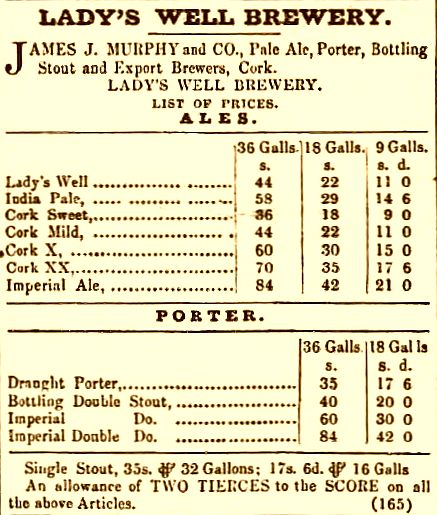
There is also a very nice mention of an amber coloured beer from 1856 in another previous post that showed how Lady’s Well Brewery (Murphy’s), also in Cork, started its life not wholly as a porter brewery but as a producer of a wide variety of beer in the hope of becoming an Irish competitor and exporter akin to Bass, Allsopp, etc., and their beers included a ‘Lady’s Well Ale’ that was described as having ‘a clear, amber colour’.

Somewhat ironically, Smithwick’s in Kilkenny also had an amber ale, as a visitor to the brewery in 1876 sampled ‘October ales, eleven months old and clear as amber’. So it is with a little fanfare we can say that this famous Kilkenny brewery did indeed have a reddish ale back then along with their other beers, although it appears to have been a far cry from the present iteration - more on this in the final part of this trilogy.

Again, I know that these mentions would hardly be surprising if we were looking at brewing in a general all-world context but with the focus of many of the world’s beer and travel writers firmly set on Ireland’s porter history, it is good to repeat and reinforce our much-more-than-that brewing aptitude that tends to get lost in the noise of brewing fakelore. (The alternative reason for much of my writing is not only to attempt to pull fact from fiction red ale wise, but also to show off any styles I come across that are currently not associated with that blinkered brewing history, be it Milds, Pale Ales, Imperial Ales or in this case Amber Ales.)

And those mentions above are not outliers, as newspaper mentions over the centuries mention many more ‘Amber Ales’, for example:

Saunder’s Newsletter in October 1784 printed an editorial of general complaints about issues in Dublin city and one sentence reads, ‘That fine and elegant amber ale, for which this city, forty years ago, was so remarkable, is no longer to be had; but in its stead, a wretched, ill brewed compound possessing every ill quality a malt liquor can have.’

Michael Lowry on Meath Street in Dublin was brewing ‘an Amber Beer of superior quality’ in 1795, again according to an advertisement in Saunder’s Newsletter in February of that year.

In October of 1805 again from Saunder’s Newsletter, the proprietor of the brewery at 48 Mecklenburgh Street in Dublin was brewing ‘Amber Ale, Pale Ale, superior strong Porter, and excellent Table Beer.’

In 1907 according to an advertisement in the Dundalk Examiner the Great Northern Brewery - in Dundalk - were brewing ‘single porter; XX bottling stout; amber ale; and strong ale.’ Indeed that same brewery advertised its Amber Ale quite strongly early in the 20th century, with one newspaper advertisement showing photograph-like images of a glass of that Amber Ale for 1938 that shows it to be quite dark - certainly not a ‘golden’ type of amber. (We should also note that this brings us a generation away from the third age of Irish Red Ales in the 1960s, and although I possess a label for this beer, I am unsure when exactly it ceased to be, but Smithwick’s bought the brewery in the 1950s and Smithwick’s was brewed here later on in the brand’s life under Guinness's tenure.)

(Interestingly or not - I can find no mention in print of a famous cousin of amber ale and that is the 'Ruby Ale' brewed by Lett’s Mill Park brewery in Enniscorthy - the only thing I can see is that much repeated label. I do not doubt that it existed but it must have been sold by word of mouth as very few advertisements for Lett’s ales in general seem to exist.)

What any of these beers would be categorised taste-wise is not something I can say for definite, but from the scant descriptions they seem to have had a little bitterness on the hop front, so perhaps like a dark coloured pale ale? Although in reality I would suspect that these beers I referenced were quite different from one another.

But all of this is very ambiguous still - although I am convinced enough that there were look-a-like if not taste-a-like red ales in this period - and the complete absence of the actual word ‘red’ in some way up to this point probably has you thinking that I am yet again clutching at ale-soaked straws to justify my stance, but let me share something else that might just make you into a believer that some of these ales were indeed ‘red’ in colour, at least by modern style standards, and see if we can add a certain maltiness to our ale ...

By chance I recently came across a very interesting book that was published 1872 with instructions on brewing Irish porter and stout - and I need to do a separate full post on this book itself, as it gives detailed recipes for Irish dark beers and how to brew them as well as the workings of Irish porter breweries at this time. The book also lists the usual ingredients such as hops and water, but it was a chapter on malts that caught my eye. In it the anonymous writer - who appears to be an eminent journeyman brewer - talks about a specific ‘pale’ malt that was used by Irish brewers as a base malt for their porters. The author of the piece describes the malt thus:

‘The usual kind of malt employed in brewing Irish porter is of a darker colour than what is generally used by English Brewers’… ‘which in flavour and colour resemble a malt nearly approaching dark amber, but not quite’ 

The writer states that this is still called a 'pale' malt as it is pale relative to the other much darker malt used for the making of porter, and he goes on to state that the malt has…

‘A very sweet and pleasant flavour and the farina of the malt has rather a brownish tinge. This gradual slight charring develops also a peculiar and agreeable bitter taste, which is communicate to the porter or beer and thereby renders it more agreeable to the palate…’

He goes on to tell London brewers that the can somewhat replicate this malt by mixing ‘English made Amber’ with some standard pale malt but that by having this other ‘pale’ malt as used in Dublin, which had superior flavour he states that you can… 

‘… produce a wort if mashed alone of a deep red appearance…’

Well my thoughts on this are pretty clear, if this unique malt was being used by porter brewers then was it possibly being used by ale brewers too? Perhaps mixed with a little ‘real’ pale malt but either way it would have produced an Irish ale that was amber red, and unique to Ireland - an ‘Irish Red Ale’ even, although different from what the new definition and usually stated recipe of course. But this surely helps with my case that there were malt-focused red ales in this epoch too, but they were different to what went before and what came after? (It is also worth mentioning that our brewer/author persuaded a London maltster to replicate this uniquely Irish(?) malt and market it under the name 'Hibernia' ...)

We need more evidence that this of course and with a dearth of information on Irish malting we will fall back on Alfred Barnard and his volumes on ‘The Noted Breweries of Great Britain and Ireland’2. Barnard did not tell us much about the actual details of the beers produced by the Irish breweries that he visited but his recording of a visit to Plunkett Brothers, the famous Dublin maltsters, around 1890 is one of the only records regarding what was being malted in Ireland around this time that I am aware of.

Barnard does indeed list some of the ‘numerous’ malts being produced by the Plunketts and those include ‘black, candied, amber and high dried malts, all of which are shown in tall glass vases bearing labels related to the history of the product, etc.’ He was particularly taken with a ‘golden brown malt’ that was used for ‘both ales and stouts, where flavour and richness of quality are desiderata.’ Elsewhere in his report he mentions the candied malt again and states it is ‘sweet-tasting’ and also states that ‘this make is peculiar to Plunkett Bros., and is used in conjunction with pale malts, for public house mild ales’ and that ‘it imparts a delicious aromatic smack to ales'.

These are all quite interesting as malts go but I do not think they can be our elusive amber-ish malt that our brewer speaks of, as these seem to be used in addition to other malts. So although they also seem to be unique to Dublin, and Barnard with all of his travelling and visits had never heard of them, they are probably not exactly what we were looking for even if they do deserve more research, especially that candied malt, and they may be relevant, which I will get too later.

But further on during his visit Barnard visits a separate maltings on Cork Street and discusses the ‘preparation of amber brown malt made by a very old-fashioned process’ using oak chips to fire the furnaces to achieve this colour, and no doubt a unique flavour. Could this be our elusive malt? Indeed it might be - or perhaps a variation of it - and if nothing else it shows that if Barnard was commenting on them as he was, then Dublin maltsters seemed to be malting to different specification than their English counterparts, even if they did export their malts over to there.

So if Irish ale brewers were using this amber brown malt - even if it is not the one in the brewing book - and perhaps adding that candied malt to it, which from how it is listed in order after black and before the amber must mean that it was quite dark and therefore would produce something that to my admittedly limited thinking would be an ale that to the modern eye would be classed as a red ale, even if it was used as only part of the grist.

So are these malts the proof of 'red' ales existing in Ireland in the 18th, 19th and early 20th century at the very least? Well sadly we do not know for sure, but with all of those mentions of amber ales above, plus the amber brown and candied malts that Barnard seemed so taken with, I find it hard to believe that either by themselves or as a mix they were not used in brewing ales at some point - perhaps for those lovely sounding ‘public house mild ales’ he mentions!

Another very important detail is the importance of those malts and their impact on the beers being brewed and given the tone of both the brew instruction book and Barnard’s praise of the quality and aroma of the malt I find it difficult to believe that malts would not be show-cased by the breweries supplied with these malts for the production of their 'everyday' ales. The malt would surely be the most important ingredient flavour wise, with the hops taking the backstage roll.

Given all of this can we finally say that there were malt-forward, reddish ales being brewed in Ireland in this period? I am quite convinced that these beers existed, but possibly focussed on the east coast and - ironically - within 'The Pale' around Dublin, although perhaps in other major cities too as per the Cork references above.

By the way, this idea that Dublin and its environs were fonder of darker ales is reinforced by a small note in a brewing record for Perry’s brewery in Rathdowney in Co. Laois that stated that certain ales were to be darkened for the Dublin market - with caramel colouring in that case I believe. Indeed, Perry’s used caramel, invert sugars and malt extract in some of their beers in at least the early part of the 20th century. Some of which, from my own attempts to replicate these beers, changed them into something almost reddish brown in colour.

I am aware that this is mostly based on pure conjecture, but just to reiterate, I do believe that given the evidence above that there were unique - malt-wise at the very least - Irish red ales. These were similar in colour and possibly taste to the modern versions of red ales although probably stronger flavour wise, certainly more so than the known macrobrewed versions. The malt, and recipes in general, would probably have been different from what I know of those beers produced today too.

These Historic Irish Amber Ales - I think I prefer that term - would have just been another part of our rich and varied range of beers, alongside pale ales, milds and IPAs. They have no connection with the ales of ancient history I discussed in the previous post, or at least I cannot see a link back to those versions that can be in anyway provable, and I still feel that they have no link to those of our very recent brewing history, even given what I have said in the last few paragraphs.

But we did have ‘red’ ales, which I think we all knew already anyway, right…?

Liam

Part III is here.

(Please let me know of any errors you see in this piece and I will do my best to rectify them - or argue my case.)

All written content and the research involved in publishing it here is my own unless otherwise stated and cannot be reproduced elsewhere without my permission, full credit to its source, and a link back to this post. References to quoted newspaper is available via email or DM to me.

Newspaper image is © The British Library Board - All rights reserved. With thanks to The British Newspaper Archive (www.britishnewspaperarchive.co.uk) from whom I have received permission to display this image on this site.

Monday, 13 April 2020

Fancy a Murphy's IPA? - The forgotten origins of Cork's Lady's Well Brewery...

Image pre 1890 from Barnard's The Noted Breweries of Great Britain & Ireland


(This post is a combination of a couple of older posts on this subject which I've revised and updated with extra content.)
The things you find when you're down a rabbit hole of printed brewing history...

I love looking through old newspapers,as they are such a great source of material for those looking into the past, as they are a snapshot of a particular day or date in time that might otherwise have been lost forever, akin to a word-based Polaroid - albeit one that needs to be assessed with the knowledge of who had their finger on the shutter release at the time, and what direction they were pointing the camera. These papers are of course a great resource for capturing monumental events or catastrophes and in doing so they can give you a much better feel for a society's mood as well as firsthand accounts. They are a goldmine for revisionists of history who can look back to events before and after a particular time to see if the winner-written history was really as accurate as it was portrayed. All of that is fine providing the facts being reported are what actually happened, and everything is reported in a non-partisan way, and unfortunately this is not always the case, 'Fake News' - or even 'No News' - is not a new concept. So although I am a little wary about certain content, in general I give a degree credence to what's written in older papers with regard to certain aspects of beer history, especially if reported in multiple sources.

Where am I going with this? Well up until relatively recently I associated Murphy's in Cork just with stout (apart from their dip into red ale), and if asked I would have stated that Murphy's Brewery (or James J. Murphy & Co., or more correctly Lady's Well Brewery) was founded as a porter brewery back in the day. Anything I had read mentioned just porter or stout, with at most a mention to a mysterious and short-lived 'Lady's Well' ale. I had of course fallen into the trap that many have before me, of forgetting that marketing people and not historians write the history of Irish breweries these days - something I am quietly trying to rage against via blog posts and Twitter-speak. Much of my ammunition comes from those old newspapers, and although I regard them relatively warily, they generally tend to speak a closer version of the truth than a fakeloreified advert from 100 years after an event.


So when by chance I came across a write-up on the opening of Lady's Well Brewery brewery from back in 1856 in The Cork Examiner I decided to give it a read, not thinking it would hold much interest for me. I was of course very wrong, as it gave me a first hand perspective of what the ethos and business plan was for the brewery when it was initially founded.
THE LADY'S WELL BREWERY
We hail with pleasure the commencement of a new enterprise in the opening of the magnificent brewery at the Watercourse, which will be known by the name of The Lady's Well Brewery. The undertaking is one that not merely reflects great credit on the commercial activities and spirit of the gentlemen concerned it, but will be likely to prove of great benefit to the city in the addition it will make to its resources of the industrial employment, and the very large amount of capital which its success will be the means of putting into local circulation. The names Messrs. James J. Murphy and Co., highly [and] deservedly popular throughout the town and country, have been chiefly known of late in connection with the extensive Midleton Distillery, but the decided opening which lay in the brewing trade has made them turn their attention [to] that branch of business, with what chance of success we shall endeavour to give an idea.
I was unaware at the time of the seemingly well documented Midleton Distillery connection until I read it here first, since then I've read about it in books such as The Murphy's Story by Diarmuid Ó Drisceoil & Donal Ó Drisceoil in which it is well detailed, as well as on some online sources.

The article continues...
   In this country it is well known that the consumption of porter is very large, and that there is business in that direction to occupy a manufactory, we need not say; but there is new ground to be broken in which we feel a more direct interest, leaving as it does an opening for enterprises capable of indefinite expansion. For the last few years a taste has grown up in this country for a light sparkling drink called "bitter beer," or "pale ale." The rapidity with which the sale and use of this article has grown up has been most extraordinary, knowing how difficult it is to change the habits and tastes of persons in such respects. The article of this kind sold in Ireland - unless in cases of adulteration or imposition - is exclusively the manufacturing of the breweries of Burton-on-Trent, and comes from the celebrated houses of BASS, ALLSOPP, SALT, &co., &co. An idea of the extent to which the article has gone may be inferred from the fact, that Cork's receipts of one of those firms amount to nearly thirty thousand pounds a year. When we take, then, into consideration that our city forms but a small item in the list of consumers of an article which is exported alike to the Equator and Antipodes, we will see what a vast field for specification and enterprise lies in its manufacture. Hitherto, however, no attempt of any importance or any large scale was made in this country to compete with the gigantic English establishments. One reason, it may be mentioned, that has been popularly alleged, was the want of a water containing the peculiar qualities which gave so much merit to the Burton ales. But it happened some time since that the building known as the Foundling Hospital was put up for sale, and it was purchased by the Messrs. MURPHY. It is a splendid situation for a brewery, containing a range of buildings embracing an open square of nearly 200 feet. In addition to this, however, it contained what was still more important to their purpose, a well or spring of water coming from the same rocks, and of the same quality as the delightful Lady's Well; and also of properties precisely similar to those of the celebrated Trent water, taking advantage of this circumstance, the Messrs. MURPHY resolved to enter upon the manufacture of ales, in which they have already achieved a decided triumph.
I found this to be a very interesting and exciting paragraph, as it seems to more than suggest that the stout porter we now associate with Murphy's was not the original reason for starting the brewery. If this editorial write up, which at times comes across as an advertisement and an ego massage for the Murphy's, is to be believed - and we should take everything here with a small pinch of salt perhaps - then the original plan for the brewery was to set themselves up as direct competitors to the glut of pale ales that were - seemingly - swamping the country, as well as exporting a good deal of the ale brewed. They were hoping to launch a full-on assault on the larger English ale breweries was my interpretation of this.

(I have no idea if the water being drawn up from the eponymous Lady's Well was akin to Burton's magic liquor but it is certainly possible...)

It continues...
   If energy be an element of success, the new firm decidedly can boast of it. They got their building on the 27th of July, and on the 8th of December the commenced brewing. When they took possession of the concern, all the found available for their purpose was the large shell of the building. They had to erect floors and fittings, pipes, vats, shafts, chimneys and machinery. All their work was done under the superintendence of their brewer, Mr. GRESHAM WILES, and as it has been constructed on the newest and most advanced scientific principles, a passing reference to it may not be devoid of interest. In the first place, it may be remarked, the entire of its processes are regulated and carried on by steam; and in this respect it is, we believe, quite unique in this country. Then there is scarcely a single item of its machinery which has not undergone some improvement, and does not mark an advance upon the old system. For instance the mash tun, a huge vat where, by means of huge teeth or saws, the essence of the malt is extracted, is covered with a coating of enamel, a perfectly new invention, which the firm have registered. The advantage derivable from this is chiefly its obviating any chance of mixing the colours of porter and ale, a defect to which machinery of the ordinary kind, in which both are brewed, is very liable. Even the contrivance by which the grains are expelled from this vat, after the essential principle of the malt has dropped through the false bottom, is, though simple, a great saving in labour and at the same time a great novelty. A more important improvement, however, has been effected in the machinery for extracting the essence of hops. In place of the older mode, which involved considerable waste of fuel and employed a great deal of labour, a new system, also registered, and about to be patented, has been adopted by the firm. The boiling batches (two of which are used for extracting the bitter juice of the hops - one for porter and another for ale) are covered with a perforated false bottom. In connection with this is a "sparge," or cylinder of copper, through which, by means of pipes, steam from the boilers is introduced. From the various apertures in the cylinder the subtle vapour permeates through the hops, leaving not a single one untouched, and extracting in a most complete manner their bitter principle. An equally interesting improvement has been effected in a process of depriving the porter of superfluous yeast; in the cooling apparatus, and even in the process of transmitting the malt from the lower floors through two series of flats, to the top of the building; but we do not feel ourselves at liberty to enter into particular descriptions of these. It might be thought that with so many novelties in the machinery of the brewery, there would, at some one department at all events, be risk of failure; but though on the occasion of the first brewing, out of twenty-five men employed in the establishment, not one had ever been engaged in a brewery before, not a single item failed or went out of order, and all the machinery worked as freely as if it had been twelve months in operation. The capability of this machinery may be judged, when we mention that, in full work, it can brew 5,000 tierces of ale or porter in the week or an aggregate of 260,000 tierces in the year. In connection with the appearance of the building, we may allude to one fact en passant, which will be of interest to a large class of our readers. There are no less than 150 gas lights burned in the establishment, and though the Messrs, MURPHY received most enticing proposals from the United General Gas Company to contract with them, they preferred to aid the citizens of Cork in their anti-monopoly movement, and declined the tempting offers made them.
5,000 tierces is around 800,000 litres, which is an awful lot of ale - even if it is hypothetical ale - and I don't know enough about 1850s breweries to know whether this is a little on the high side perhaps but it seems that the Murphy's were nothing if not ambitious so perhaps it is correct. Certainly the description of the enamelled covered mash tun with its 'huge teeth or saws' sounds impressive, but some of the other descriptions of the equipment are a little vague, and the 'sparge' being used to extract the 'essence' from the hops seems to me to be either rushed note taking on the part of the writer or Mr. Wiles was deliberately confusing the writer so as not to let others know his secrets, but yet again it's all quite interesting and perhaps there is such thing as a 'hop sparger'... [Edit: There is! See Ron's comments below...]

Another interesting point is that the The Murphy's Story mentioned above states that the brewer was one Edward Lane when they opened, this is at odds with the comments regarding Gresham Wiles above, so presumably he was just employed to set up the brewery and perhaps to train Edward Lane. (Curiously, there was also a Lane's Brewery in Cork at this time - which incidentally appears to have been connected with an alarming number of accidents, some fatal - but I'm not sure if there was a connection with this Edward Lane or not, although an Edward Lane was also involved with another Cork brewery, Arnott's - St. Finn Barr's Brewery, in the city. His successor at Murphy's, Edward Herring, also joined Arnott's and there is another story involving a public-touted porter brewing challenge - perhaps a post for another day...)

Let's keep going...
 The manufacture of the brewery consists of common draught porter, bottling stout, imperial stout, mild, sweet, bitter, and pale ales. Of the qualities of some of these we can speak as affording promise rivalling, nay, in some respects, surpassing, the beverages produced by the great BURTON houses. The "Lady's Well" ale, made with the spring water of which we have spoken, is one of the most agreeable malt drinks that could be manufactured. It is a clear, amber colour, possessing a light, piquant bitter, and its flavor is in every respect fully equal to the highly-prized, a we may add, highly paid for, BASS or ALLSOPP. The bitter ale is of a stronger kind, and its acid quality is more powerful. This ale is intended for export, and from the success of this article we look for results of great importance, as, should a local firm obtain a most footing in the foreign markets, or which Burton brewers have so long enjoyed a monopoly, we might look forward to its laying the foundation of a new and valuable trade for this city. Of all the manufactures of this new establishment we can only speak in terms of commendation, but we confess to taking the strongest interest in that which leads them into competition with the English firms. They have laid the foundation of their undertaking in the soundest manner; they have brought to its assistance skill, capital and enterprise; they have constructed it with every advantage which science can afford, and we consider, therefore, that they deserve to succeed. The qualities which they have brought to their aid, are indeed those of which we have been most deficient in this country, but we trust to see the success of the Messrs. Murphy affording an example and a stimulus to others to strike out new paths of industry and increase the manufacturing energy of the country. 
~The Cork Examiner 31st December 1856
This paragraph was for me the most interesting, as it describes the beers being brewed at Lady's Well when they opened. So it seems that '...draught porter, bottling stout, imperial stout, mild, sweet, bitter, and pale ales...' were being made. Again I took this with a degree of scepticism but it all seemed to be accurate, as why would they report otherwise? So it looks like there were four paler ales were being produced as well as the darker ales we are more familiar with from Murphy's, and it was nice to see they brewed an imperial stout! The list of beers looks very like what we normally expect from English brewers, which is more than a little unkind on our own brewing history but up to recently many of us had been brainwashed into thinking that all we ever brewed were stouts and red ales. (As you have seen from my previous posts this is far from the truth if you go back a century or more - or even sixty years for an Irish brewed selection of pale ales.)

The description of the 'Lady's Well' is of an amber coloured ale (Hardly a nod to the infamous quasi-mythical 'Irish Red Ale' of prose and poetry?) and seems to mention a light but sharp bitterness and they compare it favourably to Bass and Allsopp pale ales. The writer then goes on to talk about the 'bitter ale' being of a strong kind, so more alcohol perhaps(?) and more 'acidic,' which we should probably take to be being more of a highly hopped bitterness than actual sour bitterness ... and they say that this is the ale intended for their assault on the export market.

Plenty of interesting information here even if you dismiss all the praise for the beer and brewer.


Then I discovered that the writer in the Cork Examiner was not the only member of the press who appears to have gone on a trip to the brewery, as the following piece appeared in The Cork Constitution newspaper the next day. This write up focuses on the brewing machinery and vessels mostly and combined with the previous post it gives a better picture of the size, scale and workings of the brewery.

OPENING OF THE LADY'S WELL BREWERY
    A few years ago a stranger visiting Cork, and entering the city from the former terminus of the Great Southern and Western Railway, might have noticed a large square building, the high walls surrounding which frowned darkly up on the narrow and crowded thoroughfare. This building was the Cork Foundling Hospital founded in the latter half of the 18th century for the support of deserted children of both sexes and maintained by a tax upon coals. For many years the establishment continue to exist but the progress of legislation, which has subverted so many still more venerable institutions, has at length abolished the Cork foundling hospital. The property in the building became vested in the Poor Law Guardians, who wore it first desirous that it should be converted into an Emigration Depot, and entered into communication with the Emigration Commissioners for that purpose. It appeared, however, that, partly from the growing conviction on the public mind that emigration ought no longer be assisted by the home government, the Commissioners could not assent to the terms required by the Guardians or the use of the building. Subsequently the Guardians were about to offer the building to the military authorities for the purpose of an auxiliary Barracks, but for this its situation was on suited and at length the premises having been offered for sale to the public, they have been purchased by Messrs J. J. Murphy and Co., who intend devoting them to a more practical and, we hope more profitable, if not more useful, objects that close originally contemplating. Few persons not acquainted with the subject and have any correct idea of the immense quality of malt liquor annually manufactured in these countries It is calculated that in England the amount yearly drank is 3½  gallons per head on the entire population in Scotland 2 1-9[?] and in Ireland 1 ½ - that the entire quantity consumed per annum is 17,000,000 barrels. In addition to what is consumed by our home population, vast quantities are exported to almost every part of the habitable globe and the consumption, so far from diminishing, is largely augmenting every year. In England malt liquor is emphatically the national beverage - it is the favourite drink of the artisan, and is found on every dinner table. In Ireland it does not seem to have please the public taste so well as in the sister Kingdom, still large quantities are consumed, and it is to be hoped it may ultimately supersede the more intoxicating and less nutritious produce of the still.
At this time whiskey was the tipple of choice for many in Ireland and this is noted here with regard to the beer consumption per head, but it might also explain why the Murphy's didn't succeed in their bid to great an ale brewery to rival those in England. Although it's possible they just were not great ale brewers of course!
    Comparatively little of the building which went to form the Foundling Hospital was available for the purposes for which the premises were purchased by the Messrs. Murphy, and considerable expense had to be incurred in order to render the works complete. They possess, however, one great advantage in having an inexhaustible supply of the purest well water, suitable for manufacturing the finest bitter and sweet ales. The entire area included within the boundaries of the premises is 258 feet square. The building runs along each of the four sides and, is 18 feet in depth, thus leaving an open square in the centre of 240 feet each way. In the middle of the square is the well already mentioned, from which the water is pumped up a depth of 60 feet, as often as wanted. For the purpose of securing a sufficient supply, a tank has been constructed capable of holding 3,000 barrels, communicating by pipes to all parts of the building, thus any damage from fire maybe obviated. The water or “liquor,”’ as it is termed in brewers phraseology, is either soft water, for the manufacturer of porter, or hard water which is preferable for fine ales and beer.
Again we have mention of the quality of the water here, although it's somewhat confusing that they mention both hard and soft water in the last line. That may be just a general point and not suggesting that they were magically pulling both from the same well! [Edit: See Ron's comments below...]
    The entire of the building and apparatus of the brewery was erected under the superintendence of the Messrs. Murphy's brewer, Mr Gresham Wiles who studied subject under Mr James Young, of Messrs. Hoare and Co, London, one of the highest practical brewers in the Kingdom. The premises have been taking possession of by the Messrs. Murphy in July, operations were immediately commenced to render them complete at the earliest possible period, and in the lapse of a little less than six months they were so far completed that brewing was entered on. Acting under the advice of Mr Wiles, the materials are entirely heated by steam, not as usually the case by common heat. Steam is supplied from boilers situated in a detached building - it is of a new patent construction, combining the principles of the Cornish and the tubular boilers. In appearance it consists of two horizontal cylinders 18 feet in length and seven feet in diameter, running parallel to each other. Underneath are the fires, which present a great improvement over those commonly constructed, as by a lever the stoker can break and pulverize the coals, and keep up the heat without opening the doors of the grates. These boilers not only heat the materials but feed several steam engines amounting to 70 or 80 horse power, which communicating by shafts to various parts of the building keep the apparatus in motion. 
The aforementioned list that I thought sounded 'English' was perhaps reflects the training of Mr. Wiles at 'Mr. James Young of Messrs. Hoare & co. in London' and was probably why he was employed by the Murphy's in the first place.
    Ascending to the first loft the visitor is shown the mash tuns, which are 8 feet deep, 18 feet in diameter, and each capable of mashing 120 quarters of malt. The interior of each tun is enamelled, a process patented by Mr. Wiles and which enables the tun to be readily cleaned after each time of filling. All malt liquors are in one sense brewed in the same way; that is to say, the water goes into the copper, passes thence into the mash tun, through that into the receiver, then into the copper again, after which it is cooled. It then passes into the gyle tun where it undergoes the process of fermentation, and thence it is cleansed into the cask. In this general light, the process is alike, but on the mode of which the various operations are conducted, on the proportion and quality of the ingredients, on the temperature, time, &c., showed in the different portions of the process the entire quality of the produce depends. This is of course one of those “secrets” which every manufacturer keeps undisclosed, but it is reasonably to be expected that has improvements are made from time to time in the mode of operation the quality of the produce will be better, and the cost of manufacture reduced. In this respect some innovations have been introduced in the establishment of the Messrs. Murphy, the effect of which is stated to economise time, and while cheapening the expense of manufacture, to produce a liquor at once combining strength of body with excellence of flavour.     In the Lady's Well Brewery, the boiling is effected by steam, and such is the rapidity with which it is effected that the entire liquor, in two large batches, containing 200 barrels each, can be raised to a boiling temperature in three quarters of an hour. Boilers contain ‘sparges’ which are constructed upon a patent principle, combining economy of fuel with rapidity of operation. The liquor having been raised to the proper temperature it is let into one of the mash tuns already mentioned. Each of these “mash tuns” is capable of containing 430 barrels. The malt, having been ground, is then shot into the mash tun. Each mash tun at the Lady's Well Brewery may be filled and empty three times a day. The time and manner of hopping vary among different brewers, some using more and some less. Much of course, depends on the kind of ale or porter required to be brewed, and the particular particular market it is intended for. The heat should be just sufficient to separate the aromatic portion of the plant without extracting the rank and injuries elements. To the judicious management of the hopping is mainly due the mild and pleasant flavour of the “Lady’s Well Ale” manufactured at Messrs. Murphy's Brewery, and which bids fair to acquire and extend the popularity.
Another nice mention of 'Lady's Well Ale' here and a description of its flavour, however vague it sounds...
    From the copper in which the work has been hopped it is passed into the cooler, where is is brought rapidly down to a lower temperature by means of the refrigerating process, which is affected by cold water, introduced through numerous pipes running through every part of the cooler, until the wort is brought down to the requisite temperature. It is then introduced into fermenting tuns of which there will when the establishment is completed be eighteen, holding from 200 to 500 barrels each. The process of fermentation which general generally last for days, is completed in Messrs. Murphy's establishment in half the usual time, after which it is drawn off into the cleansing rounds, where it undergoes a further fermentation before being fit for use. The cleansing rounds are 150 and number, and contain 8 barrels each.     The vats in to which the liquor is subsequently introduced are of large size holding from 500 to 800 barrels each. Some idea of the extent of this establishment may be derived from the fact that they can now produce 5,000 barrels of malt liquor, each barrel holding 36 gallons, per week
 The Cork Constitution - 1st January 1857

As you can see it describes in a bit more detail some of the equipment and buildings than the first article and is probably of interest to those who need to see the nitty-gritty of how the brewery operated on its opening, but again allowing it's not being described by a professional brewer.


But we are not finished yet, as here is a third write-up which I found more recently in the Southern Reporter and Cork Commercial Courier from the 31 December 1856. This contains some common material but some new nuggets to, particularly on the range of beers being brewed at the time.

THE LADY’S WELL BREWERY
Frequent it has been our lot to complain of the great absence of enterprise which too strongly characterises our local commercial community, we feel a considerable amount of pleasure and satisfaction in being able, our present impression, to direct attention to an undertaking which reflects most creditably on our city generally, and, in particular, on the enterprise and spirit of the gentlemen concerned in it—we allude to the establishment of the Lady’s Well Brewery. The large pile of buildings which up to a recent period was occupied, and is still known, as the Foundling Hospital, on the Watercourse, and which includes, we believe, an area of 250 feet by 200, has within an astonishing short space of time been metamorphosed into a most complete and unique brewery, fitted up with all the late scientific improvements, and displaying some extremely useful and novel adaptations, never heretofore introduced into the brewing apparatus. The establishment of a manufactory in district is an epoch of importance in its local history, and this importance becomes greatly enhanced when the object of that manufactory is to diminish the imports and increase the exports of the particular place ; and this being one of the aims of the Lady’s Well Brewery, by our most respectable and spirited follow the Messrs. James J. Murphy and Co., we are inclined to hail it as a tangible indication of our local prosperous state, and a practical development[sic] of our capabalities—capabalities[sic], too, which, we are confident, will not be neglected or misapplied by the intelligent proprietors of the new brewery. The great demand which of late has sprung up in this district for such beverages as ales and porters, together with the vast quantities of “Bass,” “Alsop[sic],” and Burton,” &c., that are annually imported into this country could not have failed to attract the attention of any practical observer, pointing as such facts most unmistakably did, to great want in our local manufactures; and as there was no reason to believe that, with proper attention and proper management, Irish capital and Irish resources could not compete, in this particular department, with English imports, the offspring of the great energy and persevering application of our English neighbours, the Messrs. Murphy set themselves to work, and, have no hesitation saying, they will open to themselves a vast trade, which heretofore was entirely monopolised the English brewers—they will prove, beyond question, that all want this country, in order to rear up a great, a stupendous, and a lasting prosperity, is a little enterprise on the part of those who possess the capital—that are rich in natural resources, and in the intelligence and shrewdness which mark our artisans, and that the materials for an abundant commercial harvest are absolutely lying waste in all directions. Therefore, from those and other considerations, we greet, sincerely and warmly, the opening of the Lady’s Well Brewery.
Well there's an opening paragraph that really lets you see the writer's allegiance to the Murphy's! (It's also nice to see someone writing's that use more commas than I do...) Here again, amongst the hyperbole and praise we can see that this enterprise was indeed set up as an ale brewery to compete with English imports, and more. It's almost like the production of porter and its cousins were meant to take a back seat in the brewing scheme.
In the fittings-up, arrangement, and general details of the concern, the utmost credit is reflected on Mr. Wm. Gresham Wiles, under whose superintendence they have been carried out, displaying as they do, in a remarkable degree, large amount of scientific skill, great practical ability, and the most perfect order and regularity—desideratums of no inferior Importance such in such an establishment. What those works are—in order to give our readers some idea of their extent, powers, &c., we may mention they are capable of producing 5,000 tierces porter, stouts, pale, mild, and sweet ales per week, being a total produce 260,000 tierces a year—a capability which contrasts in a satisfactory manner with that of some of the largest breweries in this country or in England. The energy and activity which was displayed  to arrive at this efficiency may be estimated from the fact that the Messrs. Murphy did not get possession of the premises until the 27th of last July, and on the 8th of the present month they commenced brewing! It may not uninteresting here to state that this concern is the first and the only brewery in which steam has been thoroughly applied to the manufacture of beer. Heretofore the process was to inject the steam for the purpose of heating the liquor, while in the Lady’s Well Brewery it has been applied, with, the most successful results, by means of a boiling sparge—invented for the purpose by Mr. Wiles, and, we believe, patented by that gentleman—and the introduction of this most ingenious machine, he has achieved great and most desired improvement in the manufacture of beers, one to attain which much exertion has been made and time devoted by eminent brewers, and by which, with the nicest particularity and an important saving of time, the oleaginous[sic] and valuable particles of the hop are extracted, while the rosenous[sic] and coarser particles, which, when admitted into the wort impart a rankness of flavor, are unerringly excluded. We were also struck by a novel, and, now when known, simple contrivance, which a large amount of advantage must be attained, in the construction of the mash-tun. This nothing more or less than the enamelling of the inside of the tun, which, while it secures the most scrupulous cleanliness, enables the brewer to produce the brownest stouts and the palest ales in the same mash-tun, of course, at different periods. Although this may not be considered of any remarkable importance, it does assume some consequence when we recollect that in the old-fashioned timber-tuns, if ale and porter were made the one concern, the ale generally received something more than the colouring of the stout, which the timber had absorbed. It is only justice to acknowledge that this valuable improvement also has emanated from the intelligence and practical experience of Mr, Wiles, the brewer and manager of the establishment, and most creditable pupil of the eminent James Young, of Hoare and Co’s. Brewery, London—a man who has arrived at the highest eminence his profession. The cooling apparatus is also worthy of particular mention, being entirely on a new principle, and securing the greatest expedition in reducing the temperature of the wort. This is attained by means of the application of cold blasts on thin layers of wort, under which there are currents cold water constantly passing.
At least we get a mention of dark beers again here, plus a florid description of the brewing process and that enamelled mash tun. We also get another mention of the 5,000 tierces they could produce if need be...
Having said so much on the dry details, we may now speak of the quality the different articles produced and this we can do from experience. In the first we may say they embrace no less than seven distinct kinds, viz:-. common draft porter, bottling stout, imperial stout, mild, sweet, bitter, and pale ales, besides brown and pale ales and porters for export trade. The ales, which are produced from the highly prized water that supplies Lady’s Well, are exceedingly agreeable—the bitter possessing all the tonic recommendations without any of the disagreements of the ales at present in vogue; while the porter and stouts are highly nutritious and palatable beverages. We must not omit to mention—in fact, recommend the ale which the Messrs. Murphy have given the title of “Lady’s Well Ale.” It is a light, pleasantly-bitter and grateful drink, and highly calculated to fill a vacuum long felt in the want of a dinner table ale. It is the intention, we understand, to sell those ales in such quantities, as small as even nine gallon cask, that must prove vast accommodation to the public, and the heads families in particular.
Southern Reporter and Cork Commercial Courier - 31 December 1856

Again we get a description of the wonderfully diverse range being brewed by Wiles at this time, although it could be interpreted as still being a little vague given how it is presented. Once again though, we see 'Lady's Well Ale' being pushed and promoted, this time as a light table ale. This view of the company in particular runs like an advert more than an impartial article, one wonders if money changed hands or if all three contributors were sent home with a supply of 'Lady's Well Ale'!


This was all interesting and informative but we still have no detail of what was actually being offered for sale apart from tantalising mentions and hints, with very early adverts just stating that ales and porters would be available from the beginning of 1857. Then on the 12th of January 1857 the following advertisement appeared. Complete with prices, which seems to prove that all of this range was available from this date.


Wow! This seems to make it clear exactly what was being brewed at the time, no less that seven ales and five porters:

Ales

Lady's Well
India Pale
Cork Sweet
Cork Mild
Cork X
Cork XX
Imperial Ale 

Porters

Draught Porter
Bottling Double Stout
Imperial Stout
Imperial Double Stout
Single Stout


Nice to see that Cork Mild -  with a capital 'M' -  as well as a 'Cork Sweet', an X Ale and am XX Ale, so it's clear that when they opened they were brewing more than one or two beer types, as why else would you advertise and price everything? It's also worth noting their description of being and 'Export Brewery' and later adverts like the one below emphasise this and 'Pale Ale' even more so.


In May of the same year the conquest for both domestic and word domination was still in progress, as the following appeared in the Tralee Chronicle:
LADY’S WELL BREWERY
We published some months since, from the Cork papers, very lengthened and interesting account of this gigantic enterprize, then in process of completion, and which is now an accomplished fact. After expenditure of over £40,000, the Messrs. Murphy are now giving to the country the best practical proof their sagacity, the production, immense scale, of porter and ale of quality already commanding an eager demand on the part the retail trade Ireland, but such must place the spirited and patriotic projectors a position, exporters, every part of the globe, on level with the great brewers of England who have hitherto enjoyed such world-wide monopoly. This is but another evidence. among the many springing up every day, of what can do at home, and what fruitful sources of commercial aggrandizement are scattered through the length and breadth of our land, where there is energy, self-reliance and honourable industry to unveil the fountain.

As will be perceived by the advertisement elsewhere, Mr. Henry Donovan has been appointed agent for Kerry, and a visit to bis stores in the Square will convince the most sceptical of the superior quality of the article manufactured Lady’s Well.

 Tralee Chronicle - Friday 08 May 1857


Unfortunately that wonderful looking range does not seem to have lasted too long, as an advertisement in November of the same year list just XX Ale, XX Stout, X Stout and Porter seem to be available.


On the 9th of December 1857 there is an advertisement for table ale available from the brewery.


On 24th of December 1860 a Imperial West India Stout was being bottled but after that the advertisement appear to dry up for anything different or exotic from what I can see.


So, it appears that this huge trade they had hoped for in domestic and exported ales never materialised, and they dropped back to what the public obviously wanted, and what their biggest rivals in the city, Beamish and Crawford were famous for - porter. As far as I am aware it would be another 100 years before anything other than dark beers were brewed in the brewery...

It's a pity that a 'Murphy's IPA' or 'Lady's Well Imperial Double Stout' never became the household names around the globe that the owners envisaged - in fact they were forgotten in their own country, and even own city...

Liam

(Incidentally a William Gresham Wiles died in a accident in 1863 at the Gresham Wiles & Brown brewery of South Malling, Lewes, England according to online sources. I wonder did he head back to England when his huge range of beer failed to make the impact he had hoped, or if he had stayed instead of Edward Lane would the original plan have succeeded? He almost certainly would have lived longer...)

With thanks to my local library for the original research and The British Newspaper Archive for more recent additions and images.

Some newspaper images © The British Library Board. All rights reserved. With thanks to The British Newspaper Archive (www.britishnewspaperarchive.co.uk). 


(All written content and the research involved in publishing it here is my own unless otherwise stated and can not be reproduced elsewhere without full credit to its source and a link back to this post.)