Showing posts with label Brewing History. Show all posts

Sunday, 7 December 2025

Strong Words and Strange Porter: Some Notes on the Beer Recipes for a Talk and Tasting in L. Mulligan Grocer, Stoneybatter, Dublin on 7th December 2025

When Dr. Christina Wade first approached me to collaborate on a couple of 18th century beers to tie in with the English vs Irish porter wars chapter in her book Filthy Queens, I thought it would be a relatively straightforward task. I had some limited experience of homebrewing 19th century Irish porters, albeit on a modern system, so what would pushing a recipe back a century require?  Relatively, easy-peasy surely? A little more research into an era I wasn’t hugely familiar with perhaps, but it should be a relatively straightforward task to come up with a historical-ish recipe. How wrong we were …

Irish brewing records from the 19th and 20th century are scarce enough but those from the 1700s are practically non-existent outside of places like the Guinness archive, whose records of their own beers, as well as the brands they still brew, are inaccessible to the public. That left us looking through old newspapers and books for mentions of what an Irish porter from this period was like, and we certainly found some bits of information but no actual full recipes.

The English version was a little more straight forward, as there is, and was in the past, a little more published on the porters produced on that side of the pond than here, but we soon realized that anything even close to real recipes was going to be impossible. Plus, we were never going to get close to the same process on a modern brew kit anyway, nor would any of the ingredients be date-correct as, for example, barley varieties have changed since the 1700s - not to mention the malting process. Old fermentation methods and using wooden barrels would be problematic too, so we soon resigned ourselves to not being able to replicate porters from that period in any meaningful way given these constraints and settled into a more ‘inspired by’ mode – much as I dislike the term and its use by certain breweries. The difference would be that we would be sure to communicate that these were not historic recipes, but where we could we’d try to add ingredients we found mentioned in brewing at the time – even if they had been highlighted in a derogatory way – and attempt to hit mentioned alcohol contents if we could. I other words we’d have a bit of fun with it and not take the recipes too seriously!


For the Irish Porter we came up with the name Fire & Labour based on a mention of the many costs of brewing a porter, and how that factor was another expense on top of the ingredients – plus it’s a great name for a beer! The hopping rates and gravity were taken from 18th century book mentions so they were factored into the recipe. Gentian root and molasses were allegedly – and sneakily – used in small-beer at this time as a way of saving on bittering hops and increasing the sugars for fermentation, so even though we were brewing a porter in they went too! The malt was mostly modern Irish ale malt but with a little Chocolate malt and Special W in a poor attempt to replicate an old brown malt of the period – and this method is mentioned as a mix for porter in some books, but with different malts of course. Longish mash and boil times were required, and just Fuggles used in the boil for hopping, even if East Kent Golding would have been a better if not perfect fit – my bad! Irish ale yeast was used for fermentation and the target abv was 6.6%.

Again for the English Porter we based it on documented gravities and tried to keep much of the base the same, but with English pale malt and treacle, liquorice and ginger root – again as they had been mentioned as adjuncts in English porters. Fuggles were (wrongly again!) used for bittering too but some were added quite late in the boil this time. It had a higher gravity – over 7% – than the Irish one, again as mentioned in some publications, and we used English ale yeast. This one was called The Fox, a name used for a beer that wasn’t quite what it should be!

These recipes were then passed over to Trouble Brewing for replication and production, and they certainly didn’t let us down. They used as many of the ingredients as they could find that were economical – including the odd ones – and did a fair job at hitting the correct gravities given the vagaries of the conversion and those ingredients. I could not be more pleased at how they adapted and brewed the recipes.

Only one question remains.

How do the taste and who won this particular porter war?

And remember, these are not serious, historical beers – they’re a bit of experimentation and a bit of fun, although they do include historical elements.

More importantly, hopefully they are enjoyable!

Thanks again to Christina for including me in the project, and Trouble for doing all the hard work and taking a leap of faith.

Liam K


Thursday, 18 April 2024

100 Years of Irish Brewing in 50 Objects: #20 - The Harp Magazine (1963)

A TELEPHONE shrills in the Brewery Fire Brigade night quarters at 84 James's Street.

“There's been an accident.”
“Where?”
“In the brewery yard at the old weighbridge.”
“How many injured?”
“Two men.”
“Badly?”
“I don't know.”
“Right, we're on our way!”

The four-man team pile into the ambulance stationed outside and in a matter of moments are at the scene of the accident. Accident? Well, not a real one on this occasion. To keep the members of our Fire Brigade on their toes a competition is staged annually to provide practice in rescue technique. This year seven teams, each of four members, had been drawn out for the contest and the two teams of finalists were going through their paces in the presence of the Board.

Conditions made as true to life as were possible and on arrival the rescue teams discovered two men trapped in a crater beneath a pile of planks and rubble, which had collapsed on top of them.

Under the searching gaze of Dr. Eustace, F. W. Derbyshire and Dan O'Brien they go into action One man, still conscious, whose leg is trapped beneath a plank, presents the symptoms of a compound fracture; the other (a dummy) has the signs of a skull injury.

Praise is due to John McGuirk of the Rigging section, a most realistic casualty whose acting lent an authentic touch to the proceedings.

Both units displayed a high standard of proficiency, but the judges finally decided in favour of Team A, led by Edward King, with Dermot Harnett, James Scallan and James Duffy giving able support. Sir Geoffrey Thompson made the presentation to the winners at a short ceremony in the Fire Station afterwards.

We in the Brewery have indeed reason to be thankful that we have such a well-trained group of men on hand, should a real accident call them into action.
The Harp – Spring 1963

Work was a dangerous place in the past, and certainly for those who worked in industrial spaces full of noise, distractions, heat, and time pressure, then add to that toothed and spinning machinery, elevated gangways, and equipment literally on an industrial scale. Many workers were taking their lives in their hands every day that they showed up for their job, and although it would be incorrect to say that there were no safety measures in place in the 19th and early 20th century, there were certainly far fewer procedures and checks in place than we would expect to see in any factory are large processing plant today.

The above quoted training procedure from the Guinness brewery in Dublin demonstrates that breweries in Ireland were certainly as dangerous a place to work as any other similar sized and focussed enterprise, perhaps even more so, due to the oversized buildings and equipment which needed to be scaled in numerous ways at various times, and also the use of hot liquids and other unseen hazards as we shall see.

Breweries could be unforgiving and deadly places at times, and please note that this article will deal with and describe some of those deaths so those who feel uncomfortable with these types of descriptions should probably not continue.

-o-

The newspapers of the 1800s and early 1900s are dotted with reports of deaths in Irish breweries to the point where almost every decade had a report or two of workers being killed on or off site. It is, even at this remote juncture, a difficult read, as many of the reported inquests go into the details of precisely what happened these individuals, and often include a list of the people they have left behind, where sometimes, almost an afterthought, the reporter will mention the wife, children, parents or siblings that were left in heartache and possible destitution at the loss of a loved one. It is worth remembering at all times that we are dealing with actual human beings who lived not terribly long ago and who possibly still have ancestors walking our streets whose lives were affected directly or indirectly by such a dreadful occurrence.

Deaths appear to have happened in almost every brewery in this country and from multiple causes. Falls were quite common, with brewery workers - or at times hired contractors - tumbling to their deaths from the gangways that stretched across the upper reaches of the tall brewery structures. Falling from the top of the various brewing vessels was a hazard, as was falling from the roofs of the buildings themselves. At times the unfortunate individuals tumbled into mash tuns, kettles and other hot water sources, or fell close to lit boilers and suffered agonising scalds or burns that more often than not resulted in death.

Drownings in porter vats, wells or water tanks also occurred, and in the case of the deaths in vessels which held beer, the owners of the breweries were forced to comment on the fact that the porter within was dumped, due to scurrilous reports of the beer still being put out for sale after the event. In 1874, at the inquest into the drowning of a worker in a vat of porter in St. Fin Barre's Brewery in Cork, Mr. Thomas Lane felt the need to put on the record and into the local paper that 'an injurious report has gone abroad that we stocked a quantity of the porter, whereas it is all gone down the river.'

There were rarer fatalities too, such as the man who suffocated in barley in Perry’s brewery Rathdowney in 1906 when he stood in a hopper containing grain which was then then tipped into a larger silo along with the worker and he was smothered by more grain being added while the unfortunate man was still inside it, something similar had occurred in Guinness in 1895 too.

There are also particularly gruesome accounts of workers becoming entangled in a piece of machinery in the brewery with the obvious and unrepeatable horrific injuries that this would entail. One particularly poignant report from 1867 tells of an 11-year-old boy who while visiting his father’s place of work – the Beamish & Crawford brewery in Cork – was caught in the cogs of machinery. He lost a leg amongst other injuries and died later in hospital.

One form of death that seems to have been dreadfully common was death by carbon dioxide suffocation, where a worked descended into a fermenter to clean it out without realising that it was full of this deadly odourless gas, a byproduct of the fermentation process, which can incapacitate a person almost instantly. This type of death was relatively common, and some of the fatalities recorded in this way were in an unnamed Cork brewery in 1782, Guinness’s in 1839 and 1864, Lane’s brewery Cork in 1846, Wickham’s in Wexford in 1869, Jameson and Pim’s in 1894, Darcy’s in 1898 and 1915 and Cairnes Brewery in 1908. Tragically these sometimes involved two or three fatalities, as one person went down to aid the other as happened in Clonmel Brewery in 1916, when three worked climbed into a vat one after another to help the others and were overcome, only one survived.

TRAGIC CLONMEL AFFAIR
Two Brewery Workers Killed.

A shocking tragedy occurred at the Clonmel Brewery resulting in the death of two workmen and the narrow escape of a third from similar fate. While a man named Michael Mc*** was engaged on a ladder washing, with a hose, a large vat, about 15 feet high, covered at the top, and entrance to which effected by means of a ladder through a trap door, he was overcome gas fumes and fell the bottom. Another employee, James R***, apparently climbed down to the rescue, but was likewise overcome and a third, P. C*******, followed also for the purpose of rescuing his fellow-work men, but he too was overcome. Further help was quickly at hand; holes were bored in the sides of the vat to let in air, and, eventually, the three men were pulled out, and placed on the top where, under the directions Drs. Wynne, O’Brien, and Murray, artificial respiration was employed for several hours. C******* recovered under this treatment, and was sent hospital, but all efforts to revive Mc**** and R*** were unavailing. Distressing scenes were witnessed as the bodies were removed to the Morgue, the wives and relatives giving vent their grief. Rev. W. Walsh, C.C., was promptly in attendance and climbed to the top of the vat to minister to the unfortunate fellows. Both of the victims were married, R*** leaving a large young family.

The same calamity happened in Manders brewery in 1882 where one of the three men died.

FATAL ACCIDENT IN MANDERS' BREWERY

On Saturday evening three men, named George D****, Patrick R*****, and Patrick J****, were working on a loft in Messrs Manders' brewery, 113 James's street. D**** went in to a vat for some purpose, and was immediately rendered insensible by the carbonic acid gas. R***** and J**** went to the assistance of D****. and were themselves immediately overcome by the gas. In the meantime the three men were missed, and with great difficulty got out with the aid of ropes. D**** was found to be dead, and the other two remain in a precarious condition.

Reports of these types of deaths used words such as ‘foul air’ or ‘gas fumes’ or ‘spirit’ as well as ‘carbonic acid gas,’ so it appears that many breweries were aware of the issue but didn’t have the terminology or knowledge to know exactly what was the cause in the very early reports, although it appears to have been common practice to lower a candle into the vats, as it would be extinguished by the presence of this ‘foul air.’ There are also mentions of the need to open taps - or bore holes in an emergency as mentioned above - to let air in, or probably more accurately as we now know, to let the heavier than air carbon dioxide flow out.

-o-

Outside of the brewery could be a dangerous place to be working for the brewery too, especially if you were a drayman who hauled beer around the country to the various public houses or bottlers. Drivers lost their lives on occasion in accidents such as one drayman for a Dungarvan brewery who in 1870 was killed when his cart collapsed and he was pitched forward into the space between the horse and the front of the vehicle, where he was kicked to death by the animal as it tried to extricate itself. He left a wife and six children to mourn his untimely end.

A young driver from the Macardle Moore brewery in Dundalk who was delivering ale to the local military barracks in 1868 was killed when his horse was startled by the sound of a trumpet and bolted. The unfortunate individual was run over by the wheels of his own cart as he attempted to catch the reins to stop the horse.

A driver for Perry’s brewery in Rathdowney drowned in a water-filled ditch near Cuddagh Bog when the cart he was steering overturned and trapped him beneath it in 1905, and a similar accident occurred much earlier in 1829 when a drayman for D’Arcy’s brewery was drowned while attempting to rescue his horse which had ended up in the canal at Ringsend, and both man and beast perished.

But it wasn’t just drivers that were killed as can be seen from the following incident involved a young drayman from the Creywell brewery in New Ross owned by Cherrys.

FATAL ACCIDENT

During the Quarter Sessions in New Ross, an old man named P****, a farmer, from Misterin, county Wexford, was knocked down outside of the Courthouse by a local brewery van, which rolled over him, and killed him almost immediately. The driver of the van, a boy named Peter W*****, was immediately arrested and remanded. The evidence up to the present show that the deceased was more or less intoxicated - that there was [sic] some cars down the footpath outside the sessions house railings, which made the narrow lane still narrower - that W***** was driving the brewery horse (which is blind) at the rate of about six miles an hour, and did not slacken his pace coming around the corner of Cross Lane; that the deceased was crossing the lane obliquely, when the "off" shaft struck him, and when the people shouted out to the driver to stop, he pulled up, just as the wheel had rolled up from the unfortunate man's abdomen to his neck, and that he died almost immediately. Mr Colfer, solicitor, is engaged for the relatives of the deceased, and Mr Hinson, solicitor for the defence of the prisoner. Mr Carey, D.I., R.I.C, prosecuted. Bail was refused.

It would be hard to decide here whether the drunken individual, the speeding driver or the blind horse were to blame.

Sadly, small children were killed by brewery drays on at least two occasions, and there were probably even more fatalities than that. In 1899 a float belonging to Mountjoy brewery in Dublin was involved in an accident with a two-year-old boy which resulted in the loss of the child’s life, and in 1912 a three-year-old girl was killed near Bow Bridge, also in Dublin, having been run over by a dray belonging to D’Arcy’s brewery when she ran from a shop and tumbled under the wheels of the cart.

Staying with transport there have also been a few fatalities related to steam engines, with crush injuries and other accidents known to happen. For example, in 1889 a driver died on the narrow gauge in the Guinness brewery when he was knocked from his engine in a tunnel while driving between the brewery and the quay. He was crushed between the wall of the tunnel and his locomotive.

Even tugboats plying the Liffey were not completely safe, as in 1879 an employee of Guinness who was working on the steam tug Lagan was drowned after the boat hit the central arch of the Queen Street Bridge – now called Mellows Bridge - and he was thrown into the river with a companion, who survived.

-o-

Stranger incidents occurred too, such as the death in 1891 of a man in Kilkenny from rabies he contracted from a dog who ran into Sullivans’ James’s street brewery.

DEATH FROM HYDROPHOBIA

In the Moderator of Saturday but we stated that a man named Martin M*****, who was employed as a vanman in the James's-street Brewery. Kilkenny, was lying so dangerously ill in the workhouse hospital with an attack of hydrophobia that he was not expected to recover. We regret to state that the poor fellow expired early on Saturday morning last. One day in March last, it may be remembered, a dog - which it was afterwards discovered was suffering from rabies - ran into the yard of the James’s-street Brewery, where poor M***** was working. The dog ran towards M*****, and on raising his hand to keep the animal back, it immediately snapped at him and bit him on the finger. Information was at given of the to the James's- street police. and early the following morning the dog was destroyed, Mr. John Barry, V.S.. having pronounced it to be suffering from rabies. M*****, on hearing this. did not, as he should have done, place himself under medical treatment, but continued, poor fallow, from day to day at his usual employment until last Wednesday evening, when he was taken suddenly ill. Dr. Hackett was immediately sent for, and he at once stated that M***** had developed symptoms of hydrophobia, and ordered him to be removed to the hospital of the workhouse. Hydrophobia is, according to one of the highest medical authorities, a disease from which scarcely any person has ever been known to recover, and but little hope was entertained of the unfortunate sufferer's recovery. From Wednesday evening be continued to linger on until Saturday, when, as we have stated, he expired in great agony. The greatest sympathy is entertained for the deceased man's wife and family in their bereavement, and the large assemblage of the general public at his funeral on Sunday last testified to the high esteem and regard in which the deceased was held. It is a most unfortunate thing that a human life should be thus lost, merely by not having a strict law enforced as to the muzzling of dogs, and it is to be hoped that the authorities will take such steps in future as will prevent a similar dreadful occurrence.

As seen above, brewery horses died on occasion too but in 1896 there was an unusual occurrence as reported below:

A HORSE STUNG TO DEATH

On Saturday last, the 20th instant, a man named Daniel Brennan, was dispatched from the firm of E Smithwick and Sons, St Francis Abbey Brewery, to the licensed premises of Mr T Kennedy, Bennettsbridge, Kilkenny, with a load of drink. He arrived there about six o'clock, and after he had made delivery, was about leaving for home, when quite suddenly, a whole hive of bees landed on the horse’s head and neck to begin their deadly havoc. Immediately the horse became frantic and dashed madly along the road for some distance, when he was with much difficulty brought to a standstill. Some helpers having arrived at the time, he was unyoked from the car. and put into an adjacent field. Here he lay down and remained in the most acute pain until the following morning, when he was got up and removed slowly along the road. He never rallied, however, and on Monday morning he expired after undergoing the most dreadful agony.

-o-

It is worth mentioning that in many cases in the deaths reported above there was a recommendation for the breweries to make some payment to the dependants of those who died, and it would be good to think that this was followed up on, or that there was payment made via The Workman’s Compensation Act which legislated for such eventualities. But it is also worth restating that these were all real people who died in tragic circumstances, but with each death it could be hoped that steps were put in place to lessen the risk of a reoccurrence of such a tragedy in the future. The outcome can perhaps be seen in the opening quotation from Guinness’s The Harp magazine - a brewery that has seen its own fair share of those deaths as we saw - where at least there was a rapid response if an accident did occur, and presumably more preventative procedures in place too.

I know many people love a ghostly story, so maybe some think that a form of essence, or possibly a life-echo reverberation, still inhabits the brewing-related (and other) places where these deaths occurred. Perhaps they think that a small part of the dead's souls live on even still, although many of the locations are now homes, offices or just empty spaces. But whatever our thoughts on whether ghosts exist or not at least these unfortunate people live on in one way in the faded ink of newspapers - or in pixels and 1s and 0s - for ever, perhaps. They are fact not fiction.

Stories are just that, tales for entertainment be they ghost related or not, but death is real.

So brewers, be safe.

Liam K

(I have deliberately left out a couple of deaths I came across, as even though much time has passed they are connected to living, known descendants. I have also left out any mentions of self-harm or murder, and I have purposely doctored the surnames of victims in newspaper reports. As someone whose great-grandfather met a gruesome machinery-related death over a century ago, the subject and thought of his name appearing in an ‘entertaining’ article might make me or my family members feel uneasy, hence my reticence to use those last names.)

Please note, all written content and the research involved in publishing it here is my own unless otherwise stated and cannot be reproduced elsewhere without permission, full credit to its sources, and a link back to this post. The photograph and magazine itself are the authors own and the image cannot be used elsewhere without the author's permission. The actual magazine was published by Guinness for its personnel, which allowed use such as I have done here according to the notes inside the front cover. Newspaper research was thanks to The British Newspaper Archive and the exact sources for the deaths and quotations mentioned and shown above can be requested from me via email or message. DO NOT STEAL THIS CONTENT!

Monday, 20 November 2023

Solved - A Mystery 'Brewery in Ireland' & Guinness's Plea

'THE HUMBLE recorders of the scene all too often pass unsung and even unrecognised. One whose skill is today becoming more appreciated is James Malton, who lived from approximately 1766 to 1803. The illustration is entitled "Brewery in Ireland." Perhaps a reader may be able to identify the subject, as possibly the round tower with lancet windows may still be standing and even some of the buildings in the background.

Craftsmen of the quality of Malton who leave behind them a series of obviously accurately observed pictures have a great value for the historian. In this alone, which measures just over nine by twelve inches, there is a wealth of contemporary information. In the foreground the broad-tracked barrel-cart, with small details of fittings clearly indicated, dominates the scene; an interesting point with this is that although the surface of the road appears soft and muddy the big wheels are not sinking in very far, which could indicate underlying cobbles or hard surface. At the top of the tower there is a strange piece of balustrade, heading what seems to be some form of vent or chute.'

On the 31st of October 1967 the above write up appeared in The Irish Times in the ‘Art Forum’ section by artist and writer of John FitzMaurice Mills concerning a small watercolour* painting that had been sold that year by The Fine Art Society, London. As you have read, the author asked readers with help to identify the subject of the brewery in the picture, hoping that someone would recognise the distinctive round tower. What appear to be two barrel loaded brewery drays were also captured in the picture, trundling onwards towards a archway in a building in the distance.

This plea was taken up by non-other than ‘The Harp - The Journal of the Home of Guinness,’ a magazine ostensibly published for the workers in the James’s Gate brewery but read by many others as the magazine found its way around the country via the breweries many employees. The following plea and offer of a reward appeared in an edition of the publication:

REWARD FOR INFORMATION SUPPLIED

This is a Malton engraving of an Irish brewery. Its situation is unknown to us and we offer a three guinea voucher to any reader who may be able to provide this information. Perhaps some of our older readers in the country may recollect this unusual looking tower. Information may be sent to The Editor, 'The Harp', St. James's Gate, Dublin 8.

No one appears to have come forward with information of the brewery so there the matter died and appears to have been forgotten, and the reward unclaimed …

But towards the end of 2019 the question of this enigmatic Irish brewery resurfaced again thanks to John Fitzgerald via Twitter who tagged me in a post, practically challenging me to solve the mystery and attaching the above page from The Harp magazine showing Guinness offering that reward for information along with an image of the artwork. A number of people got involved in the discussion and although I did find out that it had since been attributed to a Michael ‘Angelo’ Rooker on the Sotheby’s website, we didn't discover much more about the illustration apart from confirmation that there seemed to be no response to either query at the time and that the reward appeared to remain unclaimed.

Shortly after I started digging through images of old Irish towers and spending too much time searching for that quite distinctive structure. I even bought a book about the artist - Rooker - to see if that helped pin down where he visited in Ireland but to no avail. I though I was on to something in Louth at one point but that too came to nothing, so eventually I took a break from my searching - but never quite admitted defeat in the hope that the tower would appear somewhere, somehow in some of my other brewery research.

In the intervening years I would revisit the subject on occasion and look again for anything that would finally let me scratch that unreachable itch of not being able to solve this conundrum, but I always ended up in a dead end. Of late I had almost resigned myself to never solving the mystery but also hoped that at some point I’d find something during my research that would give me that ‘Ah ha!’ moment, although in truth I had almost given up.

-o-

But then it happened …

I was scrolling through a website when a painting’s image jumped off the cover of an old book at me. It was an angled photo but it was unmistakably ‘my’ Irish brewery. There it was, with the dray carts and tower, impossible for me to mistake for anything similar as I had spent so much time studying it …

The arresting issue was the title of the book. It was a 1980s printed facsimile of ‘A History of Southampton’ by Reverend John Silvester Davies.

Southampton? In England? So not Ireland?

And with just a little further research I discovered that this so called ‘Irish Brewery’ picture seemed to be a relatively well-known image of the Polymond Tower in the North-East corner of the old defensive city walls of Southampton. The tower still exists now but it is hugely truncated from what it once was and had been rebuilt many times since its foundations were originally laid many centuries ago. Looking more closely at the image with the benefit of knowing the position of the tower in the streetscape of old Southampton I now saw that what I took to be trees behind the building seemed to be the ivy-covered walls that abutted the tower on the right of the picture, and the faint remaining edge of a long-gone wall on the opposite side was there too.

More research was required, as I needed to assure myself that the painting was what it claimed to be. The top storeys of ‘our’ tower had been removed in 1828 as they were deemed unsafe, and although there was a brief mention in one of the building's online histories of a sketch of this demolition as it was happening, which would surely be the proof I needed, it seemed to be unpublished in any form. That was until by I came across a paper called 'The Military Organisation of Southampton in the Late Medieval Period 1300-1500' by Randall Moffett** that discusses the Polymond tower and includes two telling images. One being a version of our painting from the Southampton Art Gallery storeroom which tells us that the painting is actually by Edward Dayes and - equally importantly - its title is given as ‘Tower near York Buildings, Southampton’ from c. 1794. Somewhat different from the artist and title that was attributed to it in the flawed history from the sixties that I had been lead to believe.

Crucially for my much-needed confirmation, the second sketch was that missing image of the tower’s demolition titled ‘North view of the North-East tower of the old wall, Southampton as it appeared Dec 3rd 1828.’ It can be clearly seen that it is the same building right down to the ivy on the adjoining city wall. There are a few differences with the window style but not enough to make me doubt that it truly is the Polymond tower that is featured in our original painting - not that I should have doubted Southampton’s historians of course! (The paper is copyrighted but I have included its online link details and the page number of the image below.)

How it came by its earlier misattribution and erroneous title might need to remain a minor mystery, as is the puzzle that there appears to be two of these watercolours in existence. It is possible that ‘our’ version came to be looked at as Irish given the original attribution of it being by James Malton, who was lived and worked most of his life in this country. Somebody saw the drays and barrels in the picture and just assumed it was an Irish scene featuring and Irish brewery and christened it as such.

Regardless, I think we can now repeat the more likely painter and its true depiction and title - ‘Tower near York Buildings, Southampton’ by Edward Dayes c. 1794.

-o-

And what of that brewery? To claim that three guineas Guinness voucher I still need to name the brewery, even if it is an English one.

And I can - sort of - as down through that opening seen in the distance on the left of the picture stood a brewhouse that became known as The East Street Brewery which according to the one brewery history site*** was founded c. 1786 - eight years before our watercolour was created. There is also note of a R & W Saunders supplying beer from their brewery on East Street in 1809, and a John Sanders was known to be a brewer in Southampton according to a 1790 trade directory along, with 5 other individuals admittedly. Is it too much to suggest that the drays and barrels were heading into the Sa[u]nders’ brewery? Absolutely, but I think it’s fair to say that they were heading to a brewery and there was very likely to be one there at the time of our painting, as such sites tend to change hands and be reused over the years, and this was a perfect location for one along East Street, tucked in nicely just outside what was the city walls. (Although other online resources**** state that there were three brewers operating on East Street up to the 17th century at least so those brewer's names I suggest as being on site - although real - are pure conjecture.)

We can even see inside that opening to the brewery buildings - although it's from a century later when it was Cooper’s Brewery - in an 1895 watercolour by the unrelated William Marshall Cooper*****. Look at the lower archway through which yet another dray cart is coming or going and the structure of the building and roof over it. That’s surely the opposite side of our original picture, leading back up to the tower - meaning we can literally seen through the matching archway at the end of our original picture. It is also quite likely that some if not all of these buildings are from the previous century, so perhaps here finally is our brewery, and certainly their footprint is the same in Ordnance Survey maps from almost 50 years before in 1846 which also show a brewery exactly here by the way.

John FitzMaurice Mills was right about the invaluable recording that was done by artists before the age of photography but as we can see we need to treat these sketches and paintings with a little scepticism, especially those with faltering or missing provenance, but I think we can finally put this one to bed - and at long last I’ve almost completely scratched that nagging itch.

Only one serious question still remains …

With The Harp magazine no longer around, where do I claim my three guinea voucher? Although given its value now I think I'd prefer three gold guineas ...

Liam K

The original Tweet that started this is here.

*Watercolour image was shareable via https://image.invaluable.com/housePhotos/Cheffins/97/726497/H0328-L293576612.jpg

** Moffett, Randall (2009) - The military organisation of Southampton in the Late Medieval Period 1300-1500.  University of Southampton, Doctoral Thesis, 279pp - Page 28 - https://eprints.soton.ac.uk/436604/1/Moffett.pdf

*** That date is mentioned on the Brewey History site here but I can't find verify it - http://breweryhistory.com/wiki/index.php?title=William_Cooper_%26_Co._Ltd

****Brewers' Tales: making, retailing and regulating beer in Southampton, 1550-1700 James R. Brown - http://www.breweryhistory.com/journal/archive/135/BrewersTales.pdf

***** The Cooper brewery watercolour is from the Sotonopedia site and shared under Creative Commons Attribution-ShareAlike 3.0 License: http://sotonopedia.wikidot.com/page-browse:cooper-s-brewery

Please note, all written content and the research involved in publishing it here is my own unless otherwise stated and cannot be reproduced elsewhere without permission, full credit to its sources, and a link back to this post - sources are as credited. DO NOT STEAL THIS CONTENT!

Wednesday, 4 May 2022

The Burgundy of Ireland - Drogheda Ale or Cork Stout...?

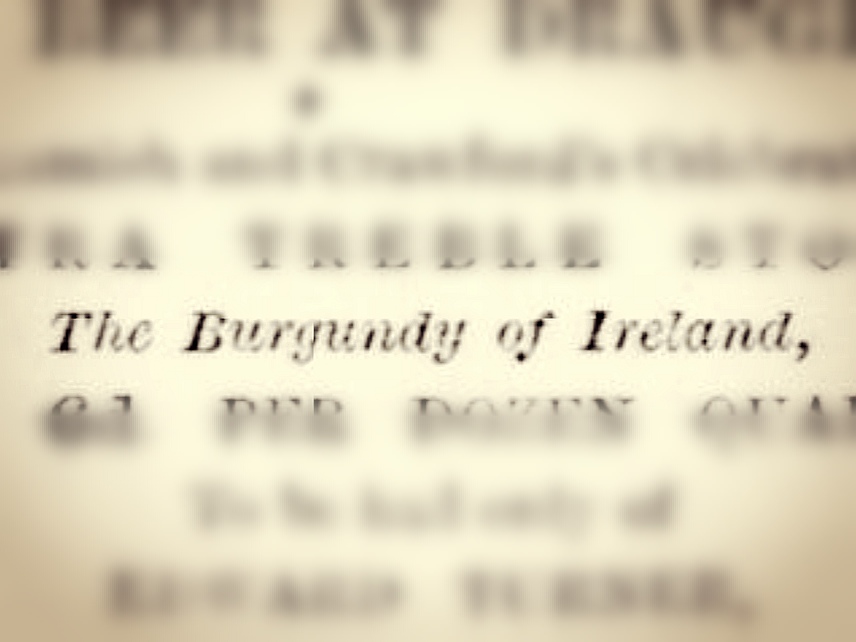
My often-addled brain can get somewhat confused when scrolling through the many advertisements and other texts that I need to absorb before and during the writing of these articles. Or that is my excuse at least for not digging quite deep enough into a by-line for a beer that I wrote about a little while ago in a post on Beamish & Crawford's Cooper Stout. That beer has quite an interesting tale, which I have covered here, and it was in that piece that I made a passing reference to 'The Burgundy of Ireland' which according to adverts in very late 1862 and on into 1863 referred to Beamish & Crawford's XXX stout. In that piece I had originally wrote that this term was for Drogheda Ale but in rereading the piece I corrected it to mean the XXX stout as this Advertisement from the Brighton Gazette in December 1862 shows  ...

But there was a nagging sense of something being wrong with this so I felt compelled to investigate it at some point, as that 'Burgundy' moniker was a little odd for a stout or porter. Stouts are dark red generally, but they are much darker than any burgundy I have partaken of - although that is not a very common occurrence to be fair. Also, I wondered how I had made the original blunder in assigning it to the Drogheda ale before changing it to the stout. (Thinking back now I possibly just associating the general quality and strengths of Burgundy wine to the XXX and did not focus too much on the colour.)

But time passed and other projects made me forget about this until quite recently when the term once again dropped into my brain and I decided to finally research it more. It did not take long for me to come across the following advertisement from The London Evening Standard from 31st July 1862, which predates the one above by a few months ...

And here is another from the same year in The Morning Post of the 1st of August that shows a variant of the same advertisement and you can see how it possibly led to the words being attached to the stout and not the ale from the way it was written and the faded brackets ...

Lastly here is a much clearer - if you squint - advertisement from The West Middlesex Advertiser from November of that same year where the attachment of the Burgundy name is clearly for the Drogheda Ale ...

These are obviously some of the advertisements I first read and that had originally stuck in my head. They clearly state that Drogheda Strong Ale is 'The Burgundy of Ireland' and I think the error came when the advertisement wording for these adverts was reused, communicated and rehashed perhaps, and the term was somehow assigned to the XXX stout instead. This makes sense in many ways as colour wise the strong ale was possibly a deep amber colour, as for example was a vintage amber ale produced by Smithwick's brewery at around this time which is mentioned in an article in The Waterford News and Star from September 1873. I have previously speculated that Drogheda ales were originally dark in colour and perhaps this is another pointer to that conclusion, but let us not jump too far on to the Irish Red Ale train just yet as there can be no comparison with the modern style and this old ale, although all of this might necessitate a new line or two in the middle part of my red ale trilogy. (The Drogheda Brewery Company mentioned in the first to adverts was Casey's brewery by the way.)

Admittedly, newspaper advertisements should not be taken as factual content in areas such as this, but my conclusion still seems to be the most accurate presumption - if one can be the other! It is also worth mentioning that in many cases these are the only records we have of certain beers, so we need to use them as reference points but with care and wariness.

As to the alcohol content I came across The Dublin Quarterly Journal of Science from 1862 that states that the abw (alcohol by weight) was 7% which would equate to 8.87% abv for Cairnes' Drogheda Ale according to this calculator. I am not sure how accurate that is but it would be relatively close and this strength would also help with its association with a wine, even if the colour would have been probably quite a bit paler.

Although there are certainly lessons to be learned all round here - especially by me - it is nice to see Drogheda Ale, which was held in such high esteem by many, getting such a nice reference.

Liam K.

All written content and the research involved in publishing it here is my own unless otherwise stated and cannot be reproduced elsewhere without permission, full credit to its source, and a link back to this post. Newspaper images are © The British Library Board - All rights reserved. With thanks to The British Newspaper Archive (www.britishnewspaperarchive.co.uk) from whom I have received permission to display these images on this site.

Tuesday, 1 March 2022

Brewing History: Dark Mild Ale inside The Pale?

Unless you have been living under a large rock you will be aware of Beer Twitter’s current obsession with Dark Mild ales, and although most of the noise on this topic is coming from across The Small Pond the cry has been taken up in certain circles in Ireland too. Currently there is a scarcity of that style on these shores apart from one notable - in every way - exception from Four Provinces Brewery, although there are probably some that would argue that certain brown ales - and perhaps even porters - are close in many ways to that style.

But it would be a mistake to think that this was a beer that was never popular in Ireland - and I use the word popular in a relative manner, as obviously it was those ubiquitous drinks called stouts and porters that ruled here for much of our relatively short ‘proper’ brewing history. It is probably better just to say that ‘mild’ ales, even dark ones, were being brewed and drunk here in the not-so-distant past. A good example is a beer that is awaiting bottling in my fermenter which was/is a dark coloured XX ale from Perry’s Brewery in Rathdowney in county Laois, that I am fairly sure could only be called a ‘Dark Mild’? Annoyingly the Perry brewing records that I have seen do not record their beers as ‘Milds’ in their records, just X and XX ales, but as I have shown previously the use of the word mild with either a small or large M was in quite common use in Ireland for a long period. Perry’s certainly used the word ‘Mild’ on their bottle labels so they appear to have used one term for the recipes and another for their marketing. (I am aware that ‘Mild’ at one time meant fresh in that same way that ‘Stale’ meant stored/aged but as the language changed I am also sure that over here at least Mild became a word for - well - a mild tasting ale that was relatively low in bitterness.)

With all of that in mind I would like to share an advertisement from The Irish Independent in 1915 for D’Arcy’s Anchor Brewery on Usher Street in Dublin where they specifically point out the colour of their ales:

Here we see that under their O’Connell’s Dublin Ales brand they were selling a Dark Extra Strong ale and a Pale Mild on draught - and let us not forget a rare mention for an Irish Best Bitter for bottling! Allowing for dubious marketing and the leeway that advertisement writers have with the truth this might be a nice mention for a Strong Dark Mild? Even if I am stretching terminology, styles and descriptions to the limit then if nothing else it is a nice record of what D’Arcy’s were brewing at this time. If we look at the table I previously posted on the strengths of Irish beers just prior to this period we can see that O’Connell’s Strong Ale varied from 5.1% to 5.5% in alcohol content and although we should not really make any assumptions as to how bitter it was - and alcohol strength has no bearing on a ‘Mild’ anyway as we know - it still seems to point the finger at there being a draught dark ale available in Dublin at the start of the 20th century that was not classed as porter or stout.

Hardly an earth-shattering find or observation but still of note.

Incidentally, D’Arcy’s were also brewing an ‘I.E.P. Ale’ (East India Pale Ale) in 1907, so they seem to have had a relatively interesting range of ales, although this could be what morphed into the ‘Best Bitter’ from 1915 perhaps? As ever, lack of information on our brewing past leads to much guesswork, 'maybes' and - perhaps - dubious assumptions …

Liam K.

Newspaper images © Independent News and Media PLC. All rights reserved. With thanks to The British Newspaper Archive (www.britishnewspaperarchive.co.uk). 

(All written content and the research involved in publishing it here is my own unless otherwise stated and can not be reproduced elsewhere without full credit to its source and a link back to this post.)

Thursday, 17 February 2022

Plain Boring?

A short while back I tweeted about a minor epiphany I had while drinking my homebrewed reproductions of historic Irish beers, as it had dawned on me that perhaps I was looking for too much from these brews. I threaded a few comments together on Twitter at that time but I decided it might be better to make a more permanent piece regarding my thoughts on here too. (It is probably worth mentioning that by historic Irish beers I mean those I am trying to recreate as best I can from old Irish brewing records - albeit on a modern homebrewing system - while trying to be as authentic as possible with brewing times, ingredients, etc.)

Up to now I have thought of these beers from the point of view of being 'special' both in flavour and in terms of their heritage and history, but on that taste point it must be said that these old beers were not brewed or drank for the appreciation and discussion we see today in 'craft' beer drinking circles. They were consumed for other reasons such as refreshment and revitalisation as well as their use as a catalyst for conversation and companionship in the pubs and other establishments where they were drunk. The actual beer was never discussed much apart from the very odd passing comment I am sure, in fact if the beer did become a great part of the conversation, then it was usually for the wrong reasons. The beers I have brewed recently such as mild ales from the 1930s, plain porter from the 1870s and vintage ales from the 1950s were the equivalent of the macrobrewed lagers, stouts and ales that are in most pubs today and which are drank by the vast majority of 'normal' beer drinkers in this country - and again those beers - mostly - only elicit conversation both on social media and real life when something goes wrong. (It is certainly true that the breweries themselves mentioned the flavour and strength of their beers in their newspaper advertising back then but that was really no more than the marketing spiel of the marketeers, something we see to this day in beer advertisements.)

Those older recipe beer did - and do - need to taste clean and free from flaws, and certainly they theoretically at least use ‘better’ ingredients on the malt side of things, where heritage malt varieties such as Spratt Archer and Chevallier seem to bring a more flavoursome base to the malt bill, but the only way to confirm that would be to do a side-by-side brew and tasting with a modern malt. (As an aside, there is certainly more time invested in the process of brewing both in the mash and the boil, but whether these could be shortened is up for debate. It seems to me that the longer mash time is need but perhaps the boil time could be curtailed as it might have minimum affect flavour-wise on modern systems - so yet more side-by-side taste tests required.)

So would these old beers appeal to modern drinkers?

Well what is clearly true is that these beers are not flavour-bombs aimed at today's palate, and especially not on the hop aroma front, so they might not strike a note with the majority of craft beer drinkers, and that demographic would be seen as their perceived target audience. Flavour-wise they might fall short, as hop-forward IPAs and certain novelty brews are still the top sellers.

And what of nostalgia and history side of these brews? Is that enough to make people curious about them? My twitter timeline and the reader count of these posts would seem to show that this is of interest only to a minority-within-a-minority of drinkers, and it certainly true that beer history is not something most drinkers care about - and I can understand that stance.  History in general can be seen as boring and beer history in general can be ultra boring - or even irrelevant - to many drinkers.

The ultimate test of any retail product is whether it would sell to a given range of consumers given a good marketing program, so a good way at looking at these historic beers is whether they could be commercially marketable based on uniqueness, heritage and process, where the actual product is assumed to be well brewed but could essentially be classed as ‘meh’ by a large part of its perceived core customer.

I feel it would indeed be a hard sell, although I know there are breweries in the UK that have sold these kinds of historic recipe beers - but they are mostly bigger breweries with huge reach ...

But there may be a different angle, and that is within the cohort of macrobrewed lager drinkers. I thought of this while drinking a pale X Mild Ale I had brewed and thinking how much - in a way - like a pale light lager it tasted, and its bigger brother the XX was quite like a ‘standard’ lager - albeit both had a little more going for them to my palate. So what if these ‘boring’ beers were used to wean more macrobeer drinkers from lagers to ales? I am well are that we have plenty of good microbrewed lagers that are already trying to do that but they do not tell a story on the marketing front.

And it is from a marketing point of view that these older beers can tell and proper tale, and have a real story and timeline - a factual story involving real people and breweries. For sure, some compromises need to take place but the basic ingredients and process can be replicated albeit on modern systems. Those records of American hops from Yakima and Oregon being used in these beers are of interest surely, and the tale of what we lost in flavour and what we gained in efficiency as we moved from one lovely old barley varieties to another before we resurrected them again for a new generation who appreciates their flavour and history. What of the defunct breweries themselves? Think of the tales we can tell of the people and towns the gave succour and employment as well as beer. There is a long list of authentic woven history wrapped up in any of these lost beers - plenty of material for actual, real marketing …

Okay, so excusing all of these musings, in reality the commercial appeal of these beers is probably a bridge too far outside of the odd once-off special brew, but at the very least independent microbreweries should be looking at actual historic records - or talking to those who have - when they decide to brew a historic beer and not just go down the easy root of creating - not recreating - a red ale or porter plastered with words such as traditional, heritage or whatever sounds good.

And still on that point perhaps there is a different marketing angle, as surely there is something appealing about these beers to tourists who look for something more interesting and different drink-wise? A minority of them perhaps but there must still be plenty of visitors to this country who might hanker for genuine historic Irish beers from real Irish breweries, served in real Irish pubs - not just the red-washing at the beer tap that we typically see …

Food (or drink?) for thought - for me at least.

Liam K.

(All content shown here including pictures cannot be reproduced elsewhere without permission, full credit to its source, and a link back to this post.)

Friday, 5 November 2021

Irish Brewing History: Beer Strengths in the Early 20th Century

One of the questions that comes to mind when I look at old newspaper brewery advertisements or at a newly-found vintage beer labels is just how strong were the beers of our brewing past. Nowadays the strength of any beer is displayed on the can or bottle, or perhaps scrawled in chalk on the blackboard over the counter in our favourite bar, and if all else fails a quick search online gives you the information you require.

But this was not always the case, as in the not-so-distant past there were few if any regulations regarding the displaying to the consumer of the strength of any given beer. I am not sure that the retailer cared, nor did the customer to any great degree other than knowing that XX was stronger than X and stout was stronger than porter - although that was really only true if you were comparing the brews from just a single brewery.

But that alcohol strength is one vital piece of information that is of importance to the strangely obsessive folks that inhabit the niche world of beer history, and in the absence of a brewing record showing the gravities of the beer before and after fermentation - and those records are quite rare in Ireland - there tends to be a lot of use of the word 'probably' instead of 'definitely' - something that seems to be the case with much of our general history too.

On a Recent visit to the archive department that is housed in the basement of the the library building on the wonderful campus at University College Cork, I unearthed an interesting notebook that belonged to an Edward Cruise of Ardee Street Brewery in Dublin. My reason for being there was to look for historic brewing recipes for Cork's own Lady's Well Brewery - or Murphy's Brewery as it is more commonly known - and I found those and much more besides, but this is a small example of the other treasures held within those well-minded records.

Ardee Street Brewery had quite a few owners, and I have written very briefly about the brewery with regard to an older beer label here, but in the time period we will be focussing on it was trading as Watkins, Jameson, Pim & Co. and Edward Cruise appears to have been the head brewer there during this period. He is listed here as a member of the London Section of The Institute of Brewing since 1913 with an address at Ardee Street. He would also become head brewer in Lady's Well Brewery in 1948 and later became a board member there1. This would explain how this notebook ended up in these archives before it fell into my grateful hands - at least for one damp morning in October.

The notebook contains some quite interesting information but what stood out for me was a list of the gravities of different beers from 1906 until 1912. These were arrived at by a somewhat complicated process of distillation and gravity measuring that may or may not be entirely accurate but seems to give a relatively accurate figure for the original gravity of any given beer based on its 'present' gravity and spirit value. Mr. Cruise, or perhaps his laboratory team, had done all the hard work to give a list of final gravities (as well as other information) and this just left me with the task of calculating the Alcohol by Volume with a simple formula, and to transcribe to the best of my ability the handwritten list. You will see below where I have made some assumptions, but what it gives us is a fascinating list of the gravities of quite a number of beers that have been 'lost' up to this point.

Beer Gravities and Strengths - Calculated by the Distillation Method

YearProductPresent GravityOriginal GravityAlcohol by Vol.
1906Ardee Street Brewery(?) Vaults X No. 311.01411.05285.08%
1906Mountjoy X [Porter?]1.01441.05875.81%
1906D'Arcy & Son Porter1.01981.05875.11%
1907Mountjoy Porter1.01371.05675.64%
1907D'Arcy & Son Stout1.01841.06175.68%
1907Guinness Extra [Stout]1.02321.07326.56%
1907D'Arcy & Son Porter1.01831.05464.76%
1907Watkins X D[raught?] 1.01621.05485.07%
1907O'Connell Strong Ale1.01051.05225.47%
1907Foreign AG & Co(?) Invalid sold in Limerick - Guinness?1.02131.07607.18%
1907Watkins 14 S.S. [Special Stout]1.01261.05435.47%
1908Guinness XX Draught1.02161.07406.88%
1908Guinness same as sent to Texas(?)1.01161.07037.70%
1908O'Connell Strong Ale1.01461.05335.08%
1908Younger & Co Canteen Stout1.02371.05083.56%
1908Watkins No. 1 Skr(?) 45 XX1.01791.07557.56%
1909"Strangways" [Strangman's!] Waterford Porter1.01981.05614.76%
1909Ind Coope Luncheon Stout1.01311.05425.39%
1909Allsopp Oatmeal Stout1.01431.05545.39%
1909Ardee Street Brewery(?) Pale Ale supplied to canteen1.00611.05175.99%
1909Ardee Street Brewery(?) Mild Ale1.00611.05115.91%
1909Ardee Street Brewery(?) Pale Ale Ex Vaults1.00601.05115.92%
1909Ardee Street Brewery(?) D.S. [Double Stout] Canteen1.01341.06406.64%
1909Ardee Street Brewery(?) XXX Ex Vaults1.02051.08218.09%
1909Ardee Street Brewery(?) Canteen Pale Ale1.01171.05405.55%
1912Guinness X1.01451.05625.47%
1912Guinness X1.01521.05635.39%
1912Guinness X1.01541.05695.45%
1912Guinness XX - Sold at 3d per pintN/AN/AN/A
       1912       Ardee Street Brewery(?) No. 44 Vaults Special Stout    N/AN/AN/A
Transcribed by Liam - www.beerfoodtravel.blogspot.com - via item BL/BM/BC/445(1-7) in Cork University Library Archives
Do not reproduce without receiving permission to do so and crediting sources

This is certainly a wonderful range with some interesting notes...
  • O'Connell Strong Ale was not as strong as I would have assumed given the name
  • He acquired a sample of Guinness that was the 'same as sent to Texas' if I have transcribed it correctly, and Guinness were certainly exporting to Texas at this time according to David Hughes's 'A Bottle of Guinness Please'
  • I have assumed that where no name is given for the brewery or 'Vaults' are mentioned that these beers are from Ardee Street's Brewery's own stock - but I have no actual proof of this. It certainly gives a lovely list of the beers being brewed if we include those written as 'Watkins' - Special Stout, Draught X, Pale Ale, Mild Ale and XXX
  • 'Canteen' beers were those normally supplied to army canteens but I am not sure if this is what the term means here, although I suspect it does
  • Note how Strangman's in Waterford is written as 'Strangway's' - almost Strangeways!
  • The 'Watkins No. 1 Skr(?) 45 XX' is quite a strong beer but I cannot quite make out some of the writing. I am assuming that the numbers shown beside various recipes refer to the gyle - again I have no proof of that
  • We see a Younger's weak looking canteen stout listed as well as an Ind Coope Luncheon Stout and an Allsopp Oatmeal Stout - both at the same abv
There are some notes to the side of the list that give the actual OGs of some of Ardee Street Brewery's own beers (as well as figures from a Lipton Analysis?) and although they do not match exactly the calculated FG figure, they are generally close enough to right to give me confidence that the gravities of the beers are relatively accurate for the purposes of showing the strengths of the various brews.

Here are the original pages from the notebook to show the extra information and other notes ...

©Murphys Archive item BL/BM/BC/445(1-7), Special Collections & Archives, UCC Library, University College Cork, Ireland

© Murphys Archive item BL/BM/BC/445(1-7), Special Collections & Archives, UCC Library, University College Cork, Ireland

I hope you find this information as interesting as I did, I must admit I was quite excited to see it jump from the pages of a century old book ...

(With thanks to all the extremely helpful and professional people in the archive department in UCC.)

Liam

1 ‘The Murphy Story’ – Donal Ó Drisceoil & Diarmuid Ó Drisceoil

All written content and the research involved in publishing it here is my own unless otherwise stated and cannot be reproduced elsewhere without permission, full credit to its source, and a link back to this post.

Original images are © Murphys Archive item BL/BM/BC/445(1-7), Special Collections & Archives, UCC Library, University College Cork, Ireland from whom I have received permission to display these images on this site.

Tuesday, 11 May 2021

The History of Hop Growing in Ireland - Part 2: The 19th Century

[An updated version of this post can be found here.]

In the last post we looked at the 17th and 18th century and how much growing of hops was taking place in Ireland, especially in the middle years of the 1700s. Much of this was driven, or at least aided, by the Dublin Society in their efforts to establish home industries to replace imports. We also saw mentions of hop growing dwindle significantly as we headed towards the 19th century so let us take it from that point and see if there was a revival for that much misrepresented plant in this country.

1801 - There is a mention of duty to be paid on importation of hops from Ireland into Great Britain in Steel's Tables of the British Custom and Excise Duties published in that year and also in a Parliamentary register the previous year which would lead us to believe there was still some hop growing in the country or at least the potential to do so.

1801 - A Mr. R. Smyth wrote to the Dublin Society regarding his espalier-trained hops that he was growing on half a rood (one eight of an acre) of his father's land in Kells Co. Meath, which he used in his own ale - via Transactions of the Dublin Society, Volume 2, Part 1 1801

1806 - A London newspaper reports that a duty of two-pence halfpenny per pound weight was resolved to be imposed on Irish hops by a committee in the House of Commons in England, it was passed a couple of weeks later. There are many other mentions of this bill too which again would make you think there was some trade between Ireland and Britain, unless they were just covering themselves in case there was a resurgence in the growing of hops on this island.

1816 - The Dublin Society were offering a premium of 1 shilling per barrel for beer brewed with Irish hops for private use or sale.

1833 - A John Pendergast from Inistioge in Kilkenny wrote to an English paper putting forth the idea of the landed gentry starting hop farms in Ireland to give more work to those living on their estates and to free said gentry 'from the enormous dead weight the heretofore has existed upon their well-known beneficence.' (!) It was reprinted a Dublin newspaper where the editor poured scorn on the idea that the gentry of Ireland would be interested in such a plan. Mr. Pendergast also suggested that an Irish acre would produce 26 cwt of hops at 7 pound 12 shillings per cwt. In response to the above letter 'a Kent Radical' responded to say that there is an act of parliament which prohibits any one in Ireland from owning a hop farm larger than a quarter or perhaps half an acre. I cannot find any such legislation but maybe it is hidden somewhere or is combined into some much older act I am unaware of that prevented Catholics from owning any more land for crops that was necessary to feed themselves?

1835 - Under the headline ‘Irish Hops’ a Belfast newspaper states that The Commission of Revenue Inquiry recommended that Irish grown hops should pay a similar rate of duty as those grown in England. (There are also mentions of duties on ‘Irish hops’ in 1843, 1845 and 1846 in various parliamentary records.) Once again this would indicate that hops were possibly still being grown somewhere on the island and in enough quantities to warrant discussion in parliament.

1849 - A report in an Irish newspaper in April via The Globe of the vessel ‘Erin's Queen’ arriving in London from Belfast with 18 packets of hops. Is this the first export of Irish hops to England? Probably not but it is the first record I can find. It would certainly have been going against the flow of hops coming the opposite direction so it would seem to be a noteworthy occurrence.

1849 - An English newspaper report of ‘The Citizen’ arrived in the Thames in May from Dublin with 27 (20 quoted elsewhere) pockets of hops from Ireland, which it appears was – unsurprisingly - not a common occurrence.

1849 - A Mr. Samuel Burke of Thomastown, Kilrush in Co. Clare sowed and acre and a half of hops. It was said to be a novelty 'in that part of the country.’

1849 - An English newspaper carries a mention under the title 'Irish Hops' of a vessel arriving in the Thames from Belfast in October carrying 5 pockets of hops that states that they are 'the produce of Ireland' and that 'this is the first arrival of this article from the sister country' - but as we saw above there were earlier shipments.

1849 - A mention in a London Newspaper in December of bales of hops arriving into England 'some time since' from an Irish port and that this was 'of some interest' and that there had been a further arrival of several bales on a ship called the ‘Cannaught[sic] Ranger’ from Sligo and Derry, and this was the 'second importation of the kind from the sister country' which again may be a little off the mark.

1850 - The vessel ‘Ranger’ arrived in London from Belfast, Dublin and Waterford in February and 'brought some packages of hops, as a portion of her cargo from the Irish metropolis, the produce of that country.’

1850 - A small note in an English newspaper in March that states - 'Irish Hops. Several additional importations of hops from Ireland have recently been noted. Hitherto the largest import has been eleven bales' so again we can see errors in reporting based on what was mentioned above. A sign that we need to be wary of what is reported in newspapers ...

1850 - Under the title 'Irish Hops' in an English newspaper in August, 17 packages arrived in London from Ireland.

Just a note on all these shipments. Although there are numerous mentions of these being Irish produced hops the doubting part of my brain thinks that maybe there were imported from elsewhere and passed of as Irish hops for financial reasons? I have no proof of this of course, but I think it may be worth considering, however unlikely it may be. For now I am taking it at face value that hops were being grown in Ireland and exported to England for use by breweries in that country – an interesting and I would image surprising turn of event to many of you!

1852 - A reference in the proceedings of the now ‘Royal’ Dublin Society regarding an exhibition mentions a donation of a ‘specimen of Irish-grown hops’ donated by a John L. Tute of Blackrock amongst other agricultural specimens.

1855 - A newspaper mention that an experiment to grow hops in Ballyteigue, Wexford by a John Stafford was successful - the reporter sounded quite surprised!

1865 - 'Hop Growing at Kingstown [Dún Laoghaire] - A fine specimen of this useful creeper may now be seen in front of the residence of Captain Wilcox, Royal Terrace. It is very strange that hops are not more generally nurtured in Ireland' according to the Catholic Telegraph newspaper.

1867 - Thomas Bromwich a hop grower at Temple Farm near Alton in Hampshire was advertising hop plants for sale in an Irish paper under the headline, 'Hops, Hops, for Ireland.'

1867 - A newspaper mentions a successful attempt was made to grow hops in Ireland with the hope that there might be a larger scale experiment in the near future. No further information is given.

1872-1873 - A chart published in Thom's Directory of Ireland shows no acreage for hops in these years. Similar charts towards the end of the 19th century show similar results, although there is no way of being 100% positive that the information was being recorded correctly. It also possible and probable that it was on such a small scale, perhaps just for a breweries own use that it would be unregistered.

Pre 1900? - There is a reference to hops being grown extensively on Whiddy Island in Cork in the schools collection on the Dúchas website but no dates unfortunately so I’m assuming the period to be in the 19th century given the tone of the mention.


So by one standard this was an unexciting century for Irish hops and towards the end it appears that we had forgotten that we grew hops here at all! Once again the middle part of the century is the most interesting, as attested by those shipments of Irish hops to England. It would be nice to think that those were used in English ales – and I presume they probably were. I wonder is there any records in London or elsewhere of ale brewed with Irish hops? Somehow I doubt it…

As you can see there is quite a bit of conjecture and assumption in this based on the various newspaper reports, so as ever we need to be wary enough on what we read into those articles. Having said that there are certainly enough mentions to suggest a continuity of hop growing in the country even if it appears to dwindle at times to sparse comments.

Still, at least we appear to have been a hop exporting country – however briefly – at one time…

The last part of this trilogy will focus on the 20th century, which is a very interesting and busy time for hop growing in Ireland!

Liam

P.S. I have purposely omitted the actual sources of exact newspaper mentions as there are quite a few and it was pain-staking research, but if anyone needs them please email or DM me and I’ll send you on the details.

(All written content and the research involved in publishing it here is my own unless otherwise stated and cannot be reproduced elsewhere without permission, full credit to its source and a link back to this post.)

Newspaper image © The British Library Board - All rights reserved. With thanks to The British Newspaper Archive (www.britishnewspaperarchive.co.uk from whom I have received permission to display here).