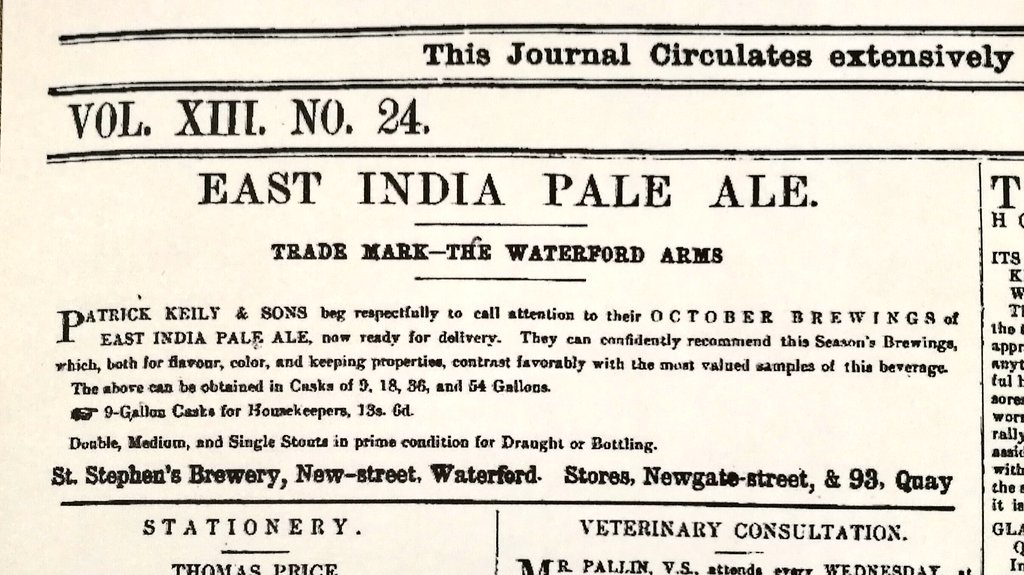
A mention of an establishment called 'St. Stephen's Brewery' piqued my interest in a previous post about The Dublin Hop Stout Company, as prior to that I had only come across a brewery of the same name in Waterford.
It turns out that the name was also used by a company called Hovenden & Orr, which was established in 1892 at 131 St. Stephen's Green (although the proper entrance seems to have been off Glover's Lane), almost opposite the main entrance to the park. Messrs. Hovenden and Orr seem to have previously worked for Thwaites, the better known mineral water manufacturer, before setting up their own company making soda water, lemonade, ginger ale and 'medicinal' drinks with names like Lithia, Kali, Potass. (In advertisements from this time they also make a point of stating they were the only manufacturer to use glass lined tubing instead of the usual lead or tin for their pipework - no lead poisoning is surely something to promote!) There is a small image of the enterprise in the corner of the poster at the top of this post. It appears to be in an inner courtyard shown on an Ordinance Survey map from around this period.

They start to advertise their Hop Bitters in 1895 and this is also their first use of the word 'Brewery' (sitting above their address) in any advertisements and in 1897 they first use the full title of 'St. Stephen's Brewery'. I can only think that they used the name to add a little legitimacy to there hop bitters at this time, especially given the competition I reference in the above mentioned post. They are brewing Ginger Beer as well as Hop Bitters in 1900, along with their core lines of soda water and other mineral waters, and a 'Dublin Ginger Stout' appears in 1905, but these are all under the Hovenden & Orr name alone. All of their production over the years seems to be of non-intoxicating products.

The St. Stephen's Brewery name, which they appear to have dropped in 1898 reappears for an advertisement tied to the Irish National Exhibition in 1907, perhaps because they had a separate stand for their Hop Bitters and a Dublin Brown Ginger Stout at the showcase and again wanted to give it more of an air of legitimacy. I can't find the brewery name being used mentioned after that point.
Advertisements seem to run with just the Hovenden & Orr name from then on, and the main company name seems to disappear when they merged with a number of other Dublin mineral water manufacturers in 1927.
The whole enterprise probably warrants a longer look, more research and a bigger post at some point in the future.
Liam
(All written content and the research involved in publishing it here is my own unless otherwise stated and cannot be reproduced elsewhere without permission, full credit to its source and a link back to this post. All original photographs are my own and can not be used elsewhere without my consent.)
The rights to the poster image is held by Dublin City Libraries (www.dublincitypubliclibraries.ie) and from whom I've received permission to reproduce here.
Newspaper images © The British Library Board. All rights reserved. With thanks to The British Newspaper Archive (www.britishnewspaperarchive.co.uk).