Showing posts with label Beamish & Crawford. Show all posts

Wednesday, 4 May 2022

The Burgundy of Ireland - Drogheda Ale or Cork Stout...?

My often-addled brain can get somewhat confused when scrolling through the many advertisements and other texts that I need to absorb before and during the writing of these articles. Or that is my excuse at least for not digging quite deep enough into a by-line for a beer that I wrote about a little while ago in a post on Beamish & Crawford's Cooper Stout. That beer has quite an interesting tale, which I have covered here, and it was in that piece that I made a passing reference to 'The Burgundy of Ireland' which according to adverts in very late 1862 and on into 1863 referred to Beamish & Crawford's XXX stout. In that piece I had originally wrote that this term was for Drogheda Ale but in rereading the piece I corrected it to mean the XXX stout as this Advertisement from the Brighton Gazette in December 1862 shows  ...

But there was a nagging sense of something being wrong with this so I felt compelled to investigate it at some point, as that 'Burgundy' moniker was a little odd for a stout or porter. Stouts are dark red generally, but they are much darker than any burgundy I have partaken of - although that is not a very common occurrence to be fair. Also, I wondered how I had made the original blunder in assigning it to the Drogheda ale before changing it to the stout. (Thinking back now I possibly just associating the general quality and strengths of Burgundy wine to the XXX and did not focus too much on the colour.)

But time passed and other projects made me forget about this until quite recently when the term once again dropped into my brain and I decided to finally research it more. It did not take long for me to come across the following advertisement from The London Evening Standard from 31st July 1862, which predates the one above by a few months ...

And here is another from the same year in The Morning Post of the 1st of August that shows a variant of the same advertisement and you can see how it possibly led to the words being attached to the stout and not the ale from the way it was written and the faded brackets ...

Lastly here is a much clearer - if you squint - advertisement from The West Middlesex Advertiser from November of that same year where the attachment of the Burgundy name is clearly for the Drogheda Ale ...

These are obviously some of the advertisements I first read and that had originally stuck in my head. They clearly state that Drogheda Strong Ale is 'The Burgundy of Ireland' and I think the error came when the advertisement wording for these adverts was reused, communicated and rehashed perhaps, and the term was somehow assigned to the XXX stout instead. This makes sense in many ways as colour wise the strong ale was possibly a deep amber colour, as for example was a vintage amber ale produced by Smithwick's brewery at around this time which is mentioned in an article in The Waterford News and Star from September 1873. I have previously speculated that Drogheda ales were originally dark in colour and perhaps this is another pointer to that conclusion, but let us not jump too far on to the Irish Red Ale train just yet as there can be no comparison with the modern style and this old ale, although all of this might necessitate a new line or two in the middle part of my red ale trilogy. (The Drogheda Brewery Company mentioned in the first to adverts was Casey's brewery by the way.)

Admittedly, newspaper advertisements should not be taken as factual content in areas such as this, but my conclusion still seems to be the most accurate presumption - if one can be the other! It is also worth mentioning that in many cases these are the only records we have of certain beers, so we need to use them as reference points but with care and wariness.

As to the alcohol content I came across The Dublin Quarterly Journal of Science from 1862 that states that the abw (alcohol by weight) was 7% which would equate to 8.87% abv for Cairnes' Drogheda Ale according to this calculator. I am not sure how accurate that is but it would be relatively close and this strength would also help with its association with a wine, even if the colour would have been probably quite a bit paler.

Although there are certainly lessons to be learned all round here - especially by me - it is nice to see Drogheda Ale, which was held in such high esteem by many, getting such a nice reference.

Liam K.

All written content and the research involved in publishing it here is my own unless otherwise stated and cannot be reproduced elsewhere without permission, full credit to its source, and a link back to this post. Newspaper images are © The British Library Board - All rights reserved. With thanks to The British Newspaper Archive (www.britishnewspaperarchive.co.uk) from whom I have received permission to display these images on this site.

Wednesday, 22 April 2020

'Where do you get your Cooper?' Ireland's first beer brand...?

From the end of October 1862 until early 1863 the following piece appeared as a short editorial-like column in a number of Irish and English newspapers:
Bottled Cooper
“What stuff is that?” growled out a passenger seated alongside the driver of omnibus the other day when he heard him smack his lips after swallowing a pint of new decoction and exclaiming “That’s first-rate.” The old roadster, looking sneeringly round, exclaimed “Don’t you know? Why, to be sure, its half porter and half stout.” The inquisitor was still dissatisfied asking, “Why call it Cooper?” This was enough to rile even a ’bus driver, at the same time feeling a thorough contempt, for such glaring ignorance that he weighed over to himself whether or no he should then satisfy his importunate companion ; but taking pity upon one evidently “from the country,” he ejaculated, “Oh, do you want to know that too ? Well, that’s easily answered. You must know that some time ago Jack Cooper, who used to drive one of the Brompton’s when be pulled up at the White Horse Cellar, Piccadilly, always had glass of this stuff; and the potboy seeing his ’bus pulled up, would always sing out – ‘Another glass of Cooper.’ The barmaid knew what was meant; but nobody else. Well, you see, this name got abroad, and now everyone does his Cooper. Take my advice, ‘Governor,’ when you feel dry take a drop.” Reader be very much obliged for this solution. Few people indeed know the origin of the word “Cooper.” Now, however, we have just had an improvement introduced in the shape of “Bottled Cooper.” Messrs. Beamish and Crawford, brewers, of Cork, who have had the supplying of the refreshment department the International Bazaar, and whose beers, by-the by, have been patronized for the quality and price, finding it necessary to have agent, appointed Mr. Henry Johnson, of the Circular Vaults, St. Paul’s; and him the public have to thank for the introduction of this popular drink. The idea suggested itself to him that what was palatable as draught drink would be doubly so when bottled.

Now I am certainly a fan of the odd piece of beer-related fan fiction but let us not put too much faith behind the story of the origin of the name 'Cooper' which is usually described as a half-and-half mix of stout and porter, and allegedly named after actual barrel coopers, but it does highlight a little known story about Beamish and Crawford's arrangement with Henry Johnson to sell their stouts in London. This is well covered in Beamish & Crawford - The History of an Irish Brewery, where a small chapter in the book explains, according to the authors, how Henry Johnson makes contact with Richard Pigott Beamish and how it was agreed that Johnson would sell a mix of their year-old Extra Treble Stout and Single Stout from his warehouse in London. It would be bottled there and sold with a nice bright label bearing the Beamish & Crawford name with a trademarked image of a castle flanked by two soldiers over the word 'Cooper', (I will not reproduce it here as I am unsure of copyright issues with posing even fragments of the above mentioned book.) and caged with branded corks, at a price 2s and 6d for a dozen pint bottles - cheaper than similar products and at what were said to be draught beer prices. (Although as you can see from the advert at the top of the page, some of Johnson's agents sold it for more.) There was even a recited advertising 'jingle' called, 'Where do you get your Cooper?' to accompany the launch.

It all ended in tears, as Johnson had both supply and quality issues (He apologised for both in the advertisement below.1) and was accused of using other brewer's beers instead of Beamish & Crawford's (Where did you get your Cooper indeed Mr. Johnson!?), so the brewery cut its ties with him at the end of April in 1863 and he was declared bankrupt not long afterwards. (A J. Hazard was selling 'The celebrated bottled Irish Cooper' in June of 1863 from the same address as Johnson's.2) You can read more about it in the book but it raises a few interesting points and I have other thoughts on it too...


The most important point perhaps is that I think that Cooper may have been the first Irish - or at least Irish brewed - beer to be marketed with a brand, jingle (I know I am taking liberties here...) and editorial advert? I am not aware of any others that existed this early anywhere else on these islands in fact, although I have not overly researched it to be fair. I would guess that it was certainly the first trademarked Irish-brewed beer ...

And there are a few more points to make too...

In August 1862 there were a couple of advertisementsfor Beamish and Crawford's Extra Treble Stout bottled with the above mentioned castle label and corks but not the Cooper name, this to my mind means that perhaps the whole range mentioned including the single and double stout had similar branding and perhaps the castle trademark covered all of the range, not just the later Cooper? The 'Cooper' appears to have been launched in September of that year, as it was not mentioned in those previous month's advertisements. Here is a copy of the first advertisement I can find for a beer with the Beamish & Crawford "Cooper" name and stating the blend - old vatted treble and single stouts - from the London Morning Post of the 1st of September.


It is worth noting that according to an advertisement for his Irish Cooper from March 1863 Johnson was then selling the unblended Extra Treble Stout. (Called 'The Burgundy of Ireland' according to some advertisements. Edit: This name was misattributed.) plus interestingly a 'Drogheda Strong Ale' as well as East India Pale Ale, but there was no sign of the single stout he supposedly blended with the triple.4 (By the way, directly above this March advert is one for bottled 'London Cooper' from Laidler and Fitch - some more local competition it seems!)

So was this the first bottled Cooper on the market? I can find some from Whitbread and others after this date but not before. And where did the bottled version actually originate if not Johnson, and Beamish and Crawford? In 1871 'The Cooper Company' claim to have originated the product in 1862 and were still selling it at the same price of 2s and 6d per dozen,5 so I'm quite confident that the bottled form of cooper - at the very least - originating from that original Cork-London partnership.

Next, in 1872 the following wonderful advertisement appears in the Islington Times:


This label is almost identical to that used by Beamish & Crawford and Johnson for their product apart from replacing their names with the name of the new company, and it still carries the trademarked logo. So does this mean that the Cork brewery were still supplying The Cooper Company or has all the branding and trademarks passed to that company when they bought out Johnson's bankrupt one? I suspect the latter and that Beamish & Crawford no longer had anything to do with it, certainly in the Beamish book I referenced above there is no mention of any continuation to supply after they withdrew from the arrangement.

Along with that advert there is an interesting report on a visit to The Cooper Company under the Hop Exchange on Southwark Street in London by a Percy Russel as part of a series of writeups under the title 'Metropolitan Industries'. In it he addresses the hygiene issues raised by a previous contributor to the newspaper with regard to brewing and bottling in general and he goes into some detail on the cleaning process for each bottle in the company's vault. More importantly for our story he also states that it is 'comforting to see by the branded barrels that the Irish stout does enter into the 'Cooper' and that the label is as true as a bank of England note.' He goes on to mention 'the happy blending of different brews' but annoyingly doesn't mention any of the actual brewers involved. He also mentions that The Cooper Company also export their beer to 'Shanghai, touched Tientsin, and even reached the Mikado of Japan himself.' (Indeed, according to an advertisement in The Times of India it was being sold in that country in 1877 too.)

In 1875 The Cooper Company were selling their Cooper at the same price as previously - and they were also selling Treble Dublin Stout by this time, as well as 'family' ale and India pale ale - and here is what they say about the Cooper product itself in an advertisement from this date:
The Cooper's Company Cooper is not plain porter, under the assumed name of Cooper, but is what the Cooper Company originally professed it to be - viz., Dublin Vatted Stout and London Porter. [My emphasis]6
So, that is somewhat of a change from what it started out as, and I think  that perhaps this company was indeed formed on the ashes of Johnson's old company or was relaunched in this way by a former agent of his perhaps? (Johnson's stock of ports, sherry and 30 dozen bottles of Cooper were auctioned in November 1863.7) It would appear that the statement of what Cooper was in 1875 - although probably true at the time it was published - had been twisted to something more marketable, as Dublin Stout and London Porter were likely to be a more saleable commodity at this point, and readily available too. The irony is that given the shenanigans of Johnston that this later blend is quite possibly what he was actually selling to unsuspecting punters back in 1863!

At the end of the above mentioned advertisement the company also say they bottle Guinness Dublin Stout and Mander's Invalid Stout as well as an enigmatic 'Red Cross Treble Dublin Stout'. Mander's Invalid Stout was an XXX stout so I believe it was both the 'Red Cross' and the Dublin stout used to make the company's Cooper at this time, as it would make logical sense.

(Curiously, in 1886 Cundell and Camozzi in Tavistock were selling a bottled Cooper that was a mix of 'Stout and Bitter' for 2s per dozen.8 Make what you will of that blend, as it was just in an advertisement...)

Anyhow, as ever I have probably raised more questions than I have actually answered, but it is good to get this part of Ireland's - and London's - brewing history online and findable for others.

Perhaps some Cork brewery might revive the 'Celebrated Irish Cooper', or maybe a Dublin and a London brewery could do a collaboration?

Just don't forget the marketing, the trademark - and to write that jingle!

Liam

(All written content and the research involved in publishing it here is my own unless otherwise stated and can not be reproduced elsewhere without full credit to its source and a link back to this post.)

Advert  - Holborn Journal - Saturday 21 February 1863


1London Evening Standard - Monday 09 March 1863

2 Illustrated Weekly News - Saturday 27 June 1863

3 London Evening Standard - Thursday 28 August 1862

4 London Evening Standard - Tuesday 17 March 1863

5 Stroud News and Gloucestershire Advertiser - Friday 18 August 1871

6 Kilburn Times - Saturday 10 July 1875

7 London City Press - Saturday 31 October 1863

8 Tavistock Gazette - Friday 05 November 1886

All via The British Newspaper Archive and Beamish & Crawford - The History of an Irish Brewery (2015) by Donal Ó Drisceoil and Diarmuid Ó Drisceoil
Newspaper images © The British Library Board. All rights reserved. With thanks to The British Newspaper Archive (www.britishnewspaperarchive.co.uk). 


Wednesday, 29 January 2020

Beamish & Crawford's Celebration Ale - The Original Rebel Beer from the Rebel County

Following on from my last post about Tower Stout it seems appropriate to continue with another lost Beamish & Crawford beer, this time an ale launched to mark the 50th anniversary of the 1916 Easter Rising. Touted as a 'strong ale'1, Celebration arrived smack bang into the hard fought beer drinking world at a time of severe upheaval in the Irish ale scene, and into that short period in the 1960s and early 1970s when their sales were in the ascendancy.

Image Source - Author's own collection

On the 4th of April 1966 the Monday edition of The Irish Press carried a short column sandwiched between escalating problems in Vietnam and an obituary for the car designer Battista Farina stating that a new ale called simply 'Celebration' would be for sale on draught from that date in fifty Dublin pubs. The official launch had been the previous month in Cork city and county2 after it had been blind tested for several months, so presumably it was decided that a new ale was firstly needed, or needed by Beamish & Crawford anyway, and it must have been relatively well received by Cork's finest ale drinkers.

Image Source - Unknown Paper September 3rd 1966 

By July of 1966 it had received 'outstanding popularity in Waterford and throughout Ireland' and it was available in half-pint bottles, pint bottles as well as on draught, and it claimed that it was 'the only ale sold here [in Ireland] in pint bottles'.(There's a picture of the stubby pint bottles here.) I wonder was this the start of the South-East's love affair with the large bottle of ale?

By December of 1966 it was mooted that Celebration would be launched in the UK - somewhat ironically given what it was launched to celebrate - in some of Charringtons United Breweries 6,205 tied houses in which Beamish & Crawford's owners Canadian Breweries had a 10% stake. At this time it already had 15% of the ale market in Ireland and the company were also making inroads into the lager sector with Carling Black Label.3

Although imported before then, towards the end of 1968 Bass began to be brewed in Beamish & Crawford and this was followed by Worthington's in late 1969, adding to a severely crowded draught ale marketplace of Smithwicks, Watneys Red Barrel, Phoenix, Macardles, Double Diamond and a number of smaller ale brands. Bass sales soon outstripped Celebration and in April 1970 its above mentioned Dublin taps were withdrawn along with those in northern half of the country, the half pint bottles were dropped and it seems to have quietly ceased to exist entirely in 19712 as the company put its faith in Bass for the battle of the ale market share.

As to its taste, appearance and alcohol content I can only guess at two, but it was certainly a pale ale like Phoenix more so than a darker one like most of its other rivals. In 1966 it won a gold medal in Brussels but this doesn't tell us much, and two of the beermats in my possession use words such as 'Big Beer', 'Full Bodied' and 'Powerful' which perhaps hint at its taste and marketing strategy - more telling perhaps as to its strength might be this quote from a Cork forum:
"It was by far the strongest drink to hit the bars at that time.I still hear stories from ould fellas chatting about the state and condition that fellas would get in,from drinking 'a few pints'"
Make of that what you like...


Image Source - Author's own collection

My collection of Celebration breweriana is quite scarce but I do possess a nice set of beer mats and a pint bottle label, sadly I don't have one of the nice Waterford glasses that you can see in the advertisement above and on one of these beer mats - yet...

Image Source - Author's own collection
Liam

(All written content and the research involved in publishing it here is my own unless otherwise stated and can not be reproduced elsewhere without full credit to its source and a link back to this post.)

References:

1 Munster Express - 8th July 1966

2 Beamish & Crawford: The History of and Irish Brewery, Donal Ó Drisceoil & Diarmuid Ó Drisceoil (2015) 

3 The Cork Examiner - 15th December 1966

Advert via local library local studies room

Wednesday, 22 January 2020

Tower Stout - Beamish's Rebrand

Image Source - Author's own collection
As we have learned from previous posts on the subject, the brewing trade in Ireland in the 1960s was extremely volatile with many new beers entering into the pub scene and some changes of name and identity from the existing Irish breweries like Smithwick's with their Time rebrand. It would be foolish to think that the Cork brewers were unaffected by the unrest, especially as they were contributing to much of it themselves, and indeed it was at this time that Beamish & Crawford decided to rebrand their famous black beer (or a version of it) as Tower Stout - named after the iconic tower on the older beer labels and logo.

Image Source - Cork Examiner September 17 1968

Launched on draught and bottle as Tower Export Strength Stout in January 1968 by Sean Lemass in his role as chairman of United Breweries of Ireland1 - who was in danger of being called a serial beer launcher as he had previously launched Idea lager for Smithwick's. This was Beamish & Crawford (or Eddie Taylor's Canadian Breweries via UBI strictly speaking) going head-to-head against Guinness and an advertisement2 from that time certainly implies that ...
"We said to our brewers: Brew the most perfect pint that has ever been tasted in Ireland. Spare no expense."
It goes on:
"Three centuries of tradition and £1,000,000 went into the making of it. (When you're competing with a giant, you can't afford to pinch the pennies). They have come up with a stout the equal of which has not been seen in Ireland. A richer, rounder flavour, brewed to export strength, and extra creamy head - and it costs no more than an ordinary pint. We modestly believe that Tower is an incomparable stout."
We can assume from the description and appearance that it was a nitro stout like Guinness but as to what 'export strength' meant in alcohol terms we can only guess.

At the International Brewing, Bottling & Allied Trades Exhibition held in London in April 1968 Tower received a gold medal, which their marketing team capitalised on in the advertisements around this time. In September of the same year it was the stout of choice at the Cork Harbour Oyster Festival where along with 6,000 oysters they hoped to sell 3,500 glasses of Tower stout.3 


So all was looking rosy for the brand it seems ... or was it?


Image Source - Cork Examiner January 26 1968

According to Beamish & Crawford: The History of and Irish Brewery by Donal Ó Drisceoil & Diarmuid Ó Drisceoil it was not well received in the UK - where they had hoped for to steal sales from its rivals - and there were complaints here of inconsistency and of its 'laxative effects'4 which presumably could not be blamed on the oysters!

More importantly it failed to make any impact on Guinness's sales, in fact it appears to have had the opposite effect, driving more stout drinkers towards that consistent and known brand.

And so Tower limped along - unloved and unwanted - until it was replaced by Beamish Cream Stout at the end of 19714, and so disappeared another Irish beer brand.

Image Source - Author's own collection
Glasses, labels and other breweriana seems scarce apart from the occasional beermat but they do occasionally surface from presses and cupboards to find their way into charity shops, vintage stores, or online auction sites.

Image Source - Author's own collection

Here are two pint glasses of different shapes which show the Tower Stout logo, although some of the gold has worn away. They are also of interest as they were verified in 1963 and 1964, which was a few years before the beer's launch and shows that Beamish & Crawford were branding from an existing stock of glasses. It is also a lesson that the verification date on glasses should only be used as an indicator of a brand's age, as the actual printing may be younger.

Liam

[Edited 22/2/2023]

With thanks to Robin Power (@robinpower6 on Twitter) for pushing me to buy the two pint glasses shown.

(All written content and the research involved in publishing it here is my own unless otherwise stated and cannot be reproduced elsewhere without full credit to its source and a link back to this post. Please be aware that my own photos are watermarked.)


References:

Cork Examiner - January 19th 1968

2 Cork Examiner - January 26th 1968


3 Cork Examiner - September 17th 1968


4 Beamish & Crawford: The History of and Irish Brewery, Donal Ó Drisceoil & Diarmuid Ó Drisceoil (2015) 
Note: The above mentioned Beamish & Crawford: The History of and Irish Brewery, Donal Ó Drisceoil & Diarmuid Ó Drisceoil is a book that should be on the shelf of anyone interested in Irish beer history and is still available online and in bookshops.
Wednesday, 26 September 2018

Beer History: Pale Stouts ... from Cork and London

(Tweet-to-Blog-Conversion-Project)

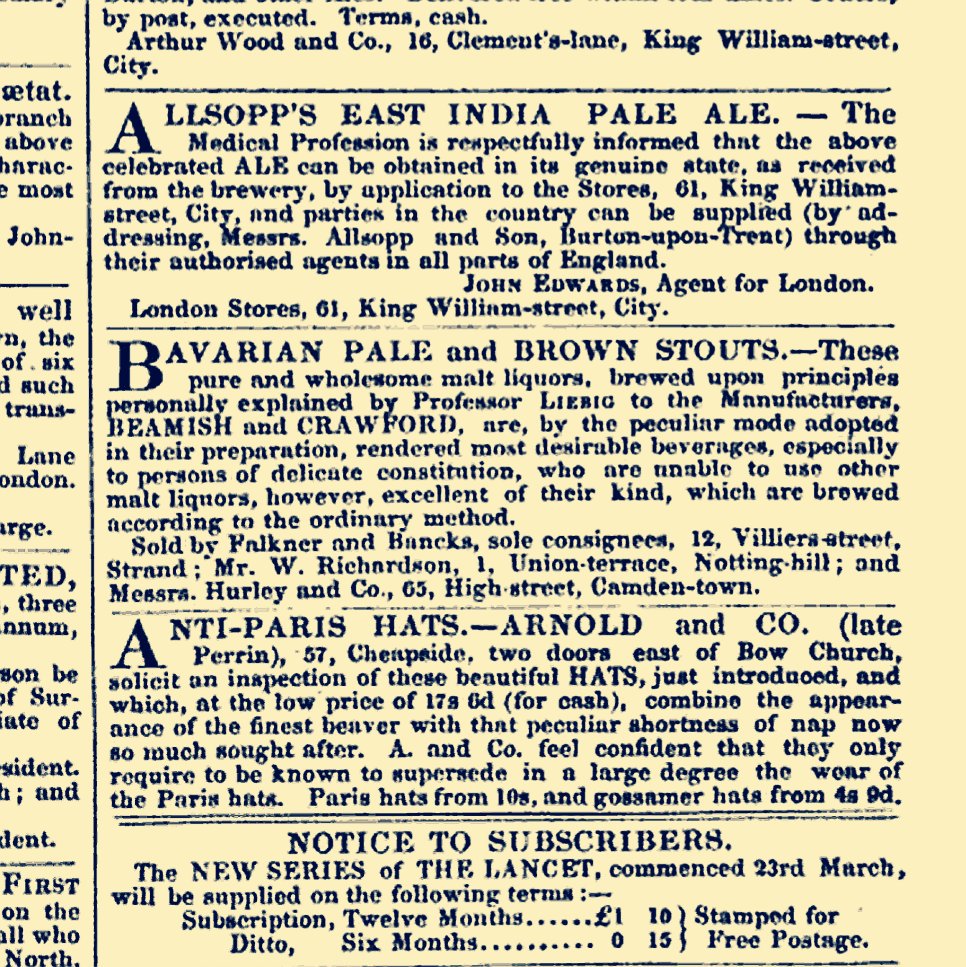
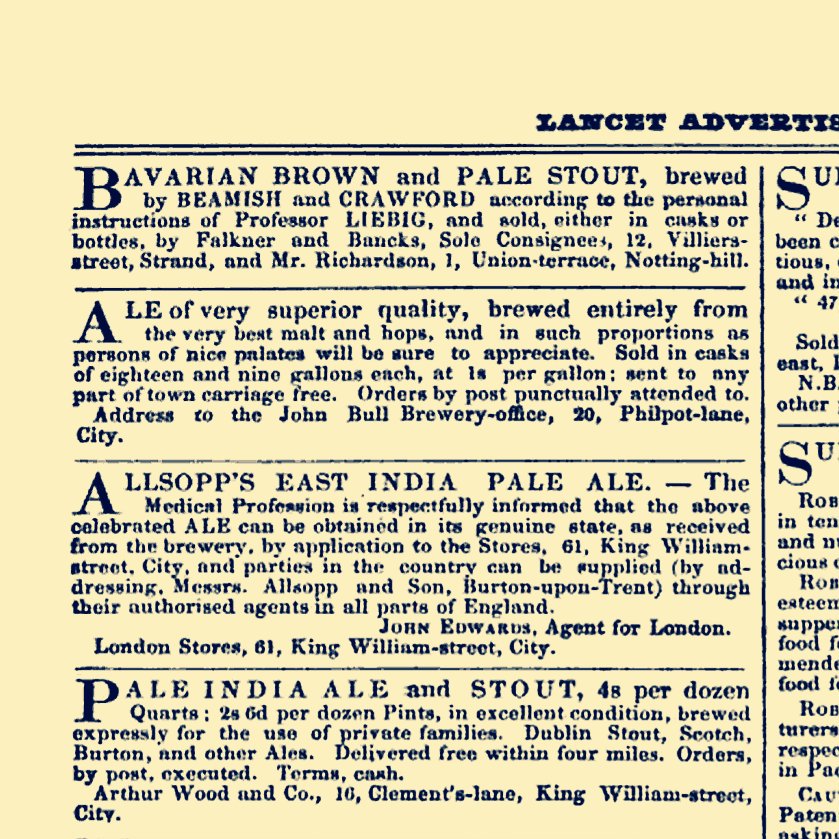
Hardly exciting or new but two nice mentions of Beamish & Crawford's Bavarian Pale and Brown Stouts from The Lancet in 1844, the only possible mystery is the Bavarian twist ... also of note is the mention of professor Liebig, previously mentioned here:


_____

I Tweeted that here back in January 2018 and since then I've come across a couple more mentions of this Bavarian Pale Stout from 1843. Keeping in mind that the word 'Stout' just meant heavy or robust when attached to a beer then and had not become attached solely to a type of strong porter...


I also came across an advertisement for Thrale's Brewery from 1771 - which I posted about here - that mentioned a 'London Pale Stout of a bright Amber Colour, superior to any Pale Beer or Ale imported...'


Note: Other, wiser minds than mine have talked about Pale Stouts in more detail, let Google be your friend...

(Part of my Tweet-to-Blog-Conversion-Project)

(With thanks to my Local Library's Local Studies room and Google Books)